


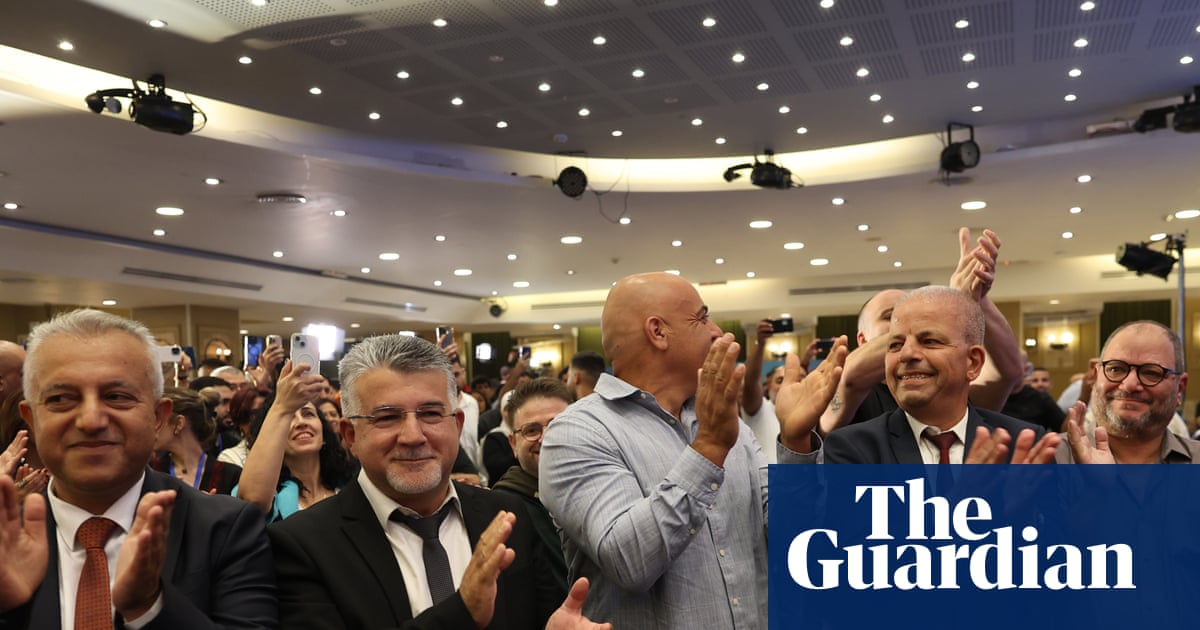
The big gains made by Palestinian parties in Israel’s general election pose an urgent and fundamental challenge to the country’s mainstream opposition: either cooperate with Arab Israelis or hand Benjamin Netanyahu a roadmap to political survival.In the wake of Tuesday’s exit polls, the leader of the opposition bloc, Gadi Eisenkot, declared them a victory for “Israel’s Zionist national majority” but the real outcome looks as if it will be far more complex than that.The greatest change between the new Knesset and the old will be the dramatically increased representation of Palestinian parties, currently projected to win 17 to 18 seats, up from 10. That redraws the battle lines on Israel’s political landscape.
Arab Israelis will not so easily be sidelined and ignored.The exit polls gave a narrow lead to Eisenkot’s opposition bloc over Netanyahu’s governing coalition and its supporters, though the prime minister’s Likud party could still be the strongest single party.If confirmed by actual results, that would give Israel’s president, Isaac Herzog, discretion over who he asks first to try to form a government. If one candidate cannot succeed in six weeks, the challenge is passed on to the next option.
It could be an extremely lengthy process, and all this time Netanyahu’s coalition would stay on in a caretaker role.Eisenkot will argue that he commands the bigger overall bloc and has the better chance of negotiating his way to a Knesset majority. To do so, however, he and his partners in the “change” bloc would be obliged to sit down to talk with the Palestinian groupings, the Joint List and Ra’am (an acronym for the United Arab List).They would probably find Ra’am and its leader, Mansour Abbas, easier to talk to.
Abbas has already participated in a right-leaning government of Naftali Bennett, now a junior partner in the Eisenkot bloc. Abbas has shown willingness to make political compromises and stated emphatically on Tuesday that his priority is to “bring down Benjamin Netanyahu, Smotrich, and Ben Gvir in this election”.However, most estimates based on the exit polls show Ra’am as the smaller of the two Palestinian groupings, with seven projected seats in the new Knesset and it is not clear that would be enough, even if a pact was made with the consent of the other members of Eisenkot’s bloc, to produce a majority government.Israeli candidates cast their votes in consequential election – videoNegotiations with the Joint List, with 10 or more projected seats, would be tougher.
Eisenkot has laid down four conditions: recognise Israel as a Jewish and democratic state, accept the values expressed in Israel’s declaration of independence, accept conscription for Palestinians Israeli citizens, who are currently exempt, and denounce Hamas as a terrorist organisation.Speaking on Tuesday as the votes were being counted, Amjad Shbita, the general secretary of Hadash, the socialist party that is the biggest faction in the Joint List, said Eisenkot would be in no position to impose terms for coalition talks.“Laying down conditions won’t work with the Joint List,” Shbita said. “We will negotiate as equals because we need each other.”In the absence of an agreement with one or both of the Palestinian groupings, it is possible that Eisenkot could try to govern as a minority government, with informal vote-by-vote agreements that would keep the new coalition afloat.It would be an unstable solution, making another election more than likely. That would provide Netanyahu the opportunity to rally support among conservative Israeli Jews and claim to have been vindicated in his campaign slogan, “the Right or Palestine” (which rhymes in Hebrew).Netanyahu has looked beaten before over his three decades at or near the top, and staged a comeback each time with the aid of his unparalleled tactical skills as a dealmaker.
No one is yet ruling out another breathtaking political escape but this time, if he does bounce back, he would owe his resurrection to his avowed political enemies for dropping him a lifeline rather than make historic compromises across Israel’s deep racial divide.