


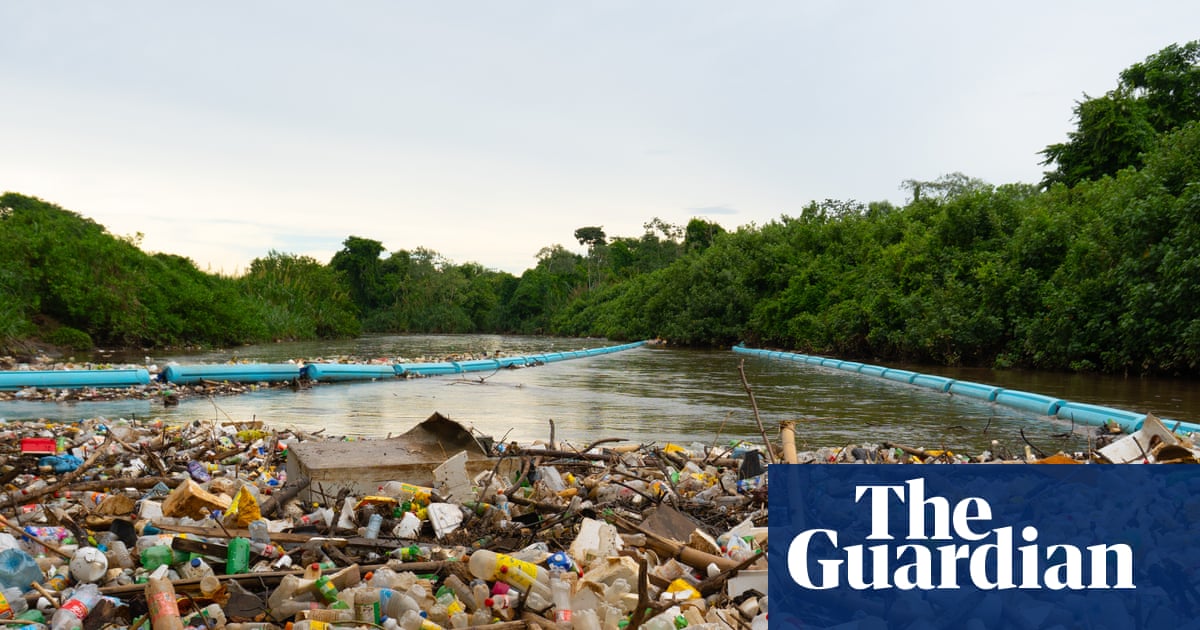
Life in San Miguelito has long been dictated by rubbish. Routes to the shop are carefully navigated to avoid pungent mountains of rotting waste, some visible from space.
Driving during the rainy season is a perilous obstacle course, dodging black bin bags and rusty fridges in the middle of the road. Children are taught early to avoid the river, the rubbish, the rats, yet mosquito-borne diseases still stalk the community.For Yamileth, who lives with her family on one of the steep, narrow streets that thread the hillside neighbourhood, the waste is a constant backdrop to daily life.
Mornings are punctuated by the stench and buzz of flies, and in the evenings you can hear rats scuttling and stray dogs rustling as they rip open bags in search of food among the rubbish heaps, known in slang as patacones (also the name of a staple side dish made from green plantains).“Since forever, we’ve had trash everywhere, flies, odours bothering us all day long,” she says, her daughter peeking around the porch door. “No one wants to live like that. Dengue is very common here.
One of our neighbours died from it. We’re really worried about our children getting sick because of the trash.
We live in the city, but we feel abandoned.”Yamileth at her home in San Miguelito: ‘We’re really worried about our children getting sick because of the trash.’ Photograph: Jessica RawnsleyLess than 6 miles from the glossy skyscrapers of Panama City, San Miguelito embodies a contradiction at the heart of modern Panama. The densely populated district is home to some of the capital’s poorest communities, many living in informal settlements, scraping a living by selling goods on the pavement and lacking basic services such as waste collection and running water.Yet, just beyond rise the tower blocks of one of Latin America’s wealthiest metropolises, flush with international banks and luxury developments.
Panama is one of the most unequal nations on Earth, and its waste crisis is one of the starkest symbols of that inequality.Decades of growth without adequate infrastructure for collection, transport and final disposal have entrenched an “out of sight, out of mind” approach to rubbish. The wealthy pay private companies to remove their waste and buy apartments facing away from the rivers, while poorer communities, many living alongside polluted waterways, are forced to dump refuse where the next rainfall will sweep it away.Along the Juan Díaz River, which snakes through San Miguelito, a slow-moving procession of waste drifts between banks of lush green vegetation.
Farther downstream, beaches and mangroves have been transformed into plastic graveyards of footballs, fridges, toys, thousands of plastic water bottles. The rest flows into the Bay of Panama and on to the Pacific Ocean.The Juan Díaz River, San Miguelito.
Video: Jessica Rawnsley“This is an area of very high ecological significance,” says Rodolfo Rodríguez, a representative of the Parque Lefevre community board, gesturing toward the mangrove-fringed coastline of Panamá Viejo. Innumerable plastic items litter the shoreline, while mangrove branches flutter beneath their plastic shrouds.
Black vultures swoop down and strut among the trees and trash.“There are lots of birds and amphibians here,” Rodríguez says. The mangroves act as storm buffers and provide nurseries for fish and birds; about 2 million migratory shorebirds flock to the city’s wetlands each year. “But fish and marine populations are declining, and the creatures here consume all this plastic.”Panama’s waste crisis is increasingly colliding with its ambitions to position itself as a tourist destination and high-income city.
A belated rubbish reckoning is under way. Last December, the government announced an urgent intervention in San Miguelito, with President José Raúl Mulino warning that it was “experiencing a sanitation crisis that could lead to a health crisis”.“We are trying to bring it under control,” says environment minister Juan Carlos Navarro. “If you don’t find a way to adequately collect and dispose of waste, you can’t have a healthy city.
We have wasted decades without addressing pollution in our rivers.”Plastic waste on the beach at Costa del Este, Panama City. Photograph: Luis Acosta/AFP/Getty ImagesThe government has pledged funding, but much of the work has fallen to environmental organisations.Adrián Benedetti, executive director of environmental NGO Ancon, says the situation has reached a “critical level”. “There is no recycling programme and inconsistent garbage collection, especially in areas higher up the watershed that generate a lot of the river trash.
There’s an element of neglect by city officials, to the point where public health and the environment are at risk.”Part of a partnership between local NGO Marea Verde and the Ocean Cleanup, the Siete Cuencas project aims to install floating barriers on each of the city’s seven rivers, ultimately preventing 800,000kg of waste from reaching the Pacific each year. Three interceptors have been deployed so far, the latest on the Matías Hernández River in May.“If we clean up all the legacy trash in the oceans but continue to pollute, we’re just replacing old trash with new trash,” says James Patterson, the Ocean Cleanup’s Panama project manager.
About 1,000 rivers account for 80% of the plastic emitted by rivers into the ocean each year, according to a 2021 study in Science Advances, prompting the organisation to shift its focus to the world’s most polluting rivers. “We’re trying to turn off that tap into the oceans.”James Patterson, Panama project manager for the Ocean Cleanup, one of the groups behind the drive to deal with the city’s polluted rivers. Photograph: Jessica RawnsleyIn a deprived riverside community in Puente del Rey, the barriers have already triggered change.
Liska used to dread every downpour, when the plastic-choked Abajo River invariably burst its banks and filthy water surged through homes. “Every time it rained, it flooded,” she says. “I had to help neighbours escape their houses with a canoe. It’s very sad.”She recalls rescuing a mother and her baby in one flood, and hopeless attempts to salvage nappies and bottles.
Since the barrier was installed last year, there have been no floods.For decades, the river has simply served as a rubbish bin for local people and others who travel there to dump their refuse. “My grandmother is 94, and used to tell stories about how they used the river for everything, washing clothes, bathing,” Liska says. “Now, it’s so polluted. The people here no longer have a relationship with the river.
Let’s pray that it will again be a reality that we can experience.”But the barriers are only one part of the puzzle. “This is a Band-Aid,” Patterson says. “There is much more that needs to be done within government, community and education to really create a complete solution.”Mirei Endara de Heras, president and co-founder of Marea Verde and a former environment minister, says the crisis reflects Panama’s inequality and a failure to value its urban environment.Mirei Endara de Heras, president and co-founder of Marea Verde, says rubbish was among the top three things Panama City dwellers are ashamed of. Photograph: Jessica Rawnsley“We’re working on SDGs [sustainable development goals] and these global goals and yet we’re living amid all this trash,” she says. “A survey found rubbish was one of the top three things capital citizens are ashamed of.
But it has become normalised. Accepted as a fact.
But why should we accept it as part of the scenery?”At La Casa de Wanda, perched above the Juan Díaz River, Marea Verde is driving change through education. In two years, the centre has welcomed about 14,000 visitors, mostly schoolchildren.
Interactive tours and creative programmes teach about plastic pollution, recycling and the circular economy.Many children are “completely shocked”, De Heras says, and go home demanding their parents recycle and refusing plastic water bottles. Just beyond the river barriers, an island of rubbish collects each day, a visual reminder of the scale of the challenge.At Santa Librada school in San Miguelito, an in-school recycling programme and green football league are beginning to create ripples in the wider community, teachers say.Teachers at Santa Librada school in San Miguelito.
Photograph: Jessica Rawnsley“There’s definitely a change,” says English teacher Ràmses Córdoba. “We don’t have a recycling culture in Panama. But we see kids bringing in cardboard and plastic, and each year interest is growing.”Opposite the school, what for decades was a large illegal dumping ground next to the river, with mountains of waste visible on satellite images, has been transformed into a park with sunshine-yellow benches.
It is part of efforts by San Miguelito’s mayor, Irma Hernández, to clean up the neighbourhood, alongside establishing new rubbish collection routes and schedules.Córdoba says: “The mindset change is that if it’s beautiful, it’s not a place for your trash.”Minutes later, a man wearing a backpack ambles up the road. He stops beside a small pile of rubbish, opens his bag and empties it.
Asked why he dumped the rubbish there despite the new collection schedule, he shrugs. After decades of patchy or nonexistent collection, trust is tenuous.