


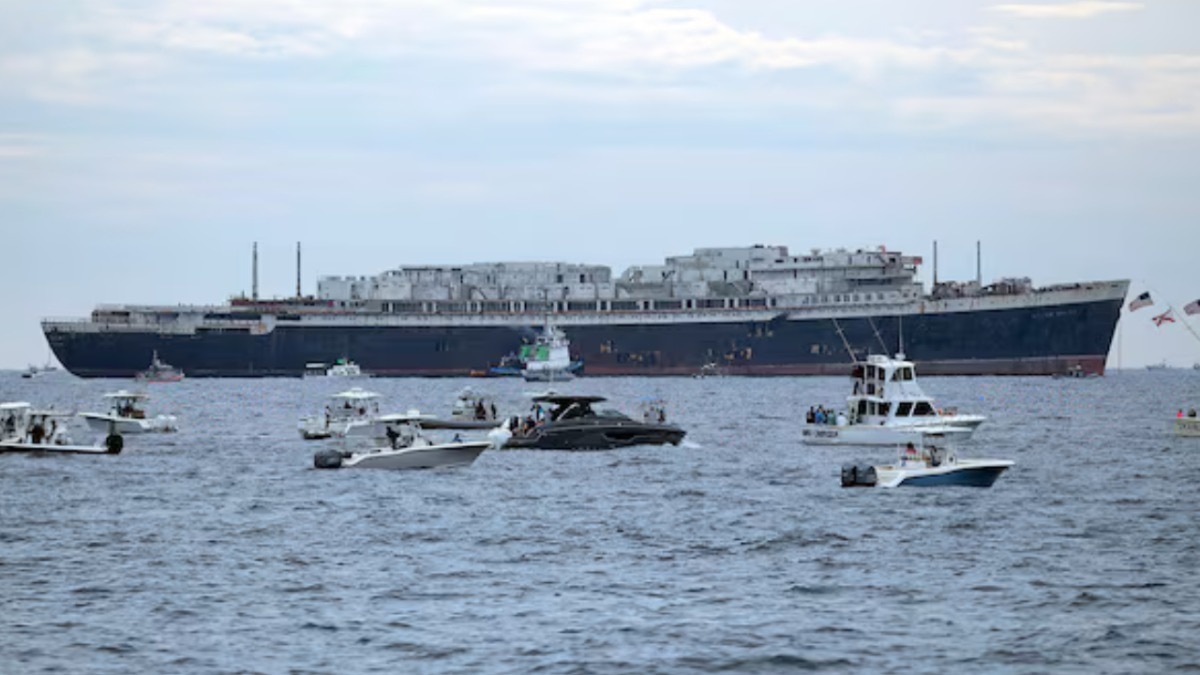
The SS United States was deliberately sunk off Florida after a controlled eight-hour flooding operation. Organisers expect the historic liner to become the world's largest artificial reef.The SS United States was towed to a designated site off Florida's Panhandle and gradually flooded after extensive preparations to make sure it would settle safely on the seabed.
The SS United States, once hailed as the world's fastest passenger ship and longer than the iconic Titanic, made its final voyage on Wednesday -- not to another port, but to the bottom of the Gulf of Mexico. The nearly 1,000-foot (300-metre) ocean liner was deliberately sunk off the coast of Florida as part of a USD 13.5 million project to turn the historic vessel into what organisers say will be the world's largest artificial reef.The sinking marked the end of a remarkable journey for a ship that once represented American engineering and post-war luxury.
Built in the early 1950s, the vessel carried celebrities, politicians and wealthy travellers across the Atlantic before being retired in 1969 as air travel began to replace ocean liners.After several hours, the SS United States, an ocean liner, is intentionally sunk off the coast of Florida to become the world's largest artificial reef. https://t.co/DwvU2Njf0f— CSPAN (@cspan) November 12, 2026The SS United States was towed to a designated site off Florida's Panhandle and gradually flooded after extensive preparations to make sure it would settle safely on the seabed.FROM SPEED RECORD TO SEABEDWhen the SS United States entered service in 1952, it was a technological marvel. At 990 feet (302 metres), the vessel was longer than the Titanic and became famous for its speed.
During its maiden voyage across the Atlantic, it reached an average speed of nearly 41 mph (66 kph), beating the previous record held by Britain's RMS Queen Mary. More than 3,000 workers had helped build the ship in Virginia.
Its speed was not its only attraction. The liner was designed as a symbol of American power and prosperity, with lavish dining rooms and luxury accommodation.Over the years, its passenger list included Hollywood stars such as Grace Kelly and Elizabeth Taylor, as well as US presidents Harry Truman, Dwight Eisenhower and John F.
Kennedy. Britain's former King Edward VIII also travelled aboard the ship.
Decades later, a young Bill Clinton took the liner while travelling to Oxford University. But the golden age of ocean liners was fading.
The rapid growth of commercial aviation made crossing the Atlantic by plane faster and more practical, eventually pushing ships such as the SS United States out of service.After its retirement, the ship spent decades sitting idle in Philadelphia. Various attempts to give it a new life failed, leaving the once-glamorous liner facing the possibility of being dismantled for scrap.
Its eventual rescue came through Okaloosa County in Florida, which became involved in the plan to preserve the vessel as part of a major artificial reef project.WHY SINK A HISTORIC SHIP?Turning an old vessel into an artificial reef is not simply about giving it a dramatic final resting place. The ship is expected to provide shelter and habitat for marine life while creating a major new destination for scuba divers and recreational fishing.The area already contains more than 500 artificial reef sites made from ships and other structures.
The SS United States will join that network and dwarf many of the existing wrecks. The largest artificial reef in the area had previously been the USS Oriskany, a 911-foot (278-metre) aircraft carrier sunk in 2006.Project organisers hope the much larger ocean liner will help turn the region into an even bigger diving attraction.Sinking a vessel of this size required extensive preparation.
Workers removed potentially harmful materials, including residual fuel, lubricants, wiring, glass, ductwork and other non-metal components. More than 400 portholes were also removed, while the ship's 65-foot (20-metre) smokestacks were taken off and are expected to become part of a museum project.Large openings were cut into the ship's decks and hull to allow water to enter in a controlled manner.
Workers also prepared the vessel's tanks by filling them with water to help keep the massive ship balanced as it descended.Crucially, no explosives were used.Associated Press reported that environmental and explosives regulations prevented the project from using explosives to scuttle the liner. Instead, the ship was designed to flood gradually through the openings created by workers.
The plan was for the vessel to settle upright in roughly 180 feet (55 metres) of water, with its upper deck remaining relatively close to the surface.The sinking itself proved far slower than expected. The operation began around 1 PM local time, but the huge liner appeared to barely move for hours.
As daylight faded, most of the vessel was still visible above the darkening Gulf waters, surrounded by boats and safety crews.The waterline slowly climbed up the hull as compartments filled.Nick Tomecek, a spokesperson for Okaloosa County, said the process took longer than expected. The enormous size of the ship was a major factor.
Eventually, however, the descent accelerated.After the vessel had taken on enough water, the SS United States began to lean to one side before finally rolling and disappearing beneath the surface at around 9 PM.The sinking may have ended the SS United States' career as an ocean liner, but organisers see it as the beginning of another chapter. Once marine life begins to colonise its decks, corridors and hull, the former passenger ship is expected to become a large underwater habitat.
The openings cut through its structure were designed specifically to allow fish and other marine organisms to move through the wreck.- EndsWith inputs from agencies