


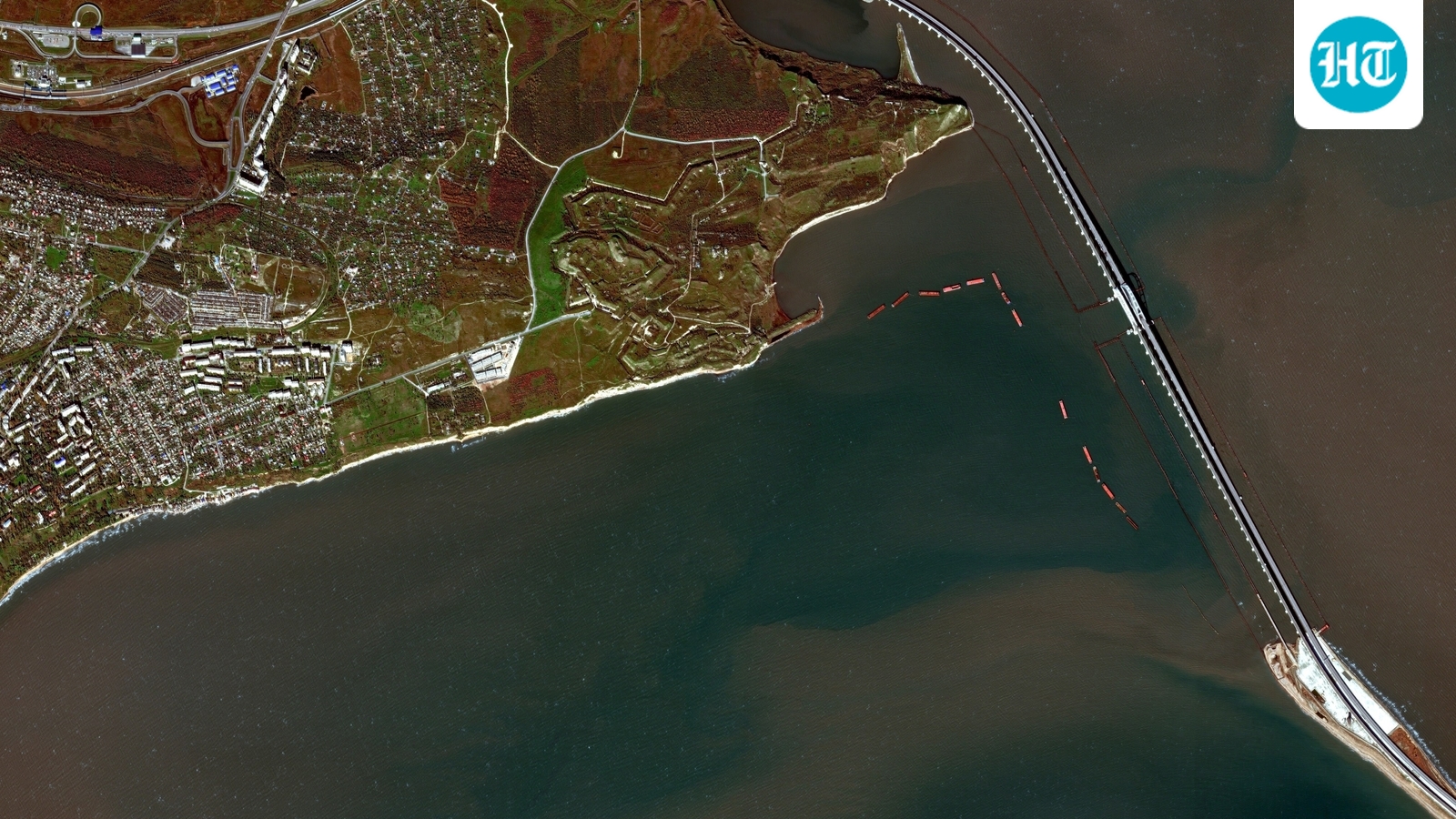
Ukraine on Tuesday struck and destroyed the central road section of the bridge connecting Russia and Crimea, dealing a significant military and symbolic setback to President Vladimir Putin ahead of his meetings with the leaders of China and the US later this week.A satellite image shows a bridge over the Kerch Strait linking Russia and Crimea, that was hit by Ukrainian drones, Crimea, November 16, 2026. Vantor/Handout. (via REUTERS)The 19-km (12-mile) Crimean Bridge is a road and rail link connecting southern Russia to the Crimean Peninsula, which Moscow annexed in 2014.The crossing spans the Kerch Strait, linking the Black Sea and the Sea of Azov, with separate sections for road and railway traffic.
Both are supported by concrete pillars, while wider steel-arch spans allow ships to pass underneath, according to a Reuters report.Also Read |Ukrainian drones strike Crimea bridge; Kremlin says minor damage caused, traffic unaffectedWhat is the bridge?The bridge connects the eastern tip of Crimea to Russia's Krasnodar region and is the only fixed crossing linking the peninsula to Russia without passing through Ukrainian territory, according to the Associated Press.It also serves as an important route for transporting essential supplies to Crimean cities, including Sevastopol, Simferopol and Yalta.Also Read | Kerch Bridge’s strategic importance as vital military supply link to Crimea comes into focusConstructed at a reported cost of $3.6 billion, the bridge was built by a company controlled by Arkady Rotenberg, a close associate of Putin and his former judo partner.Why is it important?The bridge is a crucial transport link between Russia and Crimea, allowing Moscow to reach the peninsula without crossing mainland Ukrainian territory. Following Russia's full-scale invasion of Ukraine in 2022, it became a key supply route for transporting troops, fuel, ammunition and other military equipment to southern Ukraine.With the road section now destroyed, Russia will have to depend more heavily on a land corridor connecting the peninsula to Russian territory through areas of Ukraine captured during the war.Disrupting these supply routes and isolating Crimea is among Ukraine's military objectives.
Ukrainian drone commander Robert Brovdi told Reuters in an interview earlier this year that cutting these connections was a key goal.Beyond its military significance, the crossing is also a source of considerable national pride for Russia and a symbol of Moscow's control over Crimea. It is the longest bridge in Europe.
Construction began in 2016, despite strong objections from Ukraine, and the structure was completed in just over two years.For the Kremlin, the bridge represents a major infrastructure project reinforcing its claim over Crimea and the peninsula's integration with Russia. For Ukraine, it is a reminder of Russia's 2014 annexation, which Kyiv considers illegal and which remains unrecognised by most countries.Putin's role?Putin personally championed the bridge project following Russia's annexation of Crimea in 2014, presenting it as a symbol of the peninsula's integration with Russia.In May 2018, he inaugurated the road section by driving an orange Kamaz truck across the bridge, leading a convoy during the opening ceremony.Why has Ukraine targeted itUkraine has consistently maintained that the Crimean Bridge is a legitimate military target, arguing that it plays a direct role in supporting Russia's military operations.The bridge has been targeted several times since the start of the war.
In October 2022, a truck bomb exploded on the crossing, killing four people and disrupting its capacity for several months.Another attack in July 2023 damaged a section of the road bridge using a Ukrainian naval drone. A Russian couple travelling by car were killed in the strike.Ukraine's Security Service (SBU) has also taken responsibility for subsequent operations against the bridge, including attacks targeting its underwater infrastructure.Russia has repeatedly carried out repairs and restored damaged sections following major attacks.
However, the crossing continues to remain one of the most prominent and strategically significant targets in the war.