


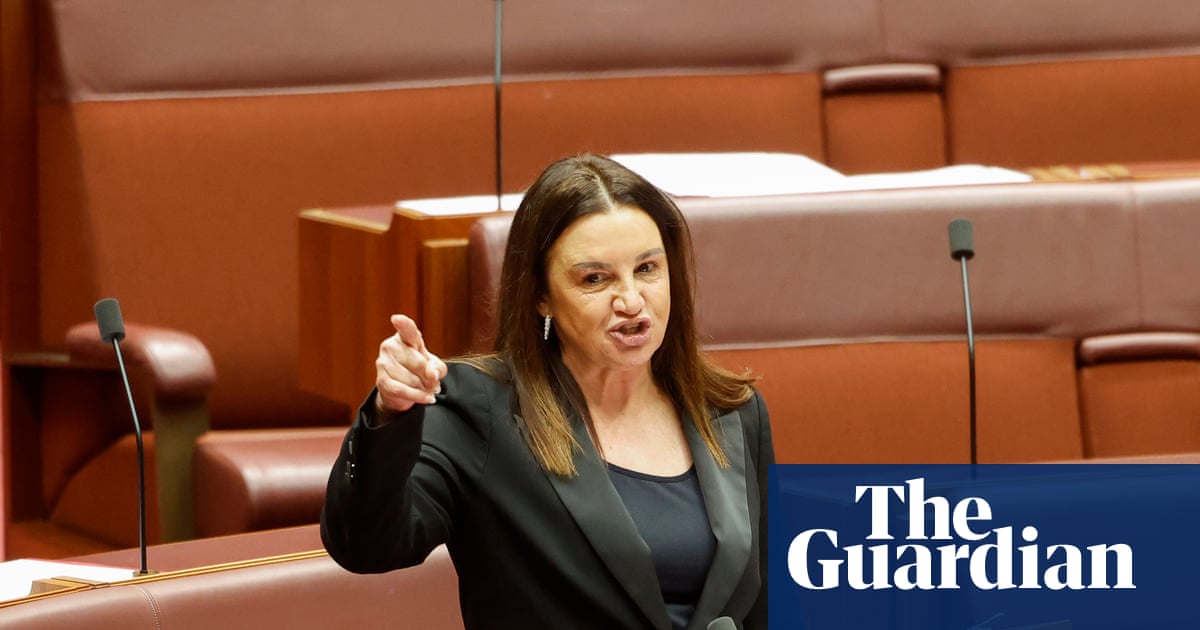
When Liberal MP Garth Hamilton stormed out of parliament in June, slamming his hands on his desk and calling out “fucking bullshit” the speaker of the house, Milton Dick, called it “a new low” in federal politics.Dick may have been on to something.New analysis from Guardian Australia has found profanity and foul language has risen significantly in Australia’s parliament over the past 20 years, with some of today’s most prominent politicians among the chief culprits for swearing.Before the year is even out, 2026 is the worst year on record for the use of swear words and language deemed “unparliamentary”. That number has risen by 78% since 2006.Analysis of Hansard debate and procedure records has found that per million words spoken in parliament this year, approximately 37 have been profane – ranging from milder (“bloody”, “damn” and “crap”) to language considered strong, or even extreme.Line chart showing swear words per million words spoken in the Australian parliament from 2006 to 2026.
The rate fluctuates but trends upwards, rising from about 16 in 2006 to a peak of 37 in 2026, with a low of around 12 in 2009. A dotted trend line highlights the overall increase.While entitled to “parle hard”, language deemed unparliamentary by the speaker or Senate president is required to be withdrawn, or else MPs face ejection from the chamber.So why bother?Beyond the impact of pushing against regulation and etiquette, there is something to be said for the currency that outbursts gain when clipped and shared online – recently demonstrated by Greens senator Peter Whish-Wilson, who called for the country to “wake the fuck up” to One Nation’s use of social media algorithms in June.But despite the politicians reaching for profanities at a record rate, Dick – the Labor MP who has been speaker of the house since 2022 – said he felt the tone and tenor of debate in parliament has gotten better in his time in the chair.“Debate is fierce and strong, and apart from a few incidents, it has improved,” he said.“Maybe it hasn’t appeared so because of the volume [of swearing], but when you analyse the words used … there are outbreaks of course, but I believe in everyone showing respect.”And to be fair, most of parliament’s most swear-y politicians are in the Senate, not the house.An oral traditionDescribed as “the great Australian adjective” in 1894 by The Bulletin magazine, “bloody” appears to have suffered no fall from grace in the subsequent years, serving as the most commonly used swear word in parliament.
Along with “damn”, “crap” and “bugger”, mild curses constitute 92% of all recorded bad language, with more severe terms such as “prick”, “shit” and “piss” used more sparingly.Excluded from this figure are rare cases of colourful and creative terms that have been called for withdrawal. Harnessing the speaker’s unilateral power to flag unacceptable language, terms such as “bin chickens – used by Julian Hill, the MP for Bruce, in 2022 to describe the opposition in the house – have been ruled as unparliamentary.Swearing and swearing allegianceMuch of this potty-talk comes from the Senate, which since 2006 has seen a 177% increase in the use of bad language.
Among active parliamentary participants (those who have spoken at least 100,000 words in this period), Bill Heffernan was the lead offender. Despite speaking just 141,000 words between 2006 and 2016, the former Liberal senator had an expletive use-rate of 877 per million words spoken, 43 times the rate of all other parliamentarians.Stacked bar chart showing swear words per million words spoken in the Australian parliament, 2006–2026.
Bill Heffernan leads with 877.2, followed by Jacqui Lambie (406.3), Derryn Hinch (398.4), Glenn Sterle (294.3), Russell Matheson (206.9), David Shoebridge (179.5), Pauline Hanson (169.5), Jordon Steele-John (167.9) and Steph Hodgins-May (161.6). Mild swear words make up most of each total, with smaller contributions from strong and extreme language.
Only politicians who spoke more than 100,000 words are included.Jacqui Lambie is the second-most sweary politician, responsible for 6% of total swearing in parliament at a rate of 406 per million words spoken – more than 19 times the average. But, like most of the politicians on this list, Lambie’s swearing is overwhelmingly mild – mostly words like “crap” or “bloody”.“I try really hard not to swear, especially in the Senate chamber.
It upsets my mum, she doesn’t even like me saying ‘bloody’,” Lambie said when we came to her with the statistics.skip past newsletter promotionafter newsletter promotion“It’s important to be respectful. But I am a straight shooter and sometimes things are just crap – and it’s hard not to say so.
I don’t think it would be an Australian parliament without a few swear words thrown in.”Not all occurrences of swearing in parliamentary records are “own-use”, or rather, swearing with intent. Quotes, such as reading out abuse a politician has received, or a quote from a document, account for some of it.However, when excluding these cases our analysis shows that own-use swearing in parliament has nearly tripled over the last 20 years, from 6.4 per million words in 2006-9, to 18.9 in 2022-5.Line chart showing the three-year rolling rate of politicians’ own-use swearing per million words spoken in the Australian parliament, by party, from 2008 to 2026.
One Nation peaks at about 175 in 2024 before falling to 110 in 2026. The Greens rise unevenly, reaching nearly 100 in 2026.
Independents peak at about 80 in 2017 before declining sharply. Labor and Liberal rates remain below 15 throughout, while the Nationals reach about 24 in 2026.Broken down by party, One Nation are the worst offenders, swearing for the sake of it at 7.4 times the rate of Labor – perhaps unsurprising, given that the party leader, Pauline Hanson, ranks fourth among discursively active politicians for use of foul language.Dick said he had strived to improve the tone of discussion in parliament, believing that greater diversity in politics and in the chamber – with more women, more First Nations MPs and people from multicultural backgrounds – had also changed dynamics of debate.Asked about recent heated moments in parliament, he said he recalled only two major moments in the lower house in recent years Hamilton’s June storm-out and fellow Liberal MP Dan Tehan’s demand to “cut the crap” in August.“I want to ensure among our people and our democracy, that we fight hard to disagree more civilly … But I’m a big believer in upholding traditions and standards.
When things get a bit heated, I’ll take firm action,” Dick said.Notes on the analysisPoliticians’ speeches from both Houses of Parliament were analysed for the years 2006 to 2026. For each speech, the number of swearwords were counted using the these categories: Mild: bloody, damn, crap, bugger, bastard, bulldust, arse, mongrel, boofhead, bollocks Strong: prick, shit, bullshit, piss, piss off, dickhead, arsehole, shithouse, wanker Extreme: fucking, cunt, fuck, fuck off, fucker, fucked, motherfucker To control for politicians’ tenure length and verbosity affecting swearing totals, swearing numbers were converted to a rate per million words by dividing the total swearwords by the total number of words spoken for that politician in that year, or for the total time period.To separate swearing in a politician’s own voice from quotes, idioms and literal uses, an LLM was used to read the speech text surrounding each swearword and sort these into categories.
A random sample of the results were manually checked, to achieve an agreement of 97% on whether a use was the speaker’s own. Therefore these figures are approximate.