


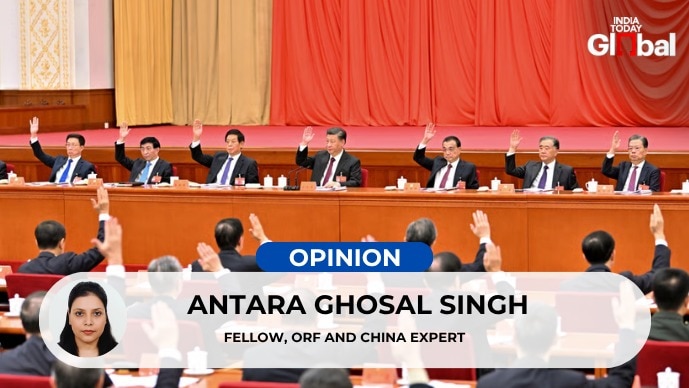
China's Fifth Plenum expelled 33 officials and sharpened its anti-corruption campaign. The shake-up is viewed abroad as a purge but presented domestically as self-purification.Taking the anti-corruption agenda aheadThe Fifth Plenary Session of the 20th Central Committee of the Communist Party of China (CPC) was held in Beijing from 26 to 29 October 2026.
It coincided with the start of the 15th Five-Year Plan and carried particular weight as the Party’s roadmap, ahead of next year’s 21st Party Congress.A purge, as seen from outsideThe session drew global attention for two reasons. Only 279 of the 376 full and alternate Central Committee members attended, a record low.
The Party also confirmed the expulsion of 33 officials, including former Politburo member Ma Xingrui and former senior military leader Zhang Youxia.Internationally, the political restructuring was read as a major purge: President Xi removing opposition, consolidating his position and preparing the ground for an unprecedented fourth term at the 21st Party Congress in late 2027. The long list of expelled senior military officers has also raised questions about the PLA’s leadership and operational readiness, despite its technological progress.
Self-purification, as projected insideDomestically, the personnel changes and disciplinary sanctions were presented as the Central Committee showing the political courage to “purify the team” and remove hidden dangers through self-reform. The stated aim is to strengthen the Party’s creativity, cohesion and combat effectiveness in an uncertain global environment through “revolutionary forging.” The logic is that only a strong Party can make China strong.
Chinese commentaries add that although the CPC is the world’s largest ruling party, with significant global influence, it must not lose its revolutionary spirit. Only by avoiding complacency, the argument runs, can the century-old Party stay vibrant, youthful and connected with the people.
The plenum therefore stressed “persistently advancing comprehensive and strict party governance” and achieving the Party’s “self-purification, self-improvement, self-renewal and self-enhancement.”Taking the anti-corruption agenda aheadTaking the anti-corruption agenda ahead from the Fifth Plenary Session of the 20th Central Commission for Discipline Inspection held in January, the session pledged to intensify the struggle with greater clarity and determination and carry it through to the end. The session reiterated its stance of advancing the struggle in an integrated manner, ensuring that the officials “dare not be corrupt, cannot be corrupt, and do not want to be corrupt.”According to Chinese interpretations, the drive will continue to focus on sectors where power and resources are concentrated: finance, state-owned enterprises, energy, pharmaceuticals and infrastructure, with particular scrutiny of collusion between government and business.Priority is being given to investigating ‘hidden and new types of corruption’ such as expected returns, agreed shareholdings, and government-business ‘revolving doors’, and intensify cross-border corruption.
Solving "petty corruption" problem is also top on agenda, particularly focusing on areas like rural collective asset management in medical insurance funds, elderly care services, education, and healthcare so as to ensure fairness and justice for broader masses. And, finally improving supervision mechanisms for top leaders and key positions, through promoting the construction of a digital discipline inspection and supervision system.Although the scale of the political shake-up under President Xi has drawn scrutiny and criticism abroad in recent years, China’s propaganda and censorship apparatus appears to have kept domestic sentiment in check, preventing any visible large-scale criticism or unrest at home.
President Xi may well be using a sweeping anti-corruption and political-discipline campaign to centralise authority and remove challenges to his life-long leadership. But it is also possible that the campaign, framed as a mission of “offending thousands, not betraying 1.4 billion,” resonates with ordinary Chinese netizens.
There may be genuine domestic support, at least among some sections of society, for the idea that a more united Party and country, with Xi Jinping at its core, is essential to the “great rejuvenation of the Chinese nation” through Chinese-style modernisation. Given the limits on open debate in the Chinese system, it is hard to know which reading is closer to reality.(Antara Ghosal Singh is Fellow, ORF, New Delhi.
She is a graduate from Tsinghua University, China, and has been a Chinese language fellow at the National Central University, Taiwan)- Ends