


Outside the Ukrainian educational and cultural center in a quiet Pennsylvania suburb of Jenkintown, on the outskirts of Philadelphia, a banner expressed unqualified gratitude: “Thank you USA for supporting Ukraine.”Inside, however, the sentiment was altogether different. Irene Skulsky, a retired teacher in her late 70s, voiced indignation at Donald Trump’s sudden turn against her ancestral homeland, which she believed had come close to killing her son, Darko, and a desire to punish his fellow Republicans at next week’s midterm elections.“When we vote, we have to vote with Ukraine in our hearts,” she told her fellow retirees, gathered to hear a presentation by the Daughters of Knyahynya, a women’s group delivering military equipment to Ukrainian special forces on the frontline. “I know many people here are Republicans, but we can’t go according to party lines now.
Ukraine needs us. They need our support.
We need to shift the balance of power in Congress and in the Senate.”Days earlier, Skulsky told fellow members at a meeting of the Ukrainian American Senior Citizens Association, Darko had been sitting in traffic en route to work in Kyiv when Russian drone missiles slammed into five cars immediately ahead of him.There had been no prior alert, allegedly as a result of a decision by Washington to suspend its intelligence-sharing arrangement with Ukraine that has acted as an early warning system against missiles attacks since Russia invaded in February 2022.In recent weeks, Trump – who pledged during his victorious 2024 presidential election campaign to end the Russia-Ukraine conflict within 24 hours of returning to office – appears to have abandoned Ukraine.Volodymyr Zelenskyy and Donald Trump during a meeting on the sidelines of the 81st United Nations general assembly in New York City, on 22 September. Photograph: Brendan Smialowski/AFP/Getty ImagesHe struck a deal with the Russian president, Vladimir Putin, to buy nearly 5m tonnes of diesel, overriding US sanctions on Moscow.
He called on Ukrainians to replace the country’s president, Volodymyr Zelenskyy. His administration was accused of throttling the Ukrainian military’s access to the Starlink satellite internet service.And while the Trump administration denied that it had stopped sharing intelligence this month, as relations with Ukraine nose-dived, Zelenskyy has said his country received no advance warning from US intelligence networks of two Russian missile attack waves.Darko escaped injury, but several people in the vehicles in front were killed in the strikes, according to Skulsky.
Her frustration spilled over to include Trump’s fellow Republicans, whom she said were “selling our souls” rather than standing up to the president.“Republicans are afraid of Trump,” she said. “They’re afraid to lose their position. I think their heart is with Ukraine, but they’s sitting on their hands.”Many American Ukrainians will express their outrage at the polls on 3 November, according to Eugene Luciw, a retired lawyer and local representative of the Ukrainian Congress Committee of America, an advocacy group.“For [American] Ukrainians, I believe foreign policy is unquestionably the No 1 issue,” he said. “But I think even the average American without the added affinity of a homeland in Europe is going to see foreign policy as a very important issue.“It’s beginning to reach people’s minds and hearts that something very important is brewing in Europe.
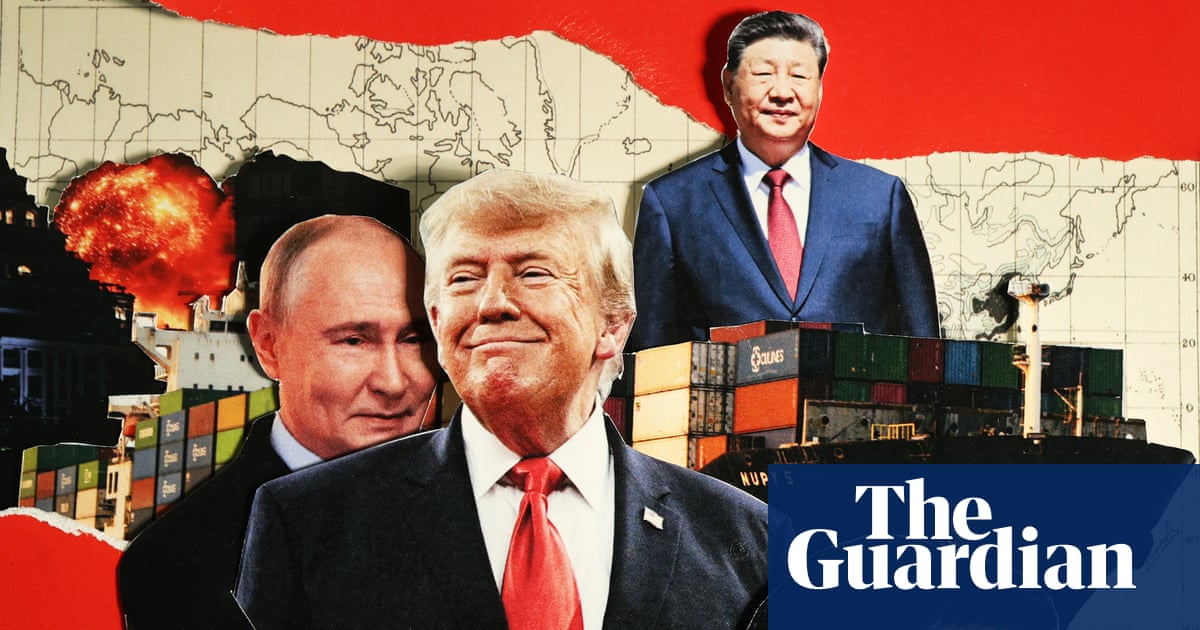
If Ukraine loses this war, we have the beginnings of world war three.”The most recent Ukraine development is the latest in a trio of Trump foreign policy decisions with the potential to hurt Republicans when Americans head to the polls next week.More relevant to voters’ living costs – a key issue in this election, according to polls – has been Trump’s protracted war with Iran, and his determination to impose tariffs on imports from much of the world.The Iran war, launched with Israel in February, shows no signs of ending despite Trump’s early claims that it would be a short-term “excursion” certain to end in the “unconditional surrender” of Tehran’s Islamic regime.Instead, Trump has reportedly drawn up plans to launch renewed strikes against Iran after the midterms as he seeks to break Iran’s grip on the strait of Hormuz, an energy choke point that was the conduit for one-fifth of the world’s energy supplies before the Tehran regime closed it in response to being attacked.Gas and diesel prices at a Chevron gas station on 14 August in Fort Stockton, Texas. Photograph: Brandon Bell/Getty ImagesThe strait’s closure has resulted in soaring global oil prices, which have been passed on to US consumers in the form of higher prices for petrol and diesel, which is vital for supply chains and US farmers.Polls have consistently shown voters’ disapproval of Trump’s handling of the war, and his management of the economy and inflation.
Roughly 70% are now critical of both, according to a recent AP-Norc survey.The war’s economic impact has compounded the inflationary effects of Trump’s tariffs, which has affected the prices of consumer goods and increased costs for manufacturers by increasing the costs of imported raw materials such as steel, copper and aluminum.The tariff regime has also strained Washington’s relations with once-close allies – perhaps most visibly with Canada, the US’s second-biggest trading partner. Ties between the two neighbors plunged to a new low in August following the collapse of bilateral trade talks.Following the collapse, the Trump administration imposed tariffs on $20bn of Canadian imports – including cars, forestry and dairy produce – triggering a retaliatory tit-for-tat response from Canada’s government, led by the prime minister, Mark Carney.
In Michigan, which shares a border with Canada, even Republican Senate candidate Mike Rogers released an ad calling on Trump to end the trade war and declared: “Canada is not our enemy.”Trump has articulated his vision with characteristic bullishness. After January’s US attack on Venezuela, during which it ousted the country’s president, Nicolás Maduro, he dubbed his strategy the “Donroe doctrine” – a play on the Monroe doctrine, named after the 19th US president, which states that the western hemisphere should be Washington’s exclusive domain.He bragged about extracting Venezuela’s oil resources and fantasized about making the country “the 51st state” in a speech this week in Corpus Christi, Texas, during which he showed off a tanker he claimed was carrying 1m barrels of oil and repeated a phrase – “to the victors belong the spoils” – that startled foreign leaders when he first uttered it at last month’s gathering of the United Nations general assembly.There are fears that his neo-imperialist instincts could be applied after the midterms to Cuba, where he has repeatedly pledged to topple the communist regime that has ruled for the past 67 years.Meanwhile, Trump’s fixation with autocratic leaders has been extended to China’s president, Xi Jinping.
Having already met Xi at a summit in Beijing this year before hosting him at the White House, Trump will go to China again next month to meet the Chinese leader.On a range of issues, he has shown disdain for diplomatic niceties – dispensing with seasoned diplomats to instead rely on Steve Witkoff, a real estate investor and attorney with no background in foreign policy, and Jared Kushner, his businessman son-in-law, as negotiators over matters as intricate as Iran, Gaza and Ukraine.From left, Jared Kushner, Steve Witkoff and Volodymyr Zelenskyy after a joint news conference, amid Russia’s attack on Ukraine, in Kyiv, Ukraine, on 6 September. Photograph: Valentyn Ogirenko/ReutersYet Trump’s latest Ukraine turn carries special resonance, not least because it risks a dramatic rupture with Washington’s European Nato allies, who are heavily invested in Kyiv’s protection as a first line of defence.It has highlighted once again Trump’s complex relationship with Putin, an autocratic leader for whom he has repeatedly voiced admiration.
It is also a reminder of Trump’s failure to live up to his frequently expressed vow to swiftly end the Ukraine war during the 2024 presidential election campaign.Trump has blown hot and cold towards Zelenskyy. At an explosive White House meeting in February 2025, he told the Ukrainian leader “you don’t have the cards” – but with a peace deal on terms acceptable to Russia seeming ever more distant, relations seemed to thaw, with Trump even publicly mooting giving Ukraine a license to build its own Patriot missiles.In recent weeks, however, Trump appears to have definitively ditched the US’s putative ally and sided with Putin.Economists argue that the volume of diesel covered by his deal with Moscow is too insignificant to reduce diesel prices, which have been inflated mainly by the effects of the Iran war, rather than by the actions of Ukraine.Witkoff, Trump’s envoy, caused further consternation by praising Putin as a “humanitarian” after the Russian president agreed to release a 74-year-old US citizen, Stephen Hubbard, whom Russia had imprisoned for several years after falsely accusing him of fighting for Ukraine.The Russia-friendly moves have stunned Ukrainian Americans, many of whom have pro-Republican sympathies dating back to the cold war, when staunchly anti-communist presidents like Ronald Reagan were seen as champions of self-determination for the constituent, so-called “captive nations” that comprised the Soviet Union, which included Ukraine.“We are befuddled and upset by what’s going on,” said Andrij Chornodolsky, chair of the senior citizens association, who urged his fellow members to call the White House and leave comments criticizing the recent policy moves. “How can you be doing this to us?”The US is “helping a country that wants to subjugate Ukraine back into a new empire, the Russian empire”, added Chornodolsky, who was equally angry with Republicans who have failed to criticize Trump over his abandonment of Ukraine.“What are the comments coming out of Congress?” he said. “Silence speaks very loudly.
If you do nothing, you agree with the person making the pronouncements.”There are about 60,000 people of Ukrainian descent in Philadelphia’s metropolitan area, the second-largest such ethnic population in the US after New York. From 105,000 to 122,000 people are estimated to claim Ukrainian ancestry throughout Pennsylvania.Peter and Orysia Hewuka, long-term Republicans who had both previously voted for Trump, said they were likely to vote for a local Democrat because of Ukraine, even though it represented a psychological hurdle.“I am very hesitant to vote Democrat.
I’m a lifelong Republican,” said Peter, 88, a retired nuclear physicist. “But I can’t vote for people who support what Trump is doing. The Republican party has left us, we haven’t left the Republican party.“It’s very difficult for me and for a lot of Ukrainian Americans to vote for the Republican party based on what they’ve been doing in the past months.”Luciw, of the Ukrainian Congress Committee of America, said even Trump’s diehard supporters in the Ukrainian community had been alienated by the diesel deal with Putin.Donald Trump departs a campaign rally at Ohio University Chillicothe on 28 October.
Photograph: Mark Schiefelbein/AP“From my interactions on social media and elsewhere, I would say more than 75% of those who supported him have now abandoned him because it’s now clear where this is headed,” said Luciw, 68, who described himself as a Reagan Republican, but now also intends to vote Democrat.“Until the last few weeks, there was a hope that Trump’s swinging back-and-forth on Ukraine was a kind of negotiation … that maybe he would come to terms with things because it looked liked Ukraine was going to win and he would support a winner,” he said. “But the diesel deal reversed all that.”Mykola Hryckowian, director of the Center for US-Ukrainian Relations, said he voted for Trump three times and been active in an ad hoc group called Ukrainian Americans for Trump – but has since severed his last vestiges of support.“I went to the polling booth in the last election not knowing who to vote for, thinking I might write in Zelenskyy, but in the end voted for Trump, because I couldn’t vote for Kamala Harris,” he recalled. “Today, I could not vote for Trump.“But a lot of my colleagues [on the committee] were very staunch, holding onto Trump until the very end. But in these last two weeks, they have turned around and said: ‘This is an abomination’.”Not all Ukrainians are surprised by Trump’s actions.
Mark Andryczyk, a Ukrainian studies scholar at Columbia University and board member of the Ukrainian League of Philadelphia – a cultural group that hosts performances by writers and musicians from the country – said the president’s actions were predictable.“I never thought Trump would be a good idea for Ukraine,” he said. “You just have to look at how happy Russia was each time he was elected.”“All his information on the war is basically Russian talking points,” added Andryczyk. “I can’t imagine why anybody would think he was pulling for Ukraine. Perhaps people somehow thought that he wouldn’t be doing this.
I would think that their eyes are open now.”A clear-eyed view of Trump’s foreign policy could reap an electoral whirlwind for Trump’s Republican allies on 3 November, with the pocket-book effects of his tariffs and the war on Iran looming large as voters head to the polls.Yet such an outcome could be a double-edged sword. Should Trump become hemmed in at home by a Democrat-controlled Congress in the final two years of his presidency, where better to assert his power than the rest of the world?