


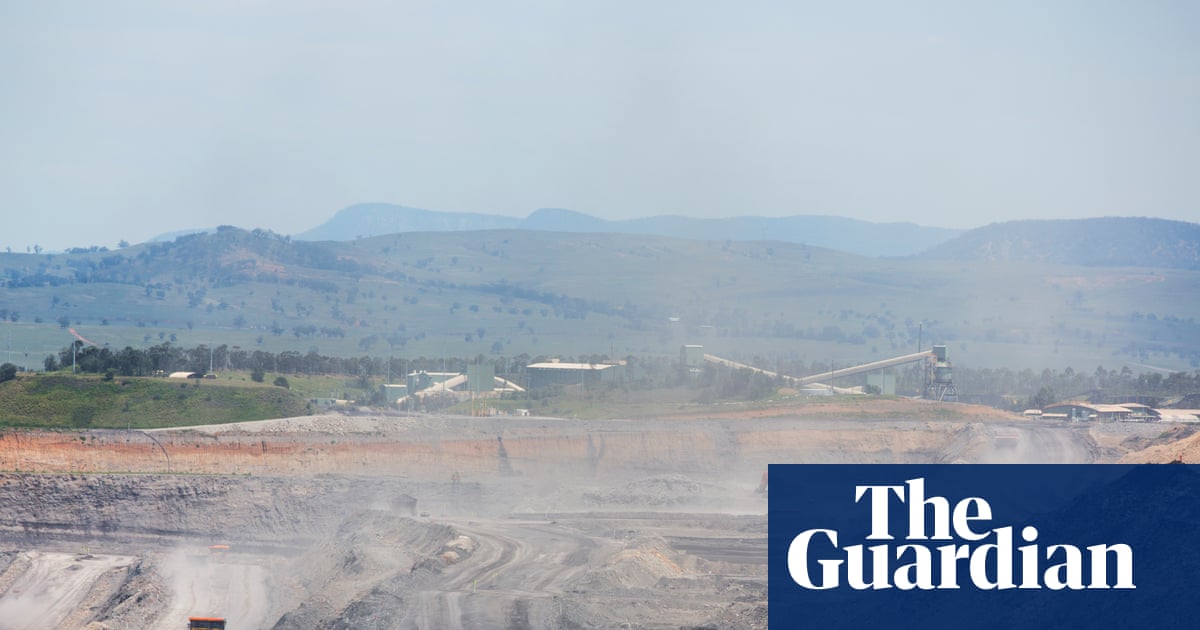
The New South Wales government has passed special legislation to allow a coalmine in the Hunter Valley to increase production by 32% in its final act of parliament before the March state election, in which the region will be a key battleground for One Nation.After a marathon session in the legislative council on Friday, the Minns government and the Coalition voted at 1.36am on Saturday morning to allow the Mount Pleasant mine to increase its annual extraction rate from 12.5MT to 16.5MT until 2032.At the start of debate, the resources minister, Courtney Houssos, told the upper house “this is a unique bill applying to unique circumstances”.“Taking the decision to intervene in the way we have is not an easy one, but it is an important one,” she said. “And it does reflect the gravity of the situation facing hundreds of workers and their families in the Hunter.”The legislation has drawn outcry from legal and anti-corruption experts, climate groups, crossbenchers and civil liberties organisations, after the high court ruled last month that an approval for an expansion that would increase the mine’s annual output to 21MT by 2048 was invalid.In a 3-2 split ruling, the high court found the state’s Independent Planning Commission (IPC) failed to properly consider imposing conditions to minimise greenhouse gas emissions that would be generated by the mine when the coal is sold and burned overseas.Despite saying he would not bypass the court’s decision, the NSW premier, Chris Minns, subsequently announced the legislation, claiming it would save 400 jobs ahead of Christmas.On Friday, the government and Coalition used their numbers to block almost 200 amendments to the bill sought by the Greens, who called the legislation “exceptional and unprecedented and dangerous”. Animal Justice party MLC Emma Hurst also opposed the bill.Sign up for the Breaking News Australia email“Labor describes the circumstances as exceptional, says this case is unique, and assures the public that other companies shouldn’t expect the same treatment,” the Greens climate spokesperson, Sue Higginson, told the parliament.“But a political assurance offers no protection against the precedent being set.”She accused the premier of being motivated by a desire to withstand a threat from One Nation to Labor seats in the Hunter.“It’s very clear to us why Chris Minns has gone here, and that is because we’re really on the eve of an election, and One Nation is right now his threat,” she said at a press conference on Thursday.The Hunter region, the centre of NSW’s coalmining industry, is emerging as a key battleground at the March 2027 state election.
The One Nation NSW upper house candidate and former coalminer Stuart Bonds contested the Labor-held federal seat of Hunter in 2025, winning 41% of the two-candidate preferred vote. The party’s NSW leader, Mike Newman, is running in the Labor-held lower house seat of Cessnock.Higginson told the upper house that in bringing the bill, the government had turned its back on the advice of the state’s Net Zero Commission, which has said further coalmine expansions are incompatible with meeting legislated emissions reduction targets.“But who seems to care any more?
What does the rule of law matter when [the premier] visits the Hunter and decides he needs to do something for someone so that he can remain somewhat popular in his own mind?” she said.The Coalition, which supported the bill, said it was “about people”.“It’s about the hundreds of workers at MACH Energy’s Mount Pleasant mine who, since the high court handed down its decision in October, have been left wondering whether they will still have a job in the new year,” Nationals MLC Sarah Mitchell said.She said “losing hundreds of jobs in one go would completely devastate the Hunter region”.The legislation ties consent for the mine expansion to a jobs guarantee protecting workers at the mine. Data provided to the government by the mine for the jobs guarantee, which covers more than 720 workers, is subject to an independent audit.At a press conference on Wednesday, Minns said the legal proceedings would return to the land and environment court for consideration, but it would be “a tragedy if, in the meantime, that community effectively shut down as a result of this decision”.“Most of the workers from Mount Pleasant live in Muswellbrook, and if the mine closed, the unemployment rate would jump by 5% just in that small town,” he said, speaking alongside workers at the mine and the Mining and Energy Union, which has welcomed the legislation.‘Serious corruption risk’In a report published on Tuesday, the parliament’s legislation review committee found the Mount Pleasant bill would “effectively undermine” proceedings that were still before the land and environment court and “would undermine procedural fairness” by removing avenues for legal challenge.That report also highlighted concerns with a so-called Henry VIII clause that the barrister and anti-corruption campaigner Geoffrey Watson warned this week posed a “serious corruption risk” to the state.The clause, allowing the resources minister of the day to override state laws as they apply to the Mount Pleasant development, was amended by the government in the lower house.
Following the amendments, it cannot be used to prevent changes from being subject to Icac investigations or to change the permitted coal production limit.The Nature Conservation Council of NSW said the government had been “embarrassed into amending its own coalmining bill”, while the Greens said the amendments did not go far enough to constrain the power any resources minister might hold under the clause.The Law Society of NSW said on Thursday it was concerned that without further amendments, the Henry VIII clause risked “undermining the rule of law”.Houssos told the upper house on Friday the government had carefully considered concerns and moved amendments to the clause because it “recognises the importance of appropriate safeguards and accountability”.