


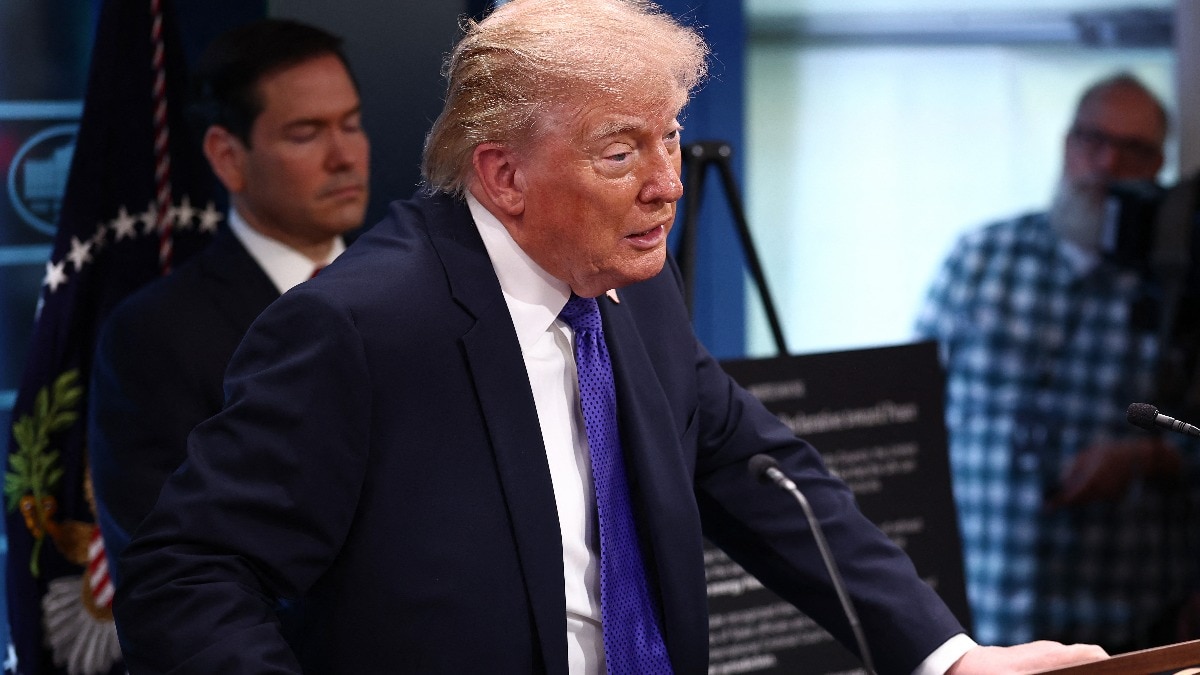
US President Donald Trump has threatened to impose a "tremendous tax" on American technology companies that build artificial intelligence data centres outside the country, in a fresh push to keep critical AI infrastructure on US soil to maintain its lead over China."We're not going to allow our companies to build data centres outside of our country," Trump said on Friday during a White House press briefing following his trip to Asia. He warned that companies choosing to construct such facilities overseas would face heavy financial penalties, although he offered no details about how the proposed tax would work.The announcement, however, appeared to catch even his own administration off guard.
Trump admitted that he had not yet discussed the proposal with his officials, leaving questions over whether the government would seek congressional approval or attempt to use existing executive powers to enforce the measure.WHY TRUMP WANTS DATA CENTRES TO STAY IN THE USData centres are the backbone of the artificial intelligence revolution. These enormous facilities house thousands of computer servers that store information and provide the computing power required to train and operate advanced AI systems.
Building such infrastructure has become increasingly important as companies race to develop more sophisticated artificial intelligence models. However, their construction is expensive and requires enormous amounts of electricity, water and land.
Trump has repeatedly backed the expansion of data centres in the United States, arguing that the infrastructure will strengthen the country's technological leadership and economic growth.On Friday, he also said that American communities should welcome these projects rather than oppose them, urging residents and local authorities to negotiate better financial arrangements with developers. "You ought to take advantage of the data centres," Trump said. "Make them pay you, make them pay your community, but don't shut them off.""They're making so much money they don't know what to do with it," he added, arguing that communities should benefit financially from the investments.However, the US President's proposal to penalise overseas construction could complicate the business plans of American data centre operators. Companies often establish facilities closer to their customers to reduce delays in data transmission, particularly for services such as financial transactions and other time-sensitive operations.
Operating data centres in different countries can also help companies comply with local laws requiring certain information to be stored or processed within specific jurisdictions.TRUMP'S CHINA CONCERNS AND THE AI RACETrump's remarks also carried a broader geopolitical message, with the President repeatedly framing the expansion of American AI infrastructure as essential to competing with China."We're not allowing data centres to go into other countries because China will take all of them, and we're not allowing that to happen," he said.Washington has been tightening restrictions aimed at preventing Beijing from gaining access to advanced American computing technology. The Commerce Department on Monday announced new restrictions on remote access to advanced US computing chips and servers.
The move is part of a wider effort to prevent Chinese companies from using computing capacity located in third countries to train sophisticated artificial intelligence models.Although the US already restricts direct sales of its most advanced AI chips to China, Chinese companies have continued to find ways to access computing power through data centres in countries permitted to import the technology.The latest restrictions seek to close some of these loopholes by limiting access to American computing infrastructure beyond US borders. Interestingly, Trump also spoke about the possibility of cooperation with China on artificial intelligence, despite his warnings about Beijing's technological ambitions.He said he and Chinese President Xi Jinping had agreed to establish "some joint guardrails" for artificial intelligence, which Trump frequently describes as "superintelligence".The US President maintained that Washington and Beijing were leading the global AI race, with "nobody even close", while stressing that the United States must emerge as the winner.Trump also claimed that Xi respected and congratulated the US for its achievements in artificial intelligence.AI BOOM MEETS LOCAL OPPOSITIONTrump's push for more data centre construction comes against the backdrop of growing resistance to these projects across the United States.
Although technology companies have presented artificial intelligence as a major economic opportunity, communities have increasingly raised concerns about the environmental and financial costs of hosting large server facilities.The biggest concerns centre on electricity consumption, pressure on local power infrastructure, rising utility bills, water requirements and the impact of construction on surrounding communities.The issue also became a political flashpoint during the November midterm elections, with several Democratic candidates promising tougher oversight of data centre development.According to figures cited by Axios, voters favoured restrictions on data centre development in 52 of 53 ballot measures across 13 states through November 2026. The issue also provided Democratic challengers with an opportunity to target Republicans over their approach to artificial intelligence infrastructure.The growing opposition has forced technology giants to reconsider how they approach communities where they want to build.
Companies including Google and Meta have been trying to address public mistrust by offering greater transparency, increasing financial incentives and promising to reduce the environmental impact of their facilities.They have also sought to reassure residents that data centre investments can benefit local economies, including through improvements in property values.- EndsInputs from agenciesTune In