


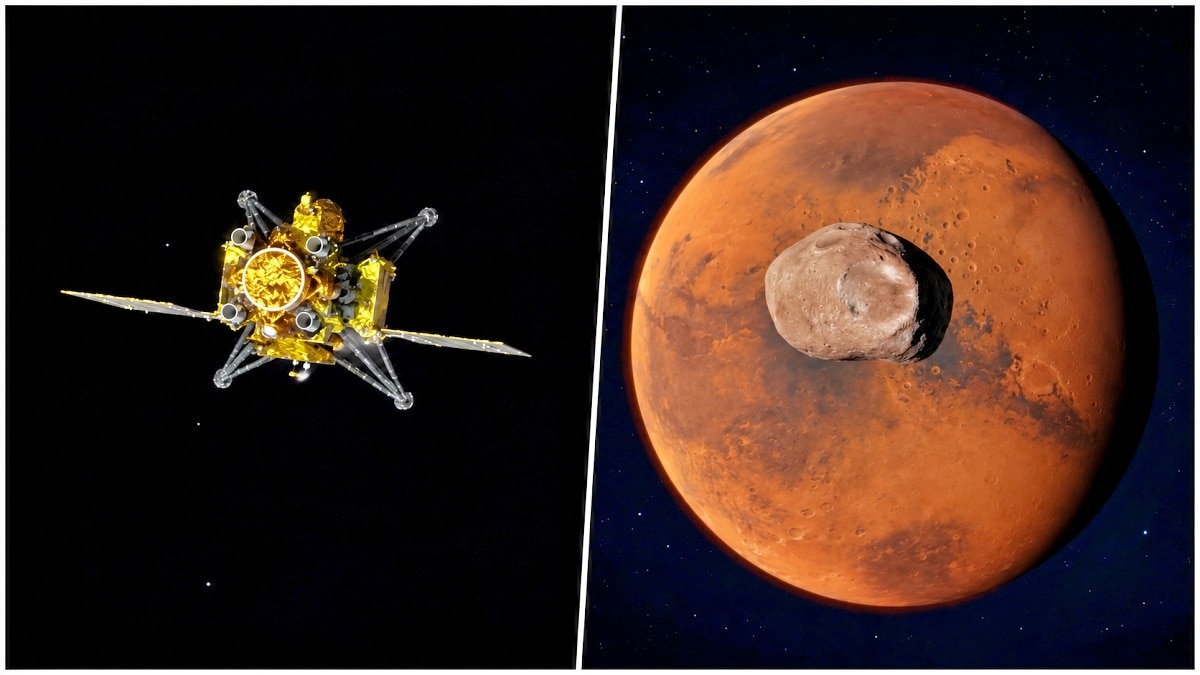
New Delhi: Japan is preparing to launch an ambitious mission to one of Mars' mysterious moons, Phobos, in a bid to bring back extraterrestrial material that could help scientists understand how the Red Planet and its surrounding moons formed.
The Japan Aerospace Exploration Agency is targeting Tuesday for the launch of its Martian Moons eXploration mission, which aims to collect at least 10 grams of material from Phobos and return it to Earth in 2031. The initiative will also study both Phobos and Deimos, Mars' two small moons, to investigate their origins and evolution. If successful, the mission would become the first to return samples from a moon of Mars, giving researchers an unprecedented opportunity to study material collected directly from the Martian system.
The spacecraft will travel to the Martian system aboard Japan's H3 rocket from the Tanegashima Space Center. It is scheduled to reach Mars in 2027 and begin detailed observations of Phobos, including its topography, internal structure, composition, and gravity. The mission's central challenge will be collecting samples from a small moon with extremely weak gravity.
The spacecraft will deploy a small rover, developed jointly by the German Aerospace Center and France's CNES, to study the surface and support exploration. To collect material, the vehicle will use two sampling systems: a coring sampler designed to obtain material beneath the surface and a pneumatic sampler that uses high-pressure nitrogen gas to lift surface particles into a collection container. The operation aims to gather at least 10 grams of material from two locations on Phobos.
The collected specimens will be sealed inside a return capsule for the journey back to Earth, with recovery planned in Australia's Woomera region in 2031. Phobos and Deimos remain among the least understood objects in the inner Solar System, with scientists investigating two competing theories for their origins: whether they are captured asteroids or debris thrown into orbit following a massive impact on Mars.
Analyzing these samples in laboratories on Earth could help distinguish between those possibilities by examining mineral compositions and chemical signatures. Researchers note the samples could also contain material ejected from Mars by ancient impacts, potentially offering clues about the planet's geological history.
The multinational effort is led by JAXA with contributions from NASA, ESA, DLR, and CNES. Beyond its scientific objectives, the mission will test technologies needed for landing on small celestial bodies, gathering samples, and executing safe returns across deep space to inform future human and robotic exploration.