


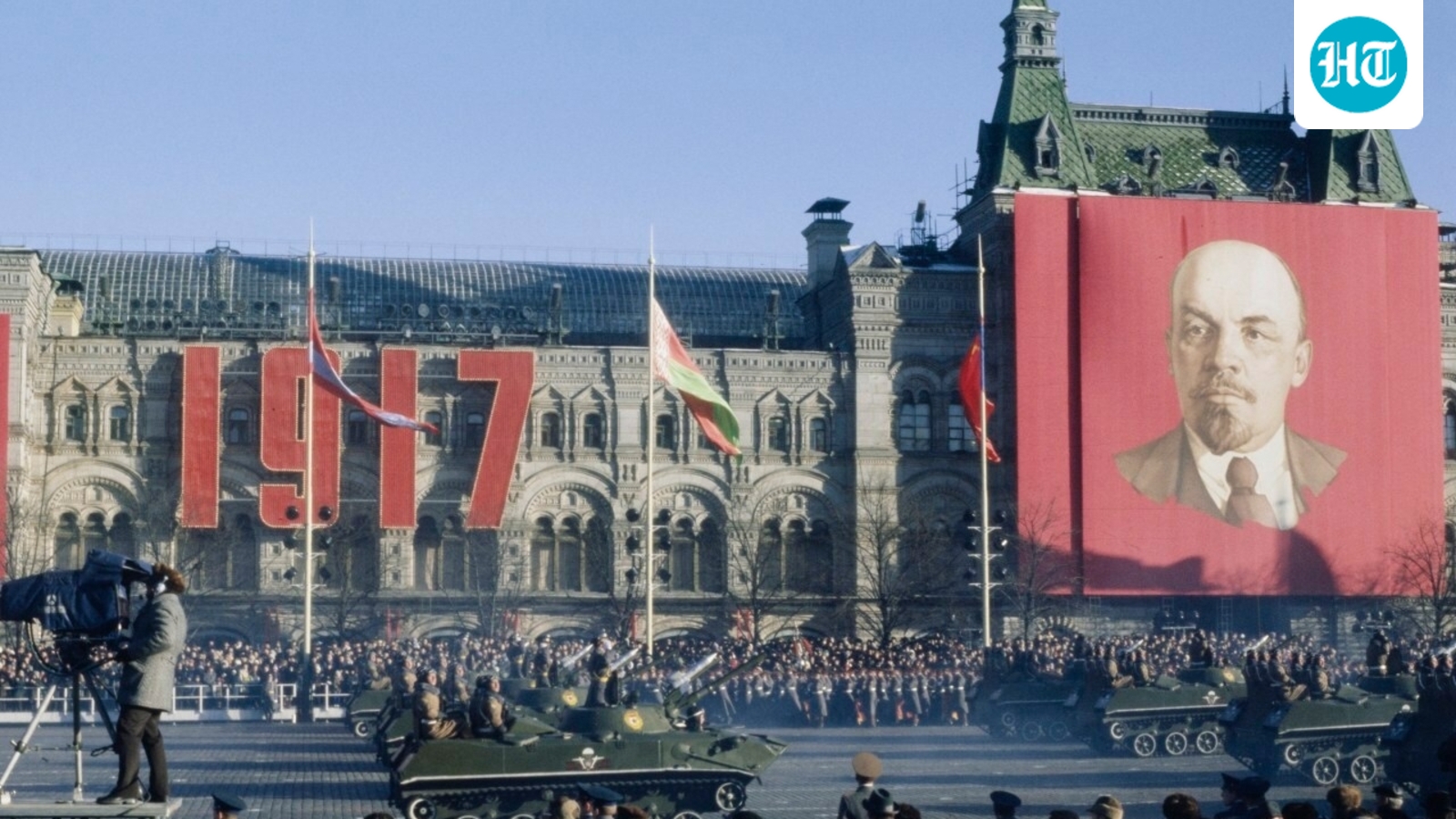
Will Lawrence looks like the poster child for Republican attacks in the midterm elections.A military parade marking the 61st anniversary of the October Revolution in Moscow’s Red Square in 1978.The bearded 36-year-old Michigan congressional candidate is a former member of the Democratic Socialists of America who once advocated for redistributing land and wealth, abolishing the police and the “forced nationalization” of fossil fuel companies. Republicans are flooding his district with ads portraying him as a radical socialist bent on “destroying the American way of life.”Yet Lawrence, who defeated two moderate candidates in the Democratic primary, is running neck-and-neck with Republican incumbent Rep.
Tom Barrett in a swing district in one of the country’s most competitive House races. Lawrence has focused on pocketbook issues, opposition to data centers and the war with Iran, and the country’s widening income disparity.Races like his are testing whether Republicans can still make accusations of socialism a political liability.
Across the country, candidates with socialist leanings—or who have associations with the DSA—have won primaries and are running competitive races. Populist ideas calling for more government intervention, including capping prescription drug prices, limiting rent increases and taxing billionaires, are gaining traction among Americans of all political persuasions.And because the GOP has spent years calling more mainstream Democrats including Barack Obama and Nancy Pelosi socialists, some GOP strategists say that the accusation has been diluted.During an age of growing socialist sentiment, the attack has lost much of its sting.Still, President Trump and many Republicans believe that tapping in to decades of deep-seated fears about socialism and communism will resonate with voters.
They have pushed their attacks further, making warnings of a “communist menace” a centerpiece of the GOP’s midterms message.“It’s going to be a communist country if they win,” Trump said of Democrats during the GOP convention in September, where he invoked communism 15 times. “They dropped socialism. They went right for the big one.”The goal to make the Nov.
3 elections a referendum on Democratic extremism rather than rising prices and the war in Iran is complicated by widespread economic frustration.While some Americans still recoil at “socialist” or “communist” labels, an increasing number of them are embracing policies that call for greater government intervention to make life more affordable. Others, especially young voters born long after the Cold War, now openly identify with the labels.A September Gallup poll showed that 43% of Americans now view socialism favorably, the highest share it has recorded, including 45% of independent voters.
Among 18-to-34-year-olds, socialism now polls better than capitalism by 57% to 43%.“Attacks that would normally be killshots get a shrug by voters,” said Jason Cabel Roe, the strategist for Barrett’s campaign. “The millennials and Gen Z voters are taught that socialism is just a different form of governing. They don’t see it as a pejorative.”White House advisers spent months testing whether anticommunist rhetoric could help Republicans in November.
The strategy solidified after the election of New York Mayor Zohran Mamdani, a strident democratic socialist. Trump has been personally involved in the framing and leading the effort as he has rapidly stepped up campaign events in October, people involved in the Republican messaging say.The push is visible across the country.Republicans at the Illinois State Fair handed out placards reading “Common Sense Over Communism.” At an Atlanta golf club, candidates held a “Living Under Communism” event where a Venezuelan exile recounted his experience to the audience over snacks and a cash bar.
Michigan Senate contender Mike Rogers’s campaign has called the state “ground zero for a dangerous communist contagion.” Tennessee Sen. Marsha Blackburn has an ad showing her crushing fortune cookies and vowing to “hunt down communists” as she vows to protect against Chinese land ownership in the state.In Florida, Republican gubernatorial candidate Byron Donalds enlisted a Bay of Pigs veteran to warn, “I lost my country once.
I won’t lose another.” Trump offers membership in an “Anti-Communist Club” and supporters have been besieged with emails asking “You’re not a communist, right?”The term communism has surfaced in some form in more than 880 episodes of conservative podcasts since Oct. 1, according to a Journal review.
The tracking firm AdImpact found more than $70 million has been spent on TV ads focused on socialism or communism.In South Florida, these labels remain so politically toxic—and so often used to attack Democrats—that a campaign stop by House Democratic leader Hakeem Jeffries at a Cuban bakery this week prompted two local bakery chains to publicly disavow socialism. One hadn’t even hosted the event.Yet even there, many question whether the labels still carry the same force.“For most voters, the suggestion that some Democratic candidates are actual communists is harder to believe,” said Carlos Curbelo, a former Republican congressman from Miami.The Republican Party under Trump, with its working class base, has itself grown a lot more populist.
And some Republican political consultants worry that attacks on Democrats are undercut by Trump’s own embrace of government intervention in the economy. His administration has taken ownership stakes in private companies and he has promised a $5,000 check to every adult American citizen if Republicans retain control of Congress—a proposal estimated to cost more than $1 trillion.Some Republicans were also revolted by Trump’s lavish reception for communist Chinese leader Xi Jinping in September and his unlikely bonhomie with Mamdani, whom Trump once branded a communist.Even so, there are signs some Democrats are worried the aggressive rhetoric about communism could stick. “No, I’m not a member of the Chinese Communist Party,” Senate candidate James Talarico says in a new Texas ad that sounds like it belongs to another era.
More than 60 Democratic candidates—including 10 sitting members of Congress—signed a pledge declaring their support for capitalism.The midterm elections could bring a new crop of Democratic socialists to Congress, expanding the movement’s influence within the party—and reshaping Republican calculations. Vice President JD Vance sees the rise of Democratic socialists as a useful foil for what appears an increasingly likely 2028 presidential bid and intends to emphasize the contrast should he run, according to people familiar with his thinking.Vance, though, is cognizant of the bigger social shift: Polls show that more young people are warming to policies—from rent freezes to government-funded healthcare—that have long been denounced as dangerous or un-American.
A September NBC News poll found that 64% of voters 65 and older viewed socialism negatively, compared with just 33% of those under 30.“My warning to my fellow Republicans would be if we don’t get this right, don’t blame young people for being sympathetic to socialism. We’ve got to blame ourselves,” he said on Fox News in August following the Democratic primary victory of Michigan Senate candidate Abdul El-Sayed, who is now within striking distance of delivering the far-left its biggest victory of the midterms.“You don’t stop socialism by throwing slogans at people about the free market,” Vance said. “As much as I love the free market, you stop socialism by making people’s lives better, and that’s what we’re trying to do every single day.”Lawrence, the Michigan congressional candidate, said he let his membership in the Democratic Socialists of America lapse this summer and has distanced himself from some of his extreme positions, including defunding the police.
He has emphasized face-to-face campaigning across the district, centered in Lansing, and frames it as a battle of growing inequalities.“People understand that our politics now is more about top vs. bottom than left vs. right,” he said in an interview.His Republican opponent is still highlighting Lawrence’s past far left ideas including wanting “open borders” and defunding the police. But last month, Barrett stopped emphasizing the word socialism in his attacks.