


"In February 1986, the District Court of Faizabad suddenly altered the status quo and ordered the unlocking of the gates. With suspicious speed, within an hour of the court's ruling, the gates of the mosque were opened, letting in a crowd of worshippers.
The effect was electric: A long-simmering but dormant conflict had been reignited." These are the words of Congress matriarch Sonia Gandhi in her recently published memoir, Belonging: A Journey of Love.Sonia Gandhi is referring to the unlocking of the gates of the Babri Masjid in Ayodhya, a decision that would alter the course of Indian politics forever, and intensify a religious dispute that eventually culminated in the mosque's demolition in December 1992.Nearly four decades later, Ayodhya remains a political battleground. As Uttar Pradesh heads towards another Assembly election in the first quarter of 2027, the Ram temple continues to figure in the political messaging of the BJP, while the Samajwadi Party has its own reasons for approaching the issue.
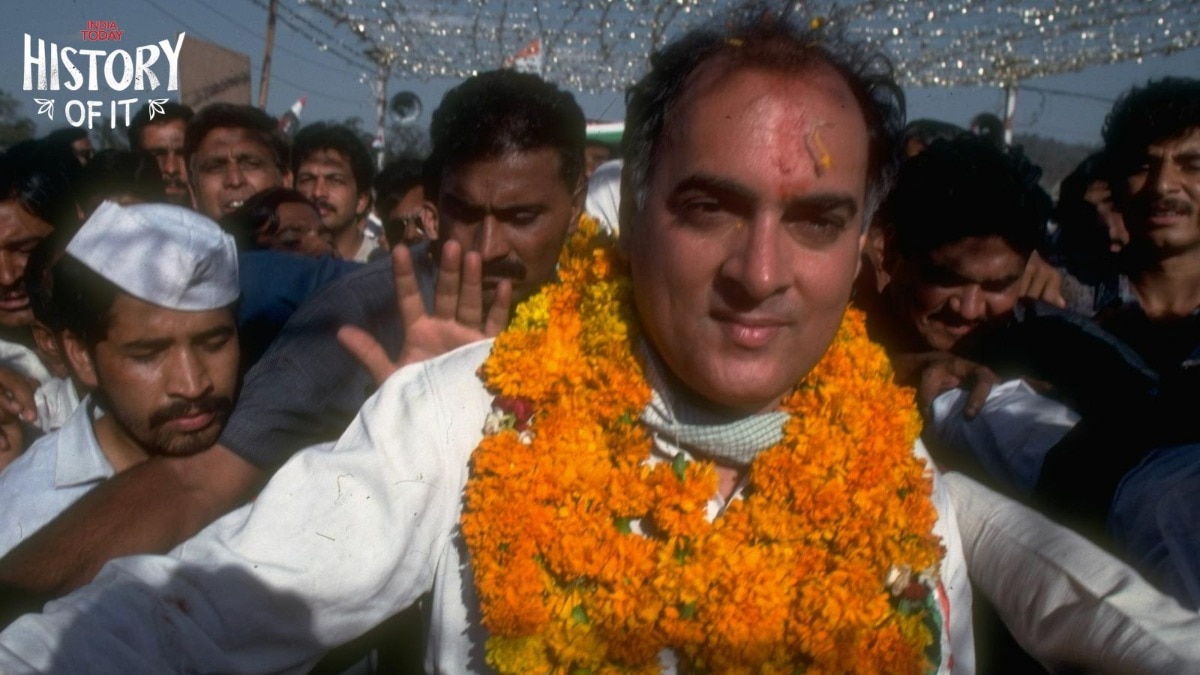
Now, Sonia Gandhi's account has brought back another chapter of the temple's political history — the Congress's attempts under her husband, former Prime Minister Rajiv Gandhi, to engage with the same religious sentiment that the BJP and the RSS were attempting to mobilise.The locks at the Babri Masjid were unlocked with an eye on the 1989 Lok Sabha election, after he was told that the overturning of the Shah Bano judgment had enraged Hindus. Despite Rajiv Gandhi's taking to Ram Mandir politics, the Congress suffered a major setback, losing its parliamentary majority despite emerging as the single-largest party with 197 seats.
For context, the Congress swept the 1984 election, bagging 404 of the 514 Lok Sabha seats. Sonia's book mentions Rajiv's attempt to revive Mahatma Gandhi's idea of Ram Rajya."Rajiv's attempt to revive Mahatma Gandhi's alternative conception of a 'Ram Rajya', with its core ideals of virtue, morality, and justice, fell on deaf ears.
RSS propaganda prevailed, and its poisonous consequences have been seen in the country through the past three decades...," she writes, offering a glimpse into how Rajiv Gandhi's politics. The story of Ayodhya, therefore, was not just one of the BJP building a political movement around a temple while the Congress watched from the sidelines.
The Congress, too, made political calculations around the temple, though its approach and eventual consequences were different.Previously, senior Congress leaders such as Kamal Nath have also highlighted the party's role in the opening of the locks of Babri Masjid, while veteran journalists have documented the unlocking of the gates in their accounts.To understand why Rajiv Gandhi's government moved towards the Ayodhya issue in 1986, it is necessary to revisit the Shah Bano case first.SHAH BANO AND THE POLITICAL TROUBLE FOR RAJIV GANDHIIn 1985, the Supreme Court ruled that Shah Bano, a divorced Muslim woman, was entitled to maintenance from her former husband under Section 125 of the Code of Criminal Procedure. The judgment was widely seen as a landmark ruling for women's rights, but it triggered opposition among sections of conservative Muslim leadership, which argued that the court had interfered with Muslim personal law.Rajiv Gandhi's government eventually responded by introducing the Muslim Women (Protection of Rights on Divorce) Act, 1986, effectively overturning the practical effect of the Supreme Court judgment on maintenance.The decision alienated sections of the liberal intelligentsia and women's rights groups, while reinforcing the perception that the Congress was willing to accommodate conservative Muslim religious leadership for political reasons.
The charge of Muslim appeasement became particularly pronounced after this move.The political damage was significant for a government that had won an unprecedented majority in the 1984 general election. It was a sympathy wave after the assassination of Indira Gandhi, Rajiv's mother, that helped the Congress sweep the polls.However, Prime Minister Rajiv Gandhi was increasingly being criticised for appearing to bend before religious conservatives.
The question confronting his government was how to address the growing discontent among Hindu voters without abandoning its political position altogether.It was against this backdrop that the locks in Ayodhya were ordered opened.In her book How Prime Ministers Decide, senior journalist Neerja Chowdhury provides an account of the political calculations that preceded the unlocking of the Babri Masjid gates. Drawing on conversations with people involved in the developments, she describes how Rajiv Gandhi's cousin and close political associate Arun Nehru played an important role in pushing the idea.According to Chowdhury's book, on January 18, 1986, the chiefs of the Intelligence Bureau (IB) and the Research and Analysis Wing (RAW) informed Rajiv Gandhi that discontent among Hindus was increasing following the government's decision on the Shah Bano judgment.Arun Nehru, who was then an influential figure in the Prime Minister's political circle, suggested a way out.
His advice, as recounted by Chowdhury, was straightforward: "Taala khulwa do (Get the gates unlocked)".The political calculation was that if the Congress government could facilitate access to the disputed site in Babri Masjid and allow Hindu worshippers to offer prayers, it could potentially recover some of the ground it had lost among Hindu voters.Arun Nehru, according to Chowdhury, also conveyed to Rajiv that he was losing support not just among conservative Hindus but sections of the liberal middle class.The criticism had become particularly uncomfortable for the government. Senior journalists, including Girilal Jain and Arun Shourie, had publicly questioned Rajiv's handling of the Shah Bano controversy, according to Neerja Choudhary's book.
Shourie, in particular, had criticised the government for ignoring the advice of its own Law and Home ministries before reversing the Supreme Court judgment.Chowdhury recounts in the book that when Rajiv Gandhi met Shourie, the latter questioned the logic of the government's decision, asking, "How could paying 179.20 a month to a seventy-three-year-old destitute woman endanger Islam?"HOW BABRI MASJID'S LOCKS WERE OPENEDThe events leading to the unlocking were not just the result of a court order emerging in isolation. Chowdhury's account points to political and administrative manoeuvring in Uttar Pradesh, with Arun Nehru emerging as an important link between the Prime Minister's Office and the state government.The disputed structure had remained locked after idols of Lord Ram and Sita were placed inside it in December 1949.
The site subsequently became a subject of litigation, with Hindu worshippers permitted to offer prayers from outside the locked gates.There was, however, growing mobilisation around the demand to open the premises. The Vishwa Hindu Parishad (VHP) had been campaigning for access to the site, and its affiliated groups were working to build a wider movement around the Ram Janmabhoomi demand.Uttar Pradesh's then Chief Minister Vir Bahadur Singh had also begun examining the Ayodhya dispute.
According to Chowdhury, Singh visited the temple town in December 1985 and went through the official files relating to the case. He reportedly concluded that the locks had originally been put in place through an administrative order rather than a specific judicial direction.Chowdhury suggests that Singh's political proximity to Arun Nehru might have helped prepare the ground for what followed.After discussing the matter with Arun Nehru, Rajiv Gandhi reportedly instructed him to communicate with the Uttar Pradesh Chief Minister.
Nehru then called Singh from the PMO. Chowdhury recounts the exchange in which Nehru told the Chief Minister, "DM se kaho ki taala khole (Tell the district magistrate to get the locks opened)".The phone was subsequently handed to Rajiv Gandhi. "Lo PM se baat karo (Here talk to the PM)," Nehru said.Chowdhury attributes much of this account to conversations with former Union minister Arif Mohammed Khan, who had been a prominent critic of the government's handling of the Shah Bano case.
She also draws on accounts from people who were involved in the Ayodhya developments at the time.The district court in Faizabad ordered the unlocking of the gates on February 1, 1986. The speed with which the order was implemented became an important part of the controversy.
Within an hour, the gates were open and worshippers were allowed inside.For the VHP, which had been campaigning for a Ram temple at the disputed site for years, this development was a major breakthrough. And for the Congress, it was an opportunity to demonstrate that it was not indifferent to Hindu religious sentiment.Sonia Gandhi, in Belonging, describes the episode as the moment when a dormant dispute was brought back to life.
She writes that the BJP and the RSS saw the development as an opportunity to push their campaign further.Her account also makes a very important distinction about Rajiv Gandhi's stated approach. She says he wanted a negotiated settlement that would be legally acceptable to all sides, allowing a temple to be built without disturbing the mosque.
But, according to her, the BJP-RSS position was fundamentally different, with the destruction of the mosque becoming the ultimate objective.CONGRESS AND THE AYODHYA RAM MANDIR MOVEMENTThe developments of 1986 intensified the Ayodhya movement.The VHP expanded its mobilisation, collecting funds and bricks from villages across the country for the proposed temple. These bricks, known as Ram Shilas, were often consecrated through local religious ceremonies before being sent to Ayodhya.By 1989, the organisation announced plans for a shilanyas, or foundation stone-laying ceremony, for the proposed temple.Sonia Gandhi's account describes how the Congress government attempted to negotiate the terms of the ceremony.
The VHP and the BJP reportedly gave an undertaking to the then Uttar Pradesh Chief Minister ND Tiwari and Union Home Minister Buta Singh that the ceremony would be conducted on an adjoining plot outside the disputed area.However, according to Sonia, the agreement was not followed in the manner promised. The ceremony took place at a location that, she writes, was intended to form part of the proposed temple complex and would inevitably affect the mosque.The shilanyas was another turning point in the mobilisation around Ayodhya.
The Congress government had attempted to manage the dispute through negotiations, but the temple movement was gathering momentum beyond its control.And Rajiv Gandhi was not entirely removed from the political symbolism surrounding the movement.In the 1989 general election campaign, the Congress attempted to bring the idea of Ram Rajya into its own political messaging. Veteran journalist Mark Tully noted in an article in India Today Magazine that Rajiv Gandhi launched the Congress's election campaign with a speech in Faizabad in which he invoked "Ram Rajya".The significance of this move was that the Congress was trying to counter the BJP and the VHP with "Ram Rajya" politics.
This was when the VHP and the BJP were building their political mobilisation around the birthplace of Lord Ram.Though Sonia Gandhi tries to create a distinction in her memoir, the Congress was in effect trying to use Ram Mandir politics with Ram Rajya politics. Both had religious intonation.THE BJP NEVER HAD A MONOPOLY OVER AYODHYA POLITICSThe Congress's involvement in the Ayodhya developments has periodically resurfaced in political debates, particularly whenever the BJP has been accused of claiming exclusive credit for the Ram temple.In November 2023, during the Madhya Pradesh Assembly election campaign, senior Congress leader Kamal Nath brought up Rajiv Gandhi's role in the unlocking of the gates. "Rajiv Gandhi got the locks opened.
Let us not forget history," Nath told The Indian Express in an interview.He also accused the BJP of attempting to appropriate the Ram temple as its own achievement.Karnataka Congress leader Basavaraj Rayareddy had made a similar argument earlier, saying that Rajiv Gandhi had facilitated worship at the disputed site by allowing the gates to be opened.These claims underline the political complications in the Congress's own history. The party cannot entirely separate itself from the decisions that helped change the status quo at Ayodhya.
Nor can it claim that the temple movement was exclusively a BJP creation from its very beginning.Reflecting on the twentieth anniversary of the Babri Masjid's demolition, Mark Tully wrote in India Today Magazine that the Ram Mandir movement was political and that the BJP was not the only party to have played politics with it. He specifically recalled Rajiv Gandhi launching his 1989 election campaign with a speech invoking Ram Rajya in Faizabad."Mixing religion and politics is playing with fire," Tully wrote in 2012.Sonia Gandhi's recollection of Rajiv's Ram Rajya idea is, therefore, a reminder of a period when the Congress attempted to counter the BJP on religious symbolism, only to find itself increasingly outmanoeuvred on an issue that would reshape Indian politics forever.- Ends