


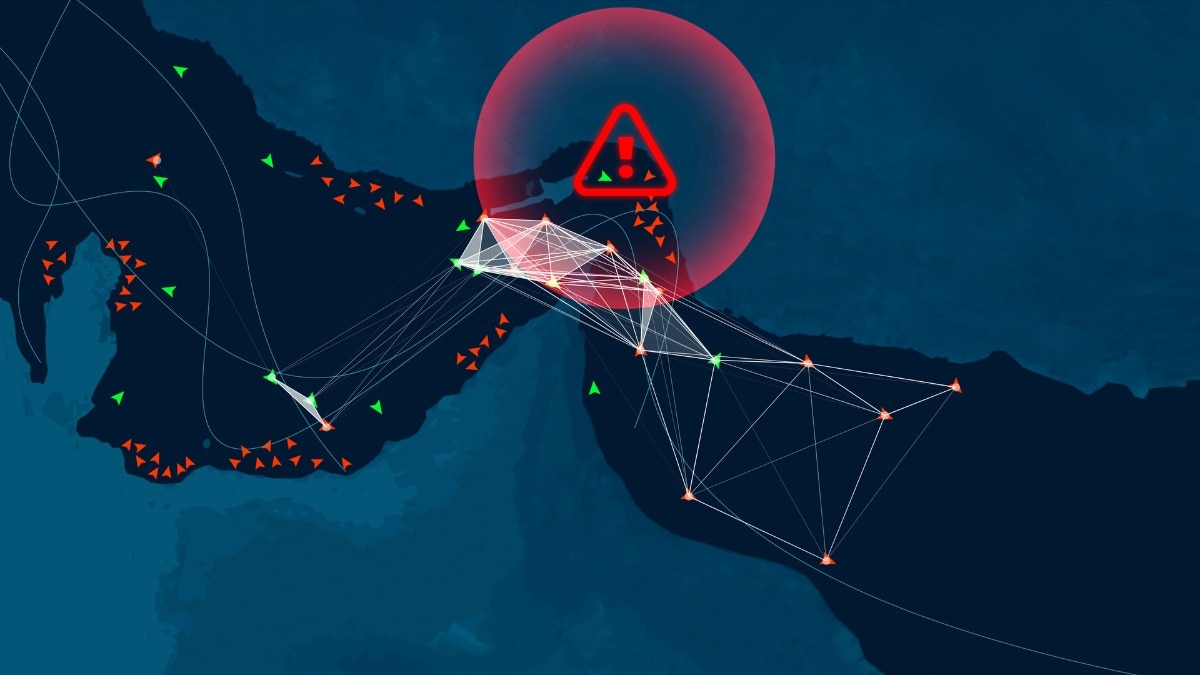
The International Energy Agency (IEA) has now put a number on the crisis India along with other global economies have been living with all year. Its World Energy Outlook 2026, released on November 19, estimates that disruption in the Strait of Hormuz has taken 2.8 billion barrels of oil and 60 billion cubic metres of gas off the market from the Gulf.No supply shock in history comes close.
Diesel has crossed $200 a barrel for the first time. Asia carries most of the risk.
Before the crisis, about 80 per cent of the oil and almost 90 per cent of the liquefied natural gas (LNG) passing through Hormuz was headed there. More than four billion people across countries get over 30 per cent of their oil through the Strait.The report also makes clear that India's exposure will not fade by itself.
Under the IEA's Stated Policies Scenario, India's crude oil production falls 20 per cent by 2035 even as refining capacity grows by about one million barrels per day (bpd). India could become a bigger exporter of petroleum products and, at the same time, more reliant than ever on imported crude.Demand will keep climbing.
The IEA expects India's energy use to grow 2.5 per cent a year until 2035, about three times the global pace. Demand for useful energy—the services that actually reach consumers—rises 6 per cent a year.
Over the next decade, the country is expected to add more than 12,000 cars to its roads every day and some 200 million household air conditioners. India and Southeast Asia together will account for 45 per cent of the growth in the world's primary energy demand.
The latest import data, also out on November 19, shows how India is coping for now. Crude imports touched a record 5.58 million bpd in October, up 6.9 per cent on a year earlier.
Russia remained the largest supplier, with roughly a third of the total. For the first time since the US-Iran conflict disrupted regional oil flows, Saudi Arabia last month overtook the UAE as the second-largest supplier of crude oil.
Saudi shipments hit an eight-month high of about 790,000 bpd while UAE supplies slipped to a seven-month low of 612,000 bpd.Refiners have adapted well, switching suppliers and changing routes. What they cannot control is the cost of getting each barrel home.
Freight from the UAE's Fujairah port to India's west coast rose to $7.51 a barrel in October, from $1.57 in February, a jump of nearly 380 per cent. Russian crude from the Baltic now costs $25-30 a barrel or more to ship.
The Indian crude basket averaged $116.09 a barrel in September, against $69.61 a year earlier. The crude import bill rose 47 per cent to $15.4 billion although volumes grew only 7 per cent.That bill travels through the economy in familiar ways.
It widens the current account deficit, weakens the rupee and raises costs for transport, fertilisers, petrochemicals and factories. The government can soften the blow through pricing or fiscal measures, but someone still pays: consumers, oil marketing companies or the exchequer.
It could hardly come at a worse time. India is in the middle of a long build-out in manufacturing, infrastructure and cities, and its energy needs will only rise.This is why the IEA looks beyond the immediate oil shock.
It argues that the crisis could speed up a long-term shift towards electricity, demand for which has grown 3.3 per cent a year since 2019—faster than the global economy. The economics are on its side.
Solar generation worldwide grew by 600 terawatt-hours (TWh) in 2025, the third-largest annual addition any energy source has ever recorded. Factories can now make roughly twice as many solar modules and batteries as the world installed last year.India has come further here than anywhere else in its energy system.
Non-fossil sources made up 55 per cent of installed power capacity at the end of September. Yet they still produce under a third of the electricity the country consumes.
The next stage is harder. India needs storage to cover the hours when the sun and wind fail, transmission lines to carry power to where it is used, and markets that can balance the grid.Worldwide, the IEA estimates, at least 25 million km of new power lines will be needed over the next decade.
A new source of demand adds urgency. The agency expects data centres to double their electricity use to around 1,000 TWh by 2030, and India wants a large share of that investment.Nuclear power could provide the steady, low-emission electricity that a grid built on renewables needs.
Nearly 90 gigawatts (GW) of new nuclear capacity was under construction worldwide by mid-2026, the most in over 35 years. India now has the legal foundation.
The SHANTI Act, which received presidential assent in December 2025, allows private companies to build, own, operate and decommission nuclear plants. But hitting 100 GW by 2047 means building about 4 GW a year, against roughly 0.15 GW a year over the past six decades.
Coal will keep its place for as long as security trumps emissions. The IEA warns that even a faster global response to the crisis leaves the world on course for about 2.4°C of warming.There is also a risk that India swaps one dependency for another.
China is the leading refiner of 19 of the 20 strategic minerals the IEA tracks, and more than half of them face export controls. India's own factories show the problem.
The country can make 261.7 GW of solar modules a year, but only 36.6 GW of cells. The battery cell incentive scheme targeted 50 GWh of capacity, but by October 2025 had delivered just 1.4 GWh.Geography will not change quickly either.
The IEA's Low Hormuz Case, an extreme scenario, looks at around seven million bpd of pipelines being built or planned to bypass the Strait, at a cost of about $40 billion. Together, with more non-Gulf production and lower demand, they could cut oil flows through the Strait of Hormuz to about two million bpd by 2035.
Even then, the Middle East would remain the world's largest oil exporter.For India, that is not a bad thing. The Gulf is a strategic partner, a big market for Indian exports and home to millions of Indian workers, and the crisis has drawn the two closer.
When the Strait was shut on February 28, India’s strong relations with the UAE, Saudi Arabia and Qatar ensured that LPG and crude oil kept flowing. Saudi Arabia's climb up the supplier list points to a rebalancing within the Gulf, not a retreat from it.
The crisis also strengthens the case for the India-Middle East-Europe Economic Corridor, which includes an energy component. Attacks on Gulf ports, though, have clouded its near-term prospects.The harder balance is between the US and Russia.
In September, US president Donald Trump signed a law authorising tariffs of up to 100 per cent on imports from major buyers of Russian crude or gas. He waived them in October, but the waiver lasts only until Washington decides further action is appropriate.
Every barrel of Russian crude now carries a possible cost for Indian exporters to the US. Yet the transition also pulls India closer to Washington.
In May, the two signed a Critical Minerals Agreement on the sidelines of the Quad Foreign Ministers’ Meeting in New Delhi, and India has struck similar deals with Germany and Brazil. Its habit of keeping energy out of bloc politics will face its sternest test.Closer home, the buffers are thin.
India's strategic reserves cover only about nine and a half days of consumption, and the country has consistently underspent on them. The government is now weighing a policy to lift total stockholding from about 74 days to 100-150 days.India handled the immediate shock well.
Building the reserves, supply chains and reactors that the reset demands will take years, not months. The task is to tie energy security to industrial strategy.
That means producing more at home where it makes economic sense, speeding up renewable and nuclear power, building storage and securing critical minerals. Electricity also has to stay affordable for households and competitive for industry.The IEA's larger point is that the next energy order will favour countries that diversify their supplies, electrify their economies and build capabilities at home.
Those will not necessarily be the countries with the most oil, gas or coal. India's demand will grow faster than that of any other major economy.
That makes it a huge market for energy investment, and also one of the economies most exposed to the next shock.New Delhi does not have to choose between energy security and the energy transition. Done well, the transition is how it gets energy security.
The West Asian crisis has made it clear there is little time to waste.Subscribe to India Today Magazine- Ends