


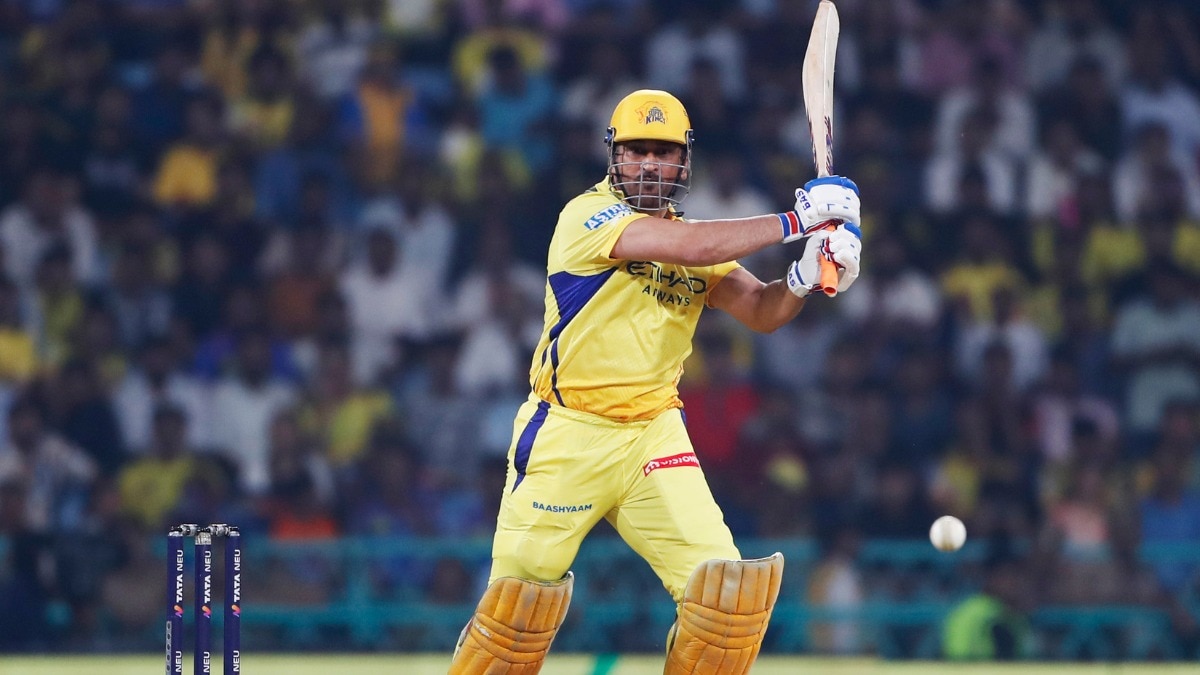
The yellow jersey shall remain, but the man who made it synonymous with an era of Indian Premier League (IPL) cricket will no longer walk out to bat. On November 17, Chennai Super Kings (CSK) announced that Mahendra Singh Dhoni would step away from his IPL career and take up the role of ‘team mentor’ from the 2027 season.After nearly two decades of association with the franchise, five IPL titles and an IPL career that began in the league’s inaugural season in 2008, the curtain has finally come down on one of cricket’s most enduring acts of leadership.For a boy from Ranchi, a city far removed from India’s traditional cricketing centres, it has been an extraordinary journey.
Dhoni did not arrive with the pedigree of a metropolitan cricket academy or the advantages of an established cricketing establishment. He made his way through sheer ability and an instinctive understanding of the game.
What Dhoni eventually brought to captaincy—both for India and CSK—was equally unconventional: a willingness to trust instinct, defy convention and remain composed when the match appeared to be slipping away. There have been more flamboyant captains, more aggressive tacticians and perhaps even more statistically successful leaders.
But few have understood the psychology of a cricket match quite like Dhoni. His greatest achievement was not merely winning trophies; it was developing an uncanny ability to recognise when a game was drifting away, identify the opposition’s vulnerability and make a decision that could change its course.The courage to defy conventionHis calmness, often mistaken for passivity, was actually an instrument of leadership.
As a wicketkeeper, Dhoni enjoyed a unique vantage point. He could observe the batsman’s footwork, the bowler’s rhythm and the subtle shifts in momentum.
He was constantly communicating with his bowlers and assessing the opposition’s intentions. The position behind the stumps became his tactical command centre.The finals against Pakistan of the 2007 inaugural T20 World Cup remains an enduring illustration of Dhoni’s unconventional thinking.
With India defending 13 runs in the final over, he entrusted the ball to Joginder Sharma rather than an established frontline bowler. It was a gamble that could have defined his captaincy negatively.
Instead, Misbah-ul-Haq’s attempted scoop ended in Sreesanth’s hands, giving India the world title.Four years later, in the 2011 World Cup final against Sri Lanka, Dhoni demonstrated another dimension of his tactical intelligence. With India chasing 275 and having lost Sachin Tendulkar and Virender Sehwag early, Dhoni promoted himself ahead of the in-form Yuvraj Singh.
The decision raised eyebrows. But he understood the value of a right-left combination with Gautam Gambhir and believed his familiarity with Sri Lankan bowlers could help stabilise the innings.
Dhoni’s unbeaten 91 sealed India’s first World Cup triumph in 28 years.Reading the gameDhoni’s greatest tactical strength has been his understanding that cricket is a contest of probabilities rather than reputations. He was prepared to give an unconventional bowler an over, alter a field to tempt a batsman into a particular shot or hold back a frontline bowler for a more consequential moment.His wicketkeeping instincts were central to this approach.
His lightning-fast stumpings, often executed before a batsman realised he had ventured out of the crease, reflected an extraordinary understanding of timing and anticipation. Dhoni’s 123 ODI stumpings remain a world record in men’s international cricket.
Overall, when it comes to combined Test, ODI and T20 records, Dhoni is right at the top with 829 dismissals. K.C.
Sangakkara with 678 dismissals is at a distant second.Dhoni’s understanding of spin bowling was particularly noteworthy. He often encouraged spinners to flight the ball even when batsmen were attempting to attack, while adjusting the field to exploit their preferred scoring areas.
He understood that a wicket could be created not just through a good delivery but by inducing a batsman into playing the wrong shot.Building a culture of trustDhoni’s leadership was also rooted in his ability to make players feel secure. He backed individuals through difficult phases, often giving them opportunities when their confidence was low.
His teams were not necessarily collections of the most celebrated names; they were combinations of players who understood their responsibilities.This was especially evident at CSK. Dhoni built a franchise culture around continuity, clarity of roles and trust.
CSK repeatedly retained experienced players even when conventional cricketing wisdom suggested they were past their prime. His faith in players such as Suresh Raina, Ravindra Jadeja and Dwayne Bravo was integral to the franchise’s sustained success.The numbers are remarkable.
Dhoni led CSK to five IPL championships—in 2010, 2011, 2018, 2021 and 2023—and 10 finals. He also led India to the 2007 T20 World Cup, the 2011 ODI World Cup and the 2013 Champions Trophy, becoming the only captain to win all three major ICC men’s white-ball titles.The ability to absorb pressurePerhaps Dhoni’s most enduring contribution was his relationship with pressure.
He rarely allowed a difficult situation to dictate his next decision. His approach was particularly effective in limited-overs cricket, where the temptation to panic can be as damaging as a poor delivery.His batting reflected the same philosophy.
As a finisher, he often preferred to take a chase deep, preserving wickets and keeping the required equation within reach. Rather than attempting to dominate every over, he calculated when to accelerate.
His 183 not out against Sri Lanka in Jaipur in 2005 and his match-winning 91 in the 2011 World Cup final illustrated two different versions of the same instinct: the ability to judge what an innings required rather than impose a predetermined template.A legacy beyond trophiesDhoni’s record was not without blemishes. India’s overseas Test defeats in England and Australia during 2011-12 exposed limitations in his leadership and the team’s ability to compete in challenging conditions.
His relatively conservative approach could occasionally become a disadvantage, particularly when the opposition seized the initiative.Yet, his legacy cannot be reduced to individual failures. Under his captaincy, India reached the top of the Test rankings in December 2009.
He also presided over a period in which Indian cricket achieved unprecedented success in white-ball tournaments.Dhoni’s departure from IPL as a player is, therefore, more than the retirement of a celebrated cricketer. It marks the end of a particular style of leadership: one that relied less on theatrical aggression and more on observation, anticipation, calculated risks and an almost clinical understanding of human psychology.
But as team mentor, he is now poised to apply these very qualities into the CSK’s game.The boy from Ranchi had travelled a long way to become Chennai’s ‘Thala’ (boss). His greatest gift to the game, however, was not the trophies he lifted but the way he made captaincy look deceptively simple.
While others reacted to the match unfolding before them, Dhoni often seemed to be preparing for the next move. That has been the Dhoni difference.Subscribe to India Today Magazine- Ends