


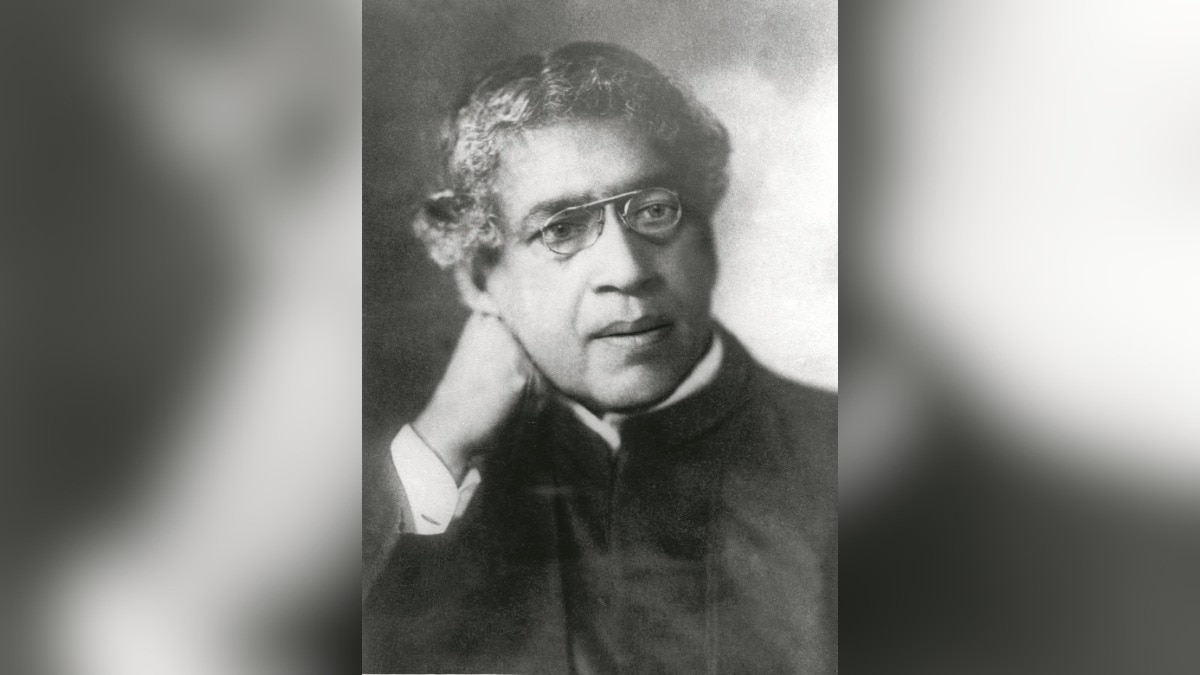
On J.C. Bose's death anniversary, a glimpse of his truly inspirational legacy for Indian science(NOTE: This article was originally published in the India Today issue dated April 21, 2008)Jagadish Chandra Bose was one of the greatest pioneers of modern science in pre-Independent India.
The controversy that arose in 1998, more than 60 years after his death, shows vividly the glory of Indian science in his time.A newspaper carried the headline ‘Bose invented Marconi’s wireless’. The story was based on a report that the detecting device, called coherer, an instrument invented by Bose two years earlier, was used by Guglielmo Marconi to develop the wireless radio in 1902.Bose believed in the free exchange of scientific knowledge and in sharing it with fellow scientists.
In 1901, he wrote to his friend Rabindranath Tagore: “The proprietor of a reputed telegraph company came with a patent form in hand. He proposed to take half of the profit and finance the business in return.
This multi-millionaire came to me begging. My friend, I wish you could see that terrible attachment for gain in this country, that all engaging lucre, that lust for money.
Once caught in that trap there would have been no way out for me.” Bose was the first to use a semiconductor junction to detect radio waves. He invented various, now commonplace, microwave components.
Nobel laureate Sir Neville Mott said, “Bose was 60 years ahead of his time. In fact, he had anticipated the existence of P-type and N-type semi-conductor.”After 1900, Bose began pursuing another long-time interest—animal and plant physiology.
He believed that by focusing on the boundaries between physical and biological sciences, he would be able to demonstrate the underlying unity of all things.In 1917, he founded the Bose Research Institute in Calcutta, which was India’s first scientific research institute. A knighthood was conferred on him the same year and in 1920, he became the first Indian scientist to be elected to Great Britain’s prestigious Royal Society.
A pioneer, Bose’s legacy is truly inspirational for Indian science.—The author is former director-general of the Council of Scientific & Industrial ResearchSubscribe to India Today Magazine- Ends