


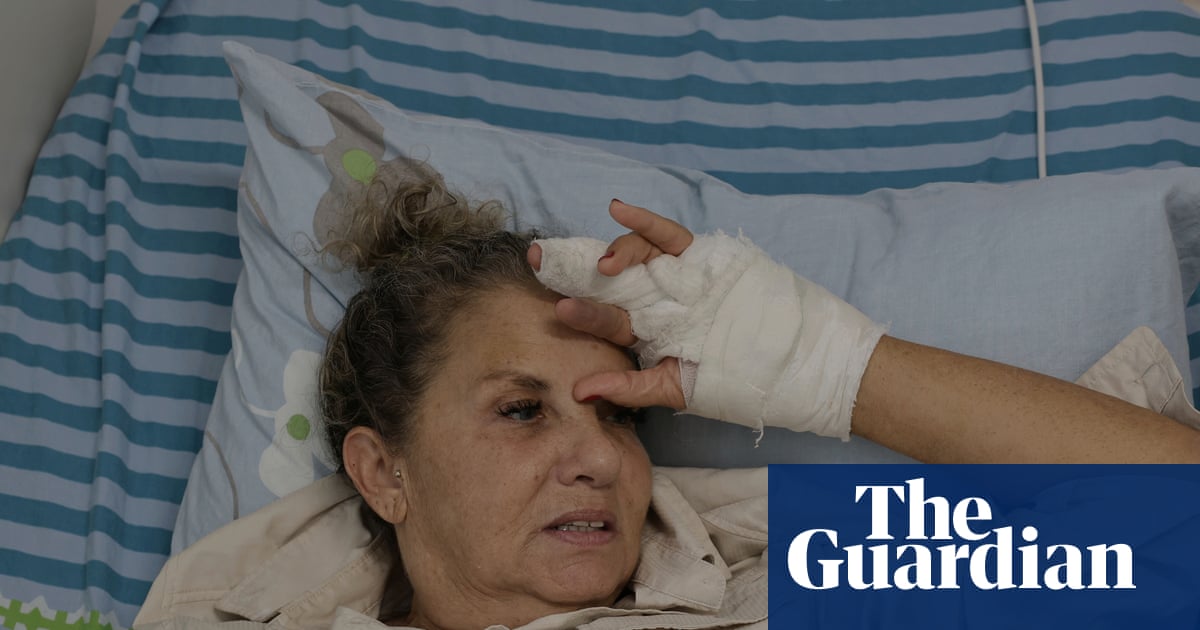
The Washington Post photojournalist who was attacked and seriously injured by Israeli settlers on the West Bank on Friday has described how she was saved with the help of local Palestinians.Heidi Levine sustained four fractured vertebrae, two broken ribs and four puncture wounds when she was knocked to the ground and repeatedly beaten by a crowd of masked settlers while she and other journalists were covering the olive harvest in the Palestinian village of Abu Falah, north of Ramallah.It is unclear whether the puncture wounds were caused by knives or other weapons. Levine said a witness to her attack had seen nails sticking out of some of the wooden clubs wielded by her attackers.Levine, 64, has covered multiple wars and had just returned from an assignment in Ukraine before Friday’s attack.
She said she would most likely have been killed had she not been wearing protective body armour and a helmet.“I probably would have been dead, because for sure it doesn’t take much to kill a person with blows to the head,” she said shortly before being discharged from hospital on Wednesday in the Israeli city of Petah Tikva.Levine pointed out that Palestinians did not have such protection and more than 20 had been killed in settler attacks so far this year, in the course of an escalating campaign of aggression – described as terrorism by Israeli security leaders – across the West Bank aimed at driving Palestinians from their land.“Every single journalist who looked at [the attack on me] are thinking they and I have gone to so many funerals of Palestinians killed by settlers,” Levine said.She said the olive harvesting at Abu Falah had begun peacefully but at some point a group of young masked settlers appeared on a nearby hilltop watching the group of Palestinian villagers, journalists and human rights activists accompanying them. Levine said the attack began only after the Israeli army arrived on the scene.“Then all hell broke loose.
Some of the farmers started to gather their tarps and bags of olives that they had picked,” she said. “Then all of a sudden I hear a machine gun, and then saw teargas in the distance. I started to run … It was just like a lot of commotion and then all of a sudden I see a dozen of them and they started charging at me.“I managed to keep my face to the ground, and I don’t know if I took that position to protect myself with my face down or it was their initial blow.
Otherwise my whole face would have been broken and I could have suffered brain damage or lost an eye.“They started kicking me and beating me with sticks. I can’t even count how many times, probably more than a hundred times.
I actually tried playing dead so that they would stop. But it didn’t work.”American photojournalist recounts Israeli settler attack in the occupied West Bank – videoWitnesses said the beating only ceased when young Palestinian men used slingshots to aim stones at settlers forcing them back, allowing another American journalist, Jasper Nathaniel, to reach Levine and, with other reporters, help her to safety.“The shabab [Palestinian youth] put themselves in front and were trying to keep them [the settlers] away, keep a protective shield, which was amazing.
It was like a biblical battle,” Levine said.After the attack, Nathaniel wrote: “Had the shabab not stepped up to protect her, she might well be dead. It is no exaggeration to say that young Palestinians armed only with stones risked their lives to save Heidi Levine’s.”He said the army pursued the young Palestinians in the wake of the incident, rather than the settlers.
Palestinians risk being shot by settlers or the soldiers if they try to resist attacks, and can face long periods in detention without charge.Levine, who has lived in Israel for four decades, said she would go back to reporting on the West Bank as soon as she recovered. “My work is important,” she said. “They have bruised me, broken some bones, but they haven’t cracked my spirit.”Since the attack, she has received letters from Israelis expressing regret, and an apologetic phone call from the president, Isaac Herzog.“He was a teddy bear on the phone,” she said. “He kept saying I just want to give you a big hug and these are not representative of who this country is, they’re a dark stain, and he called them thugs.”The office of the prime minister, Benjamin Netanyahu, however, put out a statement on X seeking to cast doubt on witness and video accounts of what he called an “alleged attack”.Levine was particularly angered by Netanyahu’s claim that some video footage “appears to show Levine knocked down and immediately helped to her feet by the same unidentified individual”.“That’s such bullshit. They helped me up because they couldn’t get my things off of me.
That’s why,” Levine said. “They robbed me of everything I have – a pouch with my documents, my American passport, credit card, camera disk and a small camera bag with two other lenses. Everything is gone … That’s why [they stood me up], and then they threw me back down and continued to kick and hit me.”The US ambassador to Israel, Mike Huckabee, called the attack a “despicable act of terror” and demanded prosecutions.
Israeli police arrested 10 suspects after the Abu Salah incident and another attack on Saturday aimed at European diplomats near the West Bank village of Taybeh. Several of them were subsequently released.
Prosecutions of settlers, who have allies in the army, police and Netanyahu’s cabinet, are very rare.Asked if she expected her attackers would be brought to justice, Levine said her level of confidence was “two out of 10”.“I am not very hopeful,” she said. “Of course, if the government made the decision to do something and crack down on this and get people arrested, they would do it. But it’s not just arresting these teenage thugs.
It’s going after their leaders, the rabbis, and how they’re organised.”