


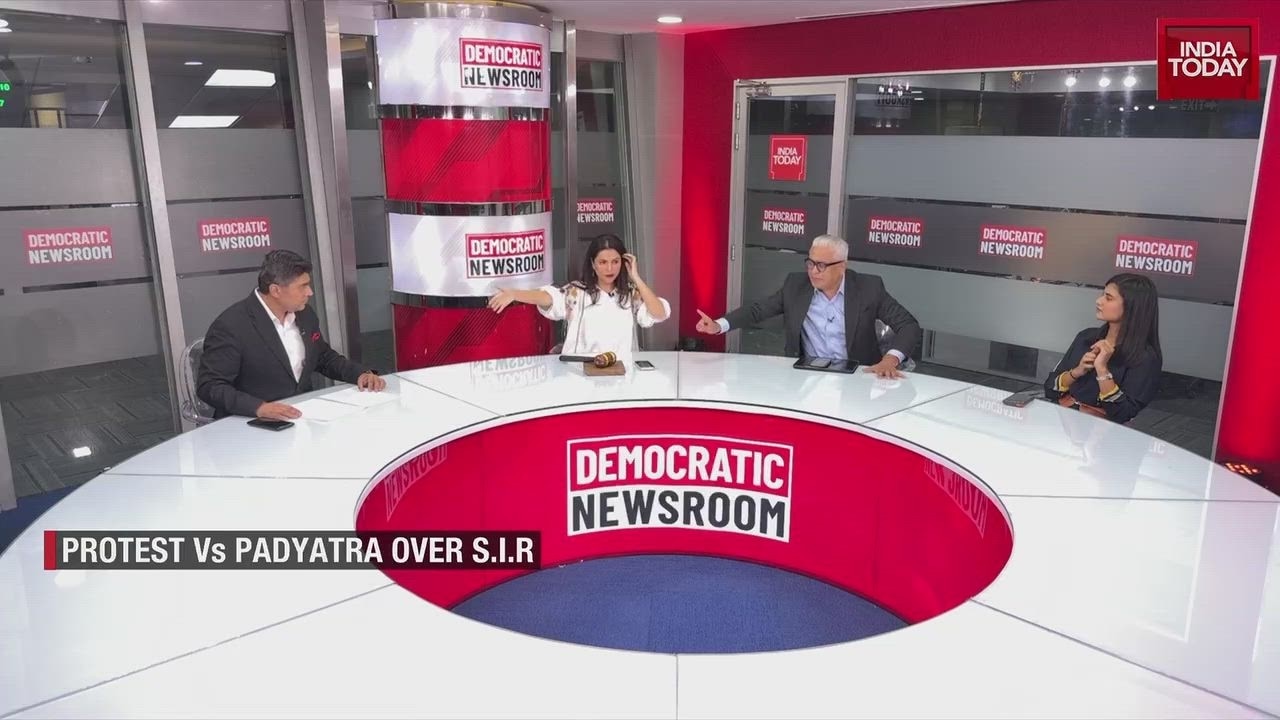
The editors debated whether the Opposition's campaign against SIR has gained electoral traction, prompted corrective action and improved scrutiny of voter rolls, while examining the roles of the Election Commission, courts and political parties.Democratic Newsroom: Opposition protests and the SIR campaignNew Delhi, Oct 30, 2026 10:56 ISTLast UpdatedOct 30, 2026 10:56 IST Published byIndia Today Web Desk Oct 30, 2026 10:56 ISTThe latest episode of Democractic Newsroom examines whether the Opposition’s campaign over the Special Intensive Revision, or SIR, is gaining traction. Preeti Choudhry moderated the discussion around the political build-up towards what the Opposition expects to be a major rally on November 1.
She asked whether the campaign had worked electorally, whether the attention surrounding it had prompted institutional responses, and whether SIR needed to be linked with a more relatable livelihood concern before it could become a persuasive political issue.The roundtable was moderated by Preeti Choudhry, Managing Editor, India Today TV. She was joined by Rajdeep Sardesai, Senior Journalist & Consulting Editor; Gaurav C Sawant, Managing Editor, India Today TV; and Akshita Nandagopal, Senior Editor, India Today TV.
Together, the four editors approached the controversy through electoral data, campaign strategy, voter awareness, constitutional responsibility and institutional accountability, while also challenging one another over whether courts, the Election Commission or political outcomes should provide the decisive test.The discussion distinguished between a campaign’s ability to generate attention and its capacity to influence votes. Participants considered acknowledged flaws and subsequent changes in the SIR process, the Opposition’s demand for accountability from the Chief Election Commissioner, and the Election Commission’s obligation to address concerns.
They differed over whether disputes should primarily be resolved by courts or through greater public communication by the poll body. The panel also debated voter eligibility, deletions from electoral rolls, constitutional morality and the limited value of smaller elections as evidence of a wider political shift.Preeti Choudhry Managing Editor, India Today TVFor SIR to become electorally effective, the Opposition must connect alleged voting irregularities with a bread-and-butter concern that citizens experience directly, much as reservation gave constitutional anxieties a material dimension in 2024.
Smaller elections cannot conclusively establish a national trend, but setbacks among educated urban voters deserve attention. Beyond party politics, the Election Commission should publicly answer bona fide journalistic questions, explain disputed deletions and demonstrate constitutional morality instead of relying only on one-way communication or leaving every concern to the courts.Rajdeep Sardesai Senior Journalist & Consulting EditorThe Opposition’s campaign has succeeded in creating attention and sustained scrutiny, although its ability to deliver votes remains uncertain.
Its more important consequence is the Election Commission’s quiet course correction, including greater assistance, verification and safeguards against mass deletions. Success should therefore be tested through constitutionality, not merely electability.
Every eligible Indian must retain the right to vote, and both the Election Commission and constitutional courts must ensure free and fair elections. Democratic safeguards deserve attention even when they are not conventional livelihood issues.Gaurav C Sawant Managing Editor, India Today TVVoters must decide whether the Opposition’s SIR allegation has political force, while courts must determine legality.
Journalists should report verifiable facts rather than pronounce verdicts. Statements from Congress leaders in states where revision exercises were conducted complicate the party’s wider charge, and recent electoral outcomes do not establish that its campaign has worked.
The Election Commission need not behave like a political party in answering every allegation. Disputes belong before courts, and voter protection must extend to eligible Indians without permitting ineligible foreign nationals to vote.Akshita Nandagopal Senior Editor, India Today TVOnline attention does not necessarily mean that rural voters understand the details of SIR, Form 6 or Form 7, and the campaign’s electoral effect remains unclear.
Flaws were raised, reported and followed by course correction, but turning the entire campaign into a demand for the Chief Election Commissioner’s resignation creates an uncertain endgame. If reform, disclosure and transparency are achievable, they offer measurable outcomes; personalising the issue means the agitation must continue until that individual leaves office.
Judicial proceedings also provide a non-political forum for resolving disputes.- Ends