


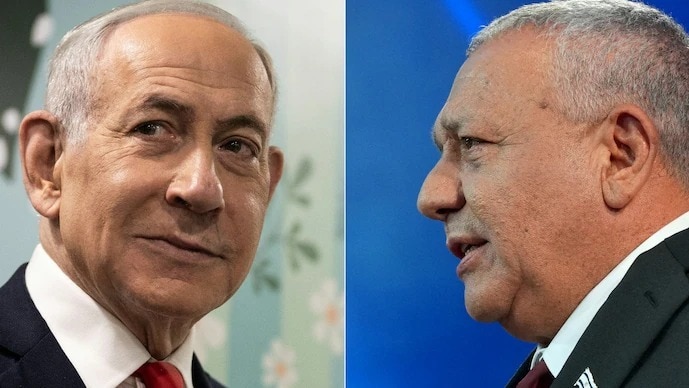
As negotiations to form a new government continue in Israel, opposition leader Gadi Eisenkot is making fresh moves to dismantle key parts of Prime Minister Benjamin Netanyahu's political agenda, with his camp gaining momentum in parliament. A crucial test is approaching in the Knesset, where lawmakers are expected to vote for a new parliamentary speaker who could help the opposition reverse some of Netanyahu's most controversial legislation.Eisenkot, a former Israeli army chief who is seeking to replace Netanyahu, has backed Matan Kahana for the powerful parliamentary post.
According to local media, Kahana appears to have the support of a majority of lawmakers in the 120-member Knesset, which potentially gives the opposition an early advantage before a new government is even formed.Israel's political deadlock following the October 27 election has left the country without a clear path to a new government. Neither Netanyahu's bloc nor Eisenkot's opposition secured the 61 seats needed for a majority, giving Eisenkot up to six weeks to negotiate with potential allies as Netanyahu remains caretaker prime minister.EISENKOT MOVES TO TAKE CONTROL OF KNESSETThe election of a new Knesset speaker could become an important early victory for Eisenkot's camp.
The speaker oversees parliamentary proceedings, administers legislative business and can influence which proposals receive priority. Eisenkot's candidate, Kahana, is a former cabinet minister who served in the Israeli military for nearly three decades.
He belongs to Eisenkot's centrist Yashar party and is being positioned as an alternative to the incumbent speaker, Amir Ohana, a close ally of Netanyahu from the Likud party.Netanyahu's camp has nominated Ofir Katz for the position, setting up a contest that could reveal how firmly the opposition parties are prepared to unite against the outgoing prime minister. Sixty-seven lawmakers signed a petition last week seeking Ohana's replacement, while Eisenkot's opposition bloc secured 48 seats in the election.
The two main Israeli Arab political groups, which together represent another 19 lawmakers, are also opposed to Netanyahu.Eisenkot has praised Kahana as the candidate who can restore credibility to the legislature."...will restore the Knesset's dignity after years of divisive, inflammatory rhetoric," Eisenkot said on X. If elected, Kahana could retain the position even if Netanyahu manages to form the next government or Israel heads towards another election, unless he chooses to step down.NETANYAHU'S JUDICIAL OVERHAUL IN THE FIRING LINEOne of the biggest targets of Eisenkot's campaign is Netanyahu's controversial judicial overhaul, which triggered widespread protests across Israel after being introduced in early 2023.
The proposed changes sought to curb the power of the judiciary and alter the balance between Israel's government, parliament and courts. Critics argued that the reforms threatened democratic checks and balances and could weaken judicial independence.Many opponents also viewed Netanyahu's push as an attempt to reduce the legal pressure on him as he faced corruption charges.Eisenkot's Yashar party has already introduced legislation seeking to reverse parts of the judicial overhaul.
A speaker sympathetic to the opposition could help the party advance those proposals through parliament.Another major demand is an independent state commission of inquiry into the October 7, 2023, Hamas attack, which caught Israel's security establishment off guard and triggered the war on multiple fronts.Netanyahu has resisted calls for the proposed state commission, favouring a narrower investigation involving representatives from rival political camps. Eisenkot, however, wants a formal inquiry with the authority to examine the failures that preceded the attack.EISENKOT ATTACKS NETANYAHU OVER DEMOCRACYThe confrontation has become increasingly bitter.
Eisenkot accused Netanyahu and his associates of threatening Israeli democracy. On Sunday, the former army chief declared that Netanyahu "cannot remain at the head of the government for a minute longer", following reports of alleged electoral interference involving an aide to the caretaker prime minister.His remarks came just hours after representatives of the two leaders met to discuss the possibility of forming a national unity government."The behaviour of the outgoing prime minister, Benjamin Netanyahu, and his entourage constitutes a concrete, direct and immediate threat to Israeli democracy," Eisenkot said.The opposition has accused Netanyahu's camp of attempting to undermine the legitimacy of Arab political parties and cast doubt on the election results to retain power.
Netanyahu, meanwhile, had appealed to Eisenkot on Saturday to join him in a national unity government. Eisenkot rejected the overture, accusing the prime minister of playing "tricks" and fuelling political tensions.ARAB PARTIES HOLD THE KEYEisenkot's possible path to power depends partly on support from Israel's Arab political parties, particularly the Joint List and Ra'am, which have indicated their willingness to back him.
The former army chief has sought to build bridges with Arab citizens, rejecting attempts to portray them as outsiders to Israeli politics."Arab citizens of Israel are an integral part of the Israeli story," he said late last week."The prime minister of Israel is the prime minister of all its citizens, including those who did not vote for him," he added.The Joint List won 11 seats in the 120-member Knesset, while Ra'am secured eight, which giving the two Arab parties a combined strength of 19 seats.- Ends