


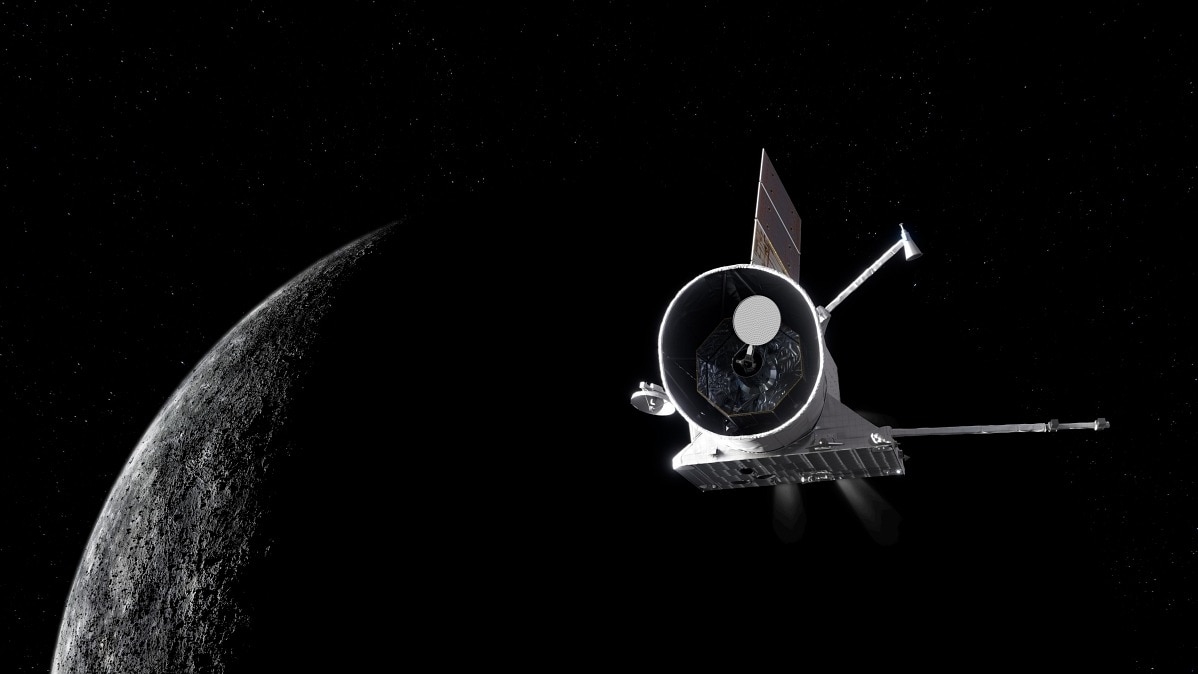
BepiColombo has achieved orbital capture around Mercury after its journey through the inner Solar System. The milestone clears the way for two orbiters to begin complementary scientific investigations.The spacecraft will study the planet's magnetic environment and how it interacts with charged particles streaming from the Sun.
Humanity's latest messenger to Mercury has reached a historic milestone. The European-Japanese BepiColombo spacecraft has achieved orbital capture around the Solar System's smallest planet, marking a major step towards its long-awaited scientific mission to study the mysterious world.In an update shared on social media, the BepiColombo team confirmed that the spacecraft had re-established contact with ground controllers and that flight dynamics teams at the European Space Operations Centre (ESOC) had verified its successful orbital capture around Mercury."We've heard back from Bepi," the mission team said, adding that engineers were assessing the telemetry received from the spacecraft.
The team said it would share another update early next week outlining the upcoming steps.We've heard back from Bepi - the spacecraft is now in contact with the ground and the teams at ESOC are busy assessing the telemetry. Flight Dynamics already has confirmed it achieved orbital capture around Mercury!
Early next week we'll share the next update with the upcoming steps.— BepiColombo (@BepiColombo) November 22, 2026The milestone marks the culmination of an extraordinarily challenging journey through the inner Solar System, bringing the spacecraft closer to unlocking the secrets of Mercury. WHAT IS THE BEPICOLOMBO MISSION?Launched on October 20, 2018, BepiColombo is a joint mission of the European Space Agency (ESA) and the Japan Aerospace Exploration Agency (JAXA).
It is designed to conduct the most comprehensive investigation yet of Mercury, a planet that remains poorly understood despite being Earth's closest planetary neighbour in terms of orbital proximity to the Sun.The spacecraft travelled for more than eight years through the inner Solar System, covering billions of kilometres and performing multiple planetary flybys to adjust its trajectory. The mission is named after Italian mathematician and engineer Giuseppe (Bepi) Colombo, who made important contributions to understanding Mercury's orbital motion.
Graphic: ESA What makes the mission particularly special is that it carries two scientific orbiters that will eventually operate around Mercury simultaneously.Mercury Planetary Orbiter (MPO): Developed by ESA, it will investigate Mercury's surface, internal structure, composition and geological history.Mercury Magnetospheric Orbiter (Mio): Developed by JAXA, it will investigate Mercury's magnetic field, magnetosphere and interaction with the solar wind.Together, the two spacecraft will provide scientists with complementary observations of the planet from different orbital perspectives.WHAT WILL BEPICOLOMBO INVESTIGATE?Mercury is one of the most unusual planets in our Solar System. Despite being the smallest, it has an unusually large iron-rich core, a weak magnetic field and an extremely thin atmosphere known as an exosphere.Scientists hope BepiColombo will answer several long-standing questions.The mission will investigate the planet's internal structure and composition to understand how Mercury formed and evolved.
An image of Mercury taken by Bepicolombo. Despite temperatures soaring on its sunlit surface, permanently shadowed craters near Mercury's poles could contain water ice.
BepiColombo will investigate these regions.The spacecraft will study the planet's magnetic environment and how it interacts with charged particles streaming from the Sun.Its instruments will map the surface, examine minerals and investigate ancient impact craters and volcanic features.WHAT HAPPENS NEXT?The orbital capture on November 21 is only the beginning. The two orbiters are currently travelling together in a stacked configuration.According to ESA's mission timeline, they are scheduled to separate on December 9-10, 2026.
Following further manoeuvres, both spacecraft will enter their designated science orbits, with scientific operations expected to begin in April 2027.BepiColombo will effectively give humanity two sets of eyes around Mercury, helping scientists understand not just the planet itself but also how rocky worlds evolved close to their stars- Ends