


Vallari Sheel wishes she could carry a camera or a pair of binoculars without being asked what her father does for a living. Once, looking at a tree in her south Delhi neighbourhood, about 50 metres away from her home, a man in a car screamed at her: “You have been clicking photos here for 10 days.
What are you going to do with them?”Sheel, an urban ecologist, spends hours observing trees of all types in all seasons. She often travels by car for her own safety, worries about the impact of her work on her family, and has clear guidance for her female interns when they are, inevitably, approached: don’t engage, don’t respond.“It’s the men who ask such intrusive questions: Who are you?
Where are you from? What does your father do?” she says.Sheel was recounting these experiences atop Delhi’s oldest fort inside Sanjay Van, a sprawling city forest overlooking a 12th-century minaret.
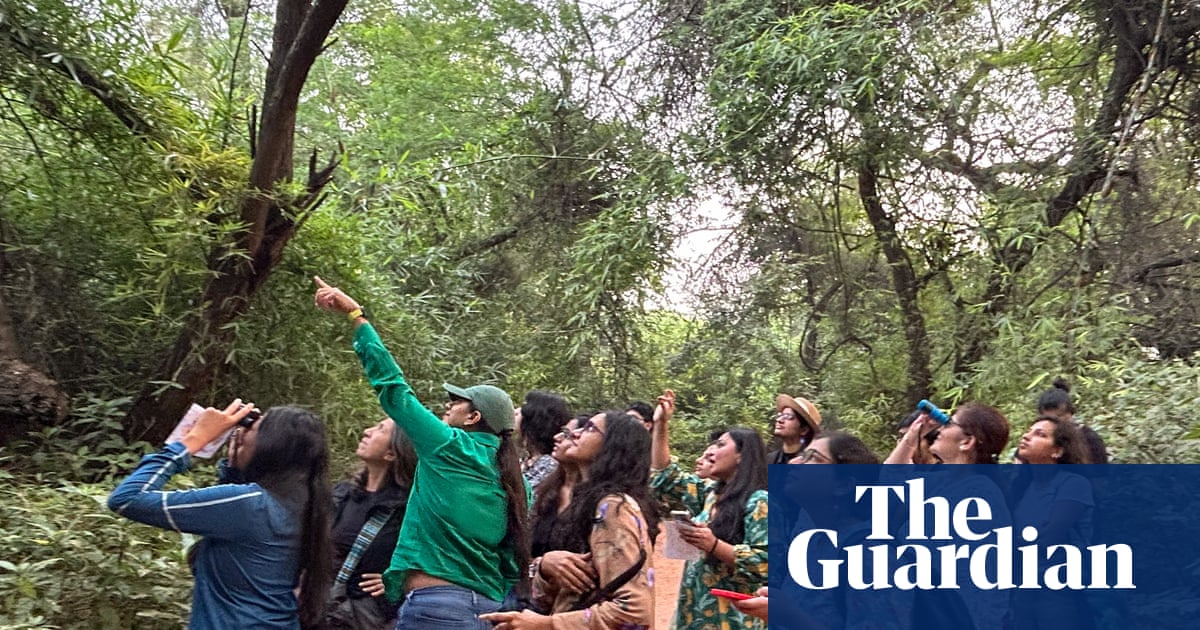
She was one of about 20 women who had gathered on a crisp Sunday morning in October to enjoy nature, safely. Many had never experienced a forest before.‘Men can pee on the road and we can’t even carry a camera’ – Delhi women discuss their lack of freedoms Photograph: Romita SalujaAmong the group were a scientist who had stopped birding since she moved to Delhi, a psychiatrist who can’t find a safe place to run, and an environmental planner who cycles everywhere.
For many women, simple pleasures such as enjoying nature have become beset by gender crimes.“The city feels designed to crush any form of freedom, any form of exploration,” says Neha Sinha, who organised the walk. Author of My Wild City: Finding Nature, Meaning, and Hope in India’s Capital, Sinha has been organising these walks for two years.During her own walks around the city’s forts, forests and wetlands to observe the diminishing number of fireflies, flying foxes, howling jackals, leopards and hyenas, civets and owls, and groves of 350-year-old trees, she has faced the wrath of men.
She has changed her route countless times to mislead stalkers, and been asked by men on the street how much she would charge for sex.“As has everybody else,” she says. “Nearly every woman I know has called a cop saying ‘I have a stalker.’ In a culture that tells you not to go out … how do you make nature your own?”Two weeks before the women gathered on the walking trails of Sanjay Van, dotted with ruellias, vajradantis and jaal trees, hundreds of people had joined a protest in Delhi over the gang-rape of a 17-year-old in a public park.Their demand was to make public spaces safer for women. The government’s response was to ban entry to public parks after sunset.For Alankrita Narayan, a wildlife conservation student who often needs to work alone at night, that rule was unhelpful.
During an internship, she recalls, her organisation trained her for worst-case scenarios in the jungle: What if something happens to your partner? What if you encounter a man carrying a weapon?
What if you encounter a forest officer asking for sexual favours?The women might hear jackals, owls and frogs on their walks. Photograph: Romita Saluja“And I was like, where did the animal come in here?
What if I’m caught alone and a leopard comes in front of me? And they were like, ‘Oh, don’t worry about the leopard.
It’s a man you don’t want to run into,” she says. Sinha agrees: “Animals have rules.”Paroma Mukherjee, a photographer, recalls the advice she once got from a well-known photographer: be inconspicuous, wear clothes that blend in, keep your equipment small. “But then, he was a man.
So he could blend in,” she adds.skip past newsletter promotionafter newsletter promotion“Men can pee on the road and we can’t even carry a camera,” another woman says. “You know, we had to take a detour today to avoid a lonely stretch on our way here,” says another. “I carry a pepper spray,” another adds.On group walks, the women pick up and drop off each other at their homes, wait outside the forest gate until everyone has arrived, and stick together in isolated areas. “I always tell women, ‘Don’t go alone’,” Sinha says.“We started the walk at 7am today, which is late for birdwatching, but everybody could not leave home while it was still dark,” she says.However, the group agree that many of these measures might not work for women from less privileged backgrounds, who then miss out.“No woman in the city is fully free,” Sinha says.Walking as a woman is an act of resistance, as is observing nature. “Because you’re actually slowing down when you do that,” she says. “It’s so different from the instant gratification culture that we have today. It is more of an immersion, rather than conquering.
Both are very political acts.”Walking is an ‘act of resistance’ for many of the women. Photograph: Romita SalujaIn the heart of New Delhi, where India’s senior officials and dignitaries live, there are thousands of fruit bats that swarm out of their roosts every evening to feast on mahua trees.“And on very clear wintry nights, when everything is silent, I even hear jackals crying and laughing from my home.
It’s almost like a parallel city,” Sinha says.Over three hours, the women collect cuttings, peer and marvel at speckle-like flowers through a pocket microscope, discuss the colonial concepts of wild plants labelled as weeds, chat about the drongo, black kite and tailorbird they spotted, and the next walk.“Can we do it at night?” someone asks. “What would the forest look like at night?”Sinha describes a previous night walk experience when frogs had put up an orchestral noise, fireflies lit the bushes and jackals were laughing. “It was the most eerie, magical, bewitching atmosphere I have ever experienced,” she says.Men, she points out, can simply go ahead and enjoy such experiences, but women have to create an ecosystem around them to be able to.But, she promises her enthusiastic group, she will try to arrange a night walk.