


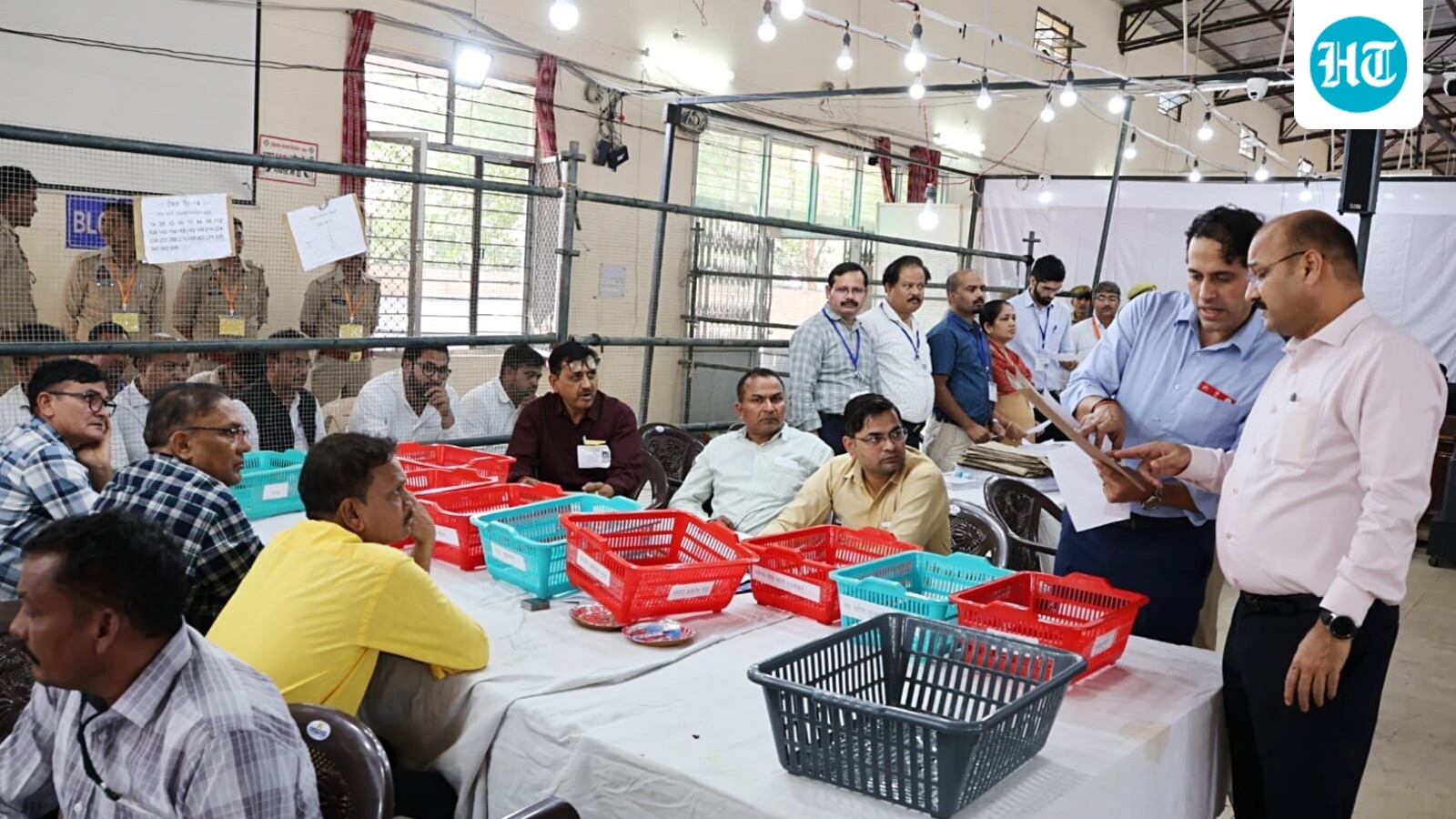
The counting of votes for the Darbhanga Graduates’ constituency in the Bihar Legislative Council elections stretched to 57 hours, with the Election Commission of India (ECI) clearing the result at around 9pm on Thursday, officials said.Rashtriya Janata Dal (RJD) candidate Anil Kumar Jha defeated sitting BJP MLC Sarvesh Kumar by 4,010 votes in a contest that saw fortunes fluctuate through several rounds of counting. (ANI/Representative)The three-day exercise was the longest among the eight constituencies – four each of Teachers’ (Patna, Darbhanga, Tirhut and Saran) and Graduates’ (Patna, Darbhanga, Tirhut and Kosi) that went to polls on October 23.Rashtriya Janata Dal (RJD) candidate Anil Kumar Jha defeated sitting BJP MLC Sarvesh Kumar by 4,010 votes in a contest that saw fortunes fluctuate through several rounds of counting. Jha polled 25,406 votes against Kumar’s 21,396.
Mohammad Imteyaz of Jan Suraaj Party (JSP) polled 12,823.None secured winning quota in first-preference votesThe prolonged count was largely due to the presence of 40 candidates — the highest among the eight constituencies — and the fact that none secured the prescribed winning quota through first-preference votes.“The victory margin may look simple, but deciding the winner was not as easy as it appeared,” Kaushal Kumar, district magistrate of Darbhanga, told Hindustan Times.Also Read: Bihar MLC polls: BJP wins 2 seats, loses Patna stronghold; Prashant Kishor's party wins in Darbhanga“Elections to the Legislative Council’s Teachers’ and Graduates’ constituencies are held under the proportional representation system through the single transferable vote (STV) method. A candidate must secure a prescribed quota of votes to be declared elected.
The winning quota is calculated by dividing the total valid votes by two and adding one. With 63,820 valid votes in Darbhanga Graduates’ constituency, the winning quota was 31,911,” Kumar added.Candidates eliminated, preference votes transferred to othersAs no candidate in the Darbhanga Graduates’ constituency reached the winning quota through first-preference votes, the counting went through the elimination process in which candidates were eliminated one by one, beginning with the lowest tally and their second-preference votes were transferred to the remaining candidates.
Once transferred, the votes of the remaining candidates were retotalled, and again, the candidate with the lowest tally was removed while their second-preference votes were transferred to the remaining candidates.The process is repeated, with candidates eliminated one by one and their preference votes transferred to the remaining candidates until any candidate reaches either the winning quota or the contest narrows only to the top three contenders.Also Read: Bihar MLC election results: BJP’s Narendra Prasad Singh wins Tirhut Teachers’ seat“In this case, 37 of the 40 candidates were eliminated, and yet none achieved the winning quota, finally leaving BJP’s Sarvesh Kumar, RJD’s Anil Jha and Mohammad Imteyaz of the Jan Suraaj Party (JSP) in the fray by the process of elimination. At this stage, Kumar led by 1,004 votes until the third-placed Imteyaz’s second-preference votes were transferred to Kumar and Jha, the remaining two leading candidates.
The transfer of Imteyaz’s preference votes gave Jha a lead of 533 votes over Kumar to secure a victory,” Kumar said.The subsequent transfer of preference votes of Kumar to Jha established the latter’s victory margin at 4,010 votes.Why the count took so longHandling ballot papers bearing the names of 40 candidates was a major logistical challenge. Officials had to mix the ballots to ensure booth-wise identification was not possible, arrange them in bundles – 25 ballot papers in a lot of 20 bundles for each of the 14 counting tables – and keep them in separate, secure containers, officials familiar with the matter said.The constituency had 138 polling booths and 14 counting tables.
The first nine hours after counting began at 8am on October 27 were spent arranging the ballot papers, an official familiar with the process said. Each of the 10 counting rounds took an average of three hours, accounting for another 30 hours to clear valid votes and count them, before the elimination process began, the official added.Result delay triggers protestsThe delay caused impatience and triggered protests by counting agents of political parties on the counting campus.
The district administration arrested five people on Wednesday following the disturbance. “They were later released on personal bonds the same evening,” district magistrate Kumar said.RJD leader Tejashwi Yadav alleged on Thursday that the Election Commission was attempting to secure a BJP victory despite the RJD candidate being ahead. In a post on X, he claimed that 10% of votes had been declared invalid and alleged irregularities during the 56 hours of counting.
The allegations could not be independently verified.In a Facebook post, another RJD MLC used abusive language against the DM and called the EC corrupt, while crediting the RJD for an emphatic win.A victorious Jha, however, gave the district officials a clean chit. “Counting (of votes for MLC polls) is process-driven, which usually takes an average 36-40 hours. There was nothing unusual about it.
Officials of the district administration cooperated and conducted it smoothly in a well coordinated manner,” Jha said.The district magistrate said the process had taken a personal toll. “I didn’t sleep for the last three days. It hurts when people run you down on social platforms, attributing motive and casting aspersions on your integrity due to the delay in counting and announcement of the result, without actually knowing the facts,” Kumar said.Ballot validityA voter must mark ‘1’ against only one candidate to indicate the first preference.
Subsequent preferences — ‘2’, ‘3’ and so on — are optional. Preferences can be indicated using international numerals, Roman numerals or numerals in any Indian language, but not in words or through ticks.The preference figures must be clearly marked in the space provided against the candidates’ names.
A ballot paper is invalid if the first preference is missing or unclear, or if the figure ‘1’ is marked against more than one candidate, or if multiple preferences are marked against the same candidate. Ballots carrying any mark or writing that could identify the voter, including a signature or name, are also liable to be rejected.Of the 69,141 votes polled for the Darbhanga Graduates’ constituency, 5,321 were declared invalid, leaving 63,820 valid votes.
The constituency, which has around 1.28 lakh voters, recorded a turnout of 54.73% on October 23.