


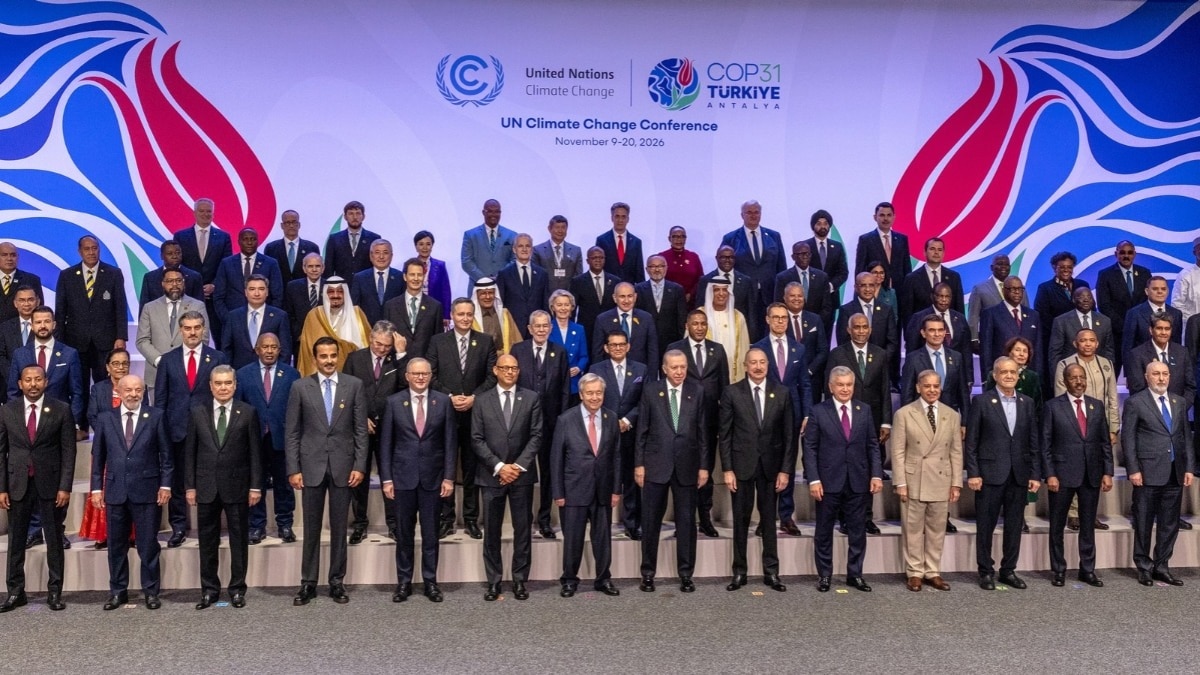
The United Nations climate talks in Turkiye collapsed on Sunday without an overarching agreement after deep disagreements over whether to explicitly mention fossil fuels, the primary cause of global warming, in the final text. The European Union and several other countries rejected the proposed deal, saying it was too weak to advance the fight against climate change.The two-week negotiations, known as COP31, continued nearly 48 hours beyond their scheduled conclusion, making them the longest COP on record.
However, countries failed to reach a consensus on a main agreement, known as a cover decision, amid irreconcilable differences over fossil fuels, climate finance and other contentious issues.Expectations had already been low heading into the negotiations. However, disagreements over explicitly mentioning fossil fuels and providing financial support to developing countries ultimately prevented governments from reaching an overarching agreement.Turkey's conference president Murat Kurum announced at the closing plenary that there was no agreement and ruled out presenting any fresh draft. "There is nothing to do, we did all that we could," he said. "There will be no new text from now on."Kurum later left the stage while representatives from various countries were delivering their speeches.
Australia's COP31 President of Negotiations, Chris Bowen, described the outcome as "very disappointing", identifying disagreements over fossil fuels and climate finance as the main dealbreakers.The European Union, along with several countries, refused to accept the final proposal put forward by the joint Turkish-Australian leadership because it did not explicitly mention fossil fuels. A considerably larger number of countries, however, accepted the proposal, often reluctantly, arguing that reaching some form of consensus was more important.Ireland's Environment Minister Darragh O'Brien, speaking on behalf of the European Union, criticised the absence of any reference to fossil fuels in the proposed agreement."It is unconscionable that we would have a climate act that makes no reference to fossil fuel, no reference to transitioning away from fossil fuels," he said.Panama also rejected the proposed text, arguing that it failed to address the scale and urgency of the climate crisis.
Belgium's Climate Minister Jean-Luc Crucke described the failure to reach an agreement as a difficult but appropriate outcome."It's not the end of multilateralism, but there has to be courage to say no," he said.FOSSIL FUEL DIVISIONS DERAIL CLIMATE AGREEMENTFossil fuels remained one of the biggest sticking points throughout the negotiations, with Saudi Arabia and other major oil-producing countries lobbying against their inclusion in the final document, according to observers at the summit.For most of the first 25 years of UN climate negotiations, agreements did not explicitly mention fossil fuels. That changed three years ago at a summit in the oil-rich United Arab Emirates, where countries reached a groundbreaking agreement calling for a "transitioning away from fossil fuels".However, subsequent agreements have not explicitly mentioned fossil fuels.The Turkish-Australian proposal referred to the Dubai agreement in its entirety, but that failed to satisfy the European Union and several other countries, which wanted a clear commitment to moving away from fossil fuels.The failure to reach an agreement marked a setback for international efforts to strengthen climate action.
The last time UN climate talks failed to adopt a deal accepted by all countries was in Copenhagen in 2009.This year's summit was also the first since the UN's environmental body confirmed in October that global temperatures were on course to exceed the 1.5-degree Celsius (2.7-degree Fahrenheit) threshold. Countries had agreed at the Paris climate talks more than a decade ago to try to prevent temperatures from crossing that limit, beyond which extreme weather impacts intensify.The breakdown in negotiations also reflected the difficulties governments faced this year in committing to more ambitious climate action as wars, economic pressures and other crises competed for their attention.CLIMATE FINANCE, CARBON REMOVAL EMERGE AS OTHER STICKING POINTSApart from fossil fuels, disagreements over climate finance and carbon-removal technologies further complicated the negotiations.The proposed agreement acknowledged that global temperatures were projected to overshoot the agreed threshold and called for faster development of carbon-removal technologies to eventually reverse the increase.Scientists say removing carbon dioxide from the atmosphere, alongside steep cuts in emissions, is essential to avoiding the worst consequences of climate change.
However, critics of the proposed agreement warned that the emphasis on carbon removal could allow countries to continue extracting and burning fossil fuels instead of reducing emissions.The proposal's carbon-removal language also drew criticism from those concerned that it could provide oil-producing countries with a justification to continue pumping oil.A representative of the Saudi delegation, which supported the proposal's reference to carbon removal, told the closing plenary that he was surprised by the resistance to the technology, which he described as a concrete solution.Developing countries also criticised the proposed agreement for failing to provide sufficient new climate finance to help them adapt to rising temperatures.The draft called for a threefold increase in such financing but did not specify the baseline against which the increase would be measured.Another contentious proposal came from Turkey, which sought to increase electricity's share of total final global energy consumption to 35 per cent by 2035, from around 23 per cent currently.Supporters argued that the target could help reduce greenhouse gas emissions by accelerating the transition away from fuel-powered cars, furnaces and other equipment. Critics, however, warned that it could impose additional costs on poorer countries without establishing a clear pathway away from fossil fuels.- Ends