


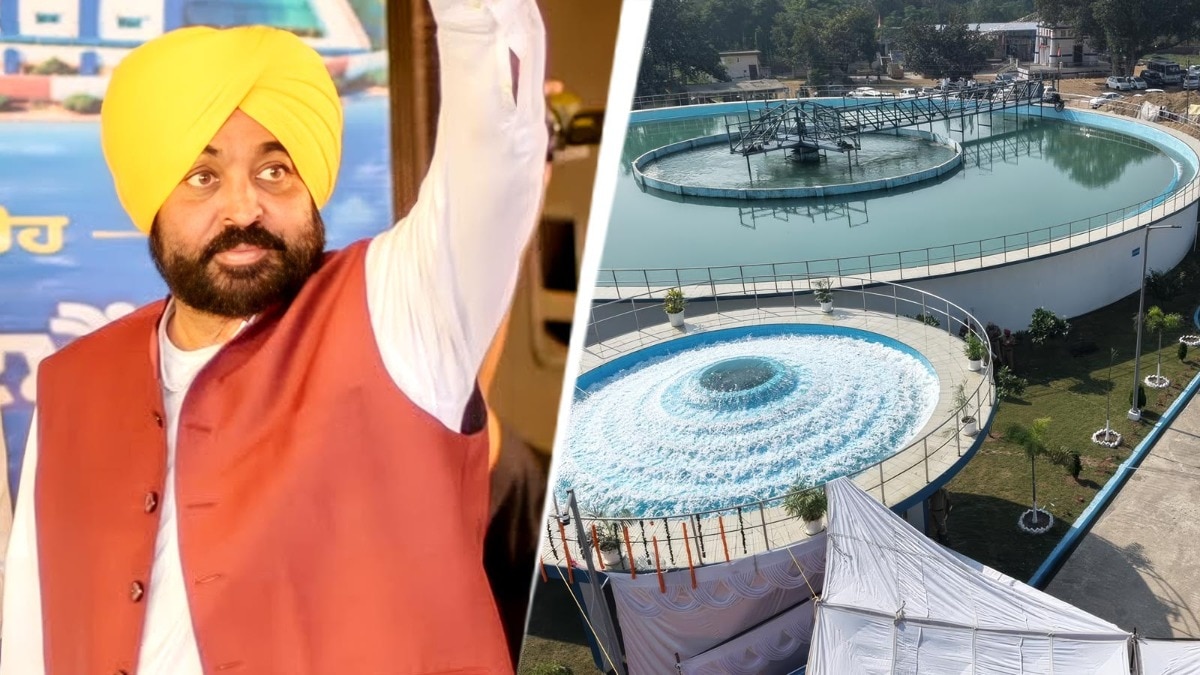
Punjab Chief Minister Bhagwant Mann on Monday inaugurated two water treatment plants in Patiala, built at a cost of Rs 432.65 crore, which will supply clean canal water daily to over 4.5 lakh people across 316 villages and help tackle groundwater contamination.Mann dedicated the two water treatment plants, located at Mandoli and Pabri in Ghanaour constituency, to the people. The project, built at a cost of Rs 432.65 crore, will supply treated canal water daily to around 75,000 households across five Assembly constituencies – Ghanaour, Rajpura, Sanour, Patiala Rural and Shambu Kalan.The plants have a combined treatment capacity of 69 million litres per day and will distribute water through a 752-kilometre pipeline network.
Designed to meet the region's drinking water needs until 2049, the infrastructure is expected to address contamination, including excessive fluoride and heavy metals, officials said.The Mandoli plant has been built at a cost of Rs 266.20 crore, while the Pabri facility cost Rs 166.46 crore. Addressing a gathering after inaugurating the facilities, Mann said the project would provide a permanent solution to the problem of contaminated drinking water in the villages."Today, dedicated two new water treatment plants built at a cost of Rs 432 crore to the people in Patiala.
Now, 316 villages across five Assembly constituencies and 75,000 households will receive clean canal drinking water every day," he said, adding that public health remained the state government's priority. Mann said it was unfortunate that residents of these villages had been deprived of safe drinking water even decades after Independence.
The government had taken up the long-pending task of ensuring access to clean water for thousands of families, he added.The project also comes amid growing concerns over groundwater depletion in Punjab. According to the state government, groundwater extraction in Punjab stands at 156.36 per cent of its natural recharge capacity.The situation is particularly serious in Patiala, where groundwater extraction has reached 1.89 billion cubic metres (BCM), against an annual recharge of 1.01 BCM.
The extractable groundwater limit is estimated at 0.9 BCM, putting the exploitation level at around 208 per cent.The government has also identified excessive levels of fluoride and heavy metals, including aluminium, lead, sulphate, arsenic and uranium, in groundwater across the 316 villages. The new canal-based supply system is aimed at reducing dependence on contaminated groundwater and providing residents with a safer source of drinking water.- Ends(with inputs from PTI)