


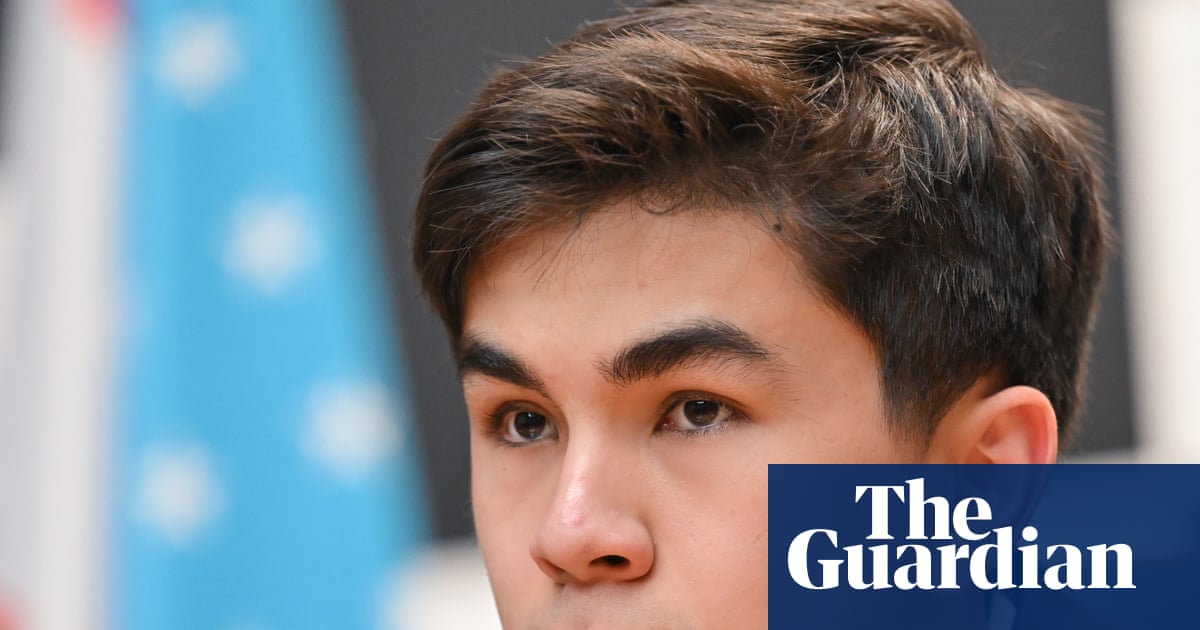
Javokhir Sindarov has a problem. The fast-rising 20-year-old Uzbek grandmaster, who is challenging for the world chess championship over the next three weeks in Switzerland, can’t stop playing for keeps.
Even when he is off the clock and meant to be relaxing with friends, a compulsion to win takes hold. His preferred escape is Counter-Strike, the tactical first-person shooter that has become one of the world’s most popular esports.
But he also plays EA Sports FC (née Fifa), the all-conquering soccer kickabout, and approaches both with the same seriousness of purpose that has propelled him toward the pinnacle of his day job.“I’m the guy who can’t play games just for fun,” Sindarov tells the Guardian less than 48 hours before Tuesday’s world championship opener in Geneva, smiling at the absurdity of it. “If I play something, I always try to learn, trying to become better.”That means poring over Counter-Strike tactics and watching YouTube tutorials before joining in with his mates. There is, it appears, no such thing as a casual game in Sindarov’s world, much less a friendly. “I always like to beat my friends,” he says. “I watch some video lessons and then come and beat them after some tournaments.
I think the best thing is to beat your friends in some game.”Quick GuideWorld Chess Championship 2026ShowThe playersIndia’s Gukesh Dommaraju is defending his world chess championship against fast-rising Uzbek grandmaster Javokhir Sindarov in the youngest world title match in chess history. The best-of-14-games contest is set to take place from 24 November to 12 December at the Fondation Martin Bodmer in Cologny, overlooking Lake Geneva, with both players aged 20 when the first move is played.Gukesh became the youngest undisputed world chess champion in history when he defeated China’s Ding Liren in December 2024, aged 18, shattering the previous record held by Garry Kasparov, who was 22 when he dethroned Anatoly Karpov in 1985.
An aggressive player known for creating sharp, tactically complex positions aimed at unsettling opponents, the Chennai-born grandmaster has struggled badly for form since winning the title, plummeting to No 26 in the world rankings from a career-high No 3 after an extended string of underwhelming performances, raising doubts over his chances of retaining the crown in his first title defense.Sindarov, roughly six months older than Gukesh, stunned the chess establishment with a commanding performance at this year’s eight-man Candidates tournament in Cyprus, finishing unbeaten with six wins and eight draws against a stacked field that included Fabiano Caruana, Hikaru Nakamura and Anish Giri. Known for his cool-headed precision and ability to mine advantages from seemingly quiet positions, the Tashkent-born grandmaster has climbed into the world’s top five after a breakthrough year that included winning the 2025 Fide World Cup in Goa.
He is the first player from Uzbekistan to challenge for the world championship.The formatThe match consists of 14 classical games, with one point awarded for a win and a half-point for a draw. The first player to reach 7½ points wins the title.
Each player has 120 minutes for the first 40 moves, followed by 30 minutes for the remainder of the game, with a 30-second increment per move starting at move 41. Players cannot agree to a draw before black’s 40th move.If the match is tied 7-7 after 14 games, a series of faster tiebreaks will decide the champion: first four rapid games (15 minutes plus 10 seconds per move), then two rapid games (10 minutes plus five seconds), followed if necessary by two blitz games (three minutes plus two seconds).
If still tied, single blitz games will be played, alternating colors, until one player wins.The scheduleSun 22 Nov Media day and opening ceremonyMon 23 Nov Media day and technical meetingTue 24 Nov Game 1 (Sindarov–Gukesh)Wed 25 Nov Game 2 (Gukesh-Sindarov)Thu 26 Nov Game 3 (Sindarov–Gukesh)Fri 27 Nov Rest daySat 28 Nov Game 4 (Gukesh-Sindarov)Sun 29 Nov Game 5 (Sindarov–Gukesh)Mon 30 Nov Game 6 (Gukesh-Sindarov)Tue 1 Dec Rest dayWed 2 Dec Game 7 (Sindarov–Gukesh)Thu 3 Dec Game 8 (Gukesh-Sindarov)Fri 4 Dec Game 9 (Sindarov–Gukesh, if necessary)Sat 5 Dec Rest daySun 6 Dec Game 10 (Gukesh-Sindarov, if necessary)Mon 7 Dec Game 11 (Sindarov–Gukesh, if necessary)Tue 8 Dec Game 12 (Gukesh-Sindarov, if necessary)Wed 9 Dec Rest dayThu 10 Dec Game 13 (Sindarov–Gukesh, if necessary)Fri 11 Dec Game 14 (Gukesh-Sindarov, if necessary)Sat 12 Dec Tiebreaks (if necessary) and closing ceremonyAll games start at 3pm local time, 2pm GMT, 9am on the US east coast and 7.30pm in India.Why isn't Magnus Carlsen playing?Norway's Magnus Carlsen holds the top position in Fide’s world rankings with a classical rating of 2823. The 35-year-old has been at No 1 for more than 16 years uninterrupted.
He was considered the best player on the planet even before removing all doubt against India’s Viswanathan Anand in their 2013 world title clash.Carlsen bolstered his claim as the greatest player of any era in 2021 when he crushed Russia’s Ian Nepomniachtchi in his fourth defense by a margin of four wins and no defeats, the most lopsided result in a world championship match since José Raúl Capablanca’s dismantling of Emanuel Lasker exactly 100 years prior. But he decided against defending it for a fifth time before the 2023 cycle, citing a lack of motivation to endure the months-long slog of preparation that world title matches demand.
The abdication marked only the second time in history that a holder voluntarily declined to defend his title after Bobby Fischer controversially forfeited the crown ahead of his scheduled 1975 match with Karpov in Manila.Instead, Ding outlasted Nepomniachtchi for the vacant title, even if critics including Kasparov branded it an “amputated” event without the world’s best player involved. Ding’s reign lasted only 593 days before Gukesh unseated him in Singapore in 2024, winning 7½–6½ to become the first teenager to win the sport’s biggest prize.Carlsen remains active at the highest level, though he’s increasingly shifted his focus away from classical chess toward alternative formats.
In February, he defeated Caruana 2½–1½ in Germany to win the Fide freestyle world championship, his 21st world title across classical, rapid, blitz and freestyle disciplines. Also known as Fischer Random or Chess960, the variation randomizes the starting positions of the pieces on the back rank, placing a premium on creativity over rote opening preparation.The prize moneyThe overall prize fund is $2.5m (£1.9m), unchanged from 2024.
Each player will receive $200,000 for each game won, including games won by forfeit. What’s left will be split equally between them.
If the winner is decided on tiebreakers, the champion receives $1.3m with the runner-up taking home $1.2m. The same split applies if the match finishes 7½–6½ with 13 decisive games or 8–6 with 14 decisive games.How to followThe Guardian will provide live move-by-move commentary, expert analysis and reaction throughout the three-week match.
Fans can also watch every game live on Fide’s official YouTube and Twitch channels.It is a revealing admission from a young man who has acquired a reputation for being uncommonly relaxed at the chess board. While many of the world’s elite players seem to carry the weight of every position on their shoulders – the viral clip of Sergey Karjakin agonizing for 25 minutes over a move during the 2016 world title match remains a cult classic in chess circles – Sindarov frequently gives off the impression of someone who is simply enjoying himself.
The easygoing mien of the sport’s happy warrior is a quality that has caught his opponent’s attention. “One thing I learned from Sindarov is that he seems to be so happy while playing chess,” Gukesh Dommaraju, the reigning world champion, said in an interview published last week.The observation is particularly notable coming from Gukesh, who has spoken candidly about the mental burden of holding the sport’s most coveted title. At 20, the Indian grandmaster is already a veteran of one world championship match, having become the youngest undisputed champion in history two years ago in Singapore.
Yet he has acknowledged buckling under the expectations that have followed since his triumph. “Clearly so far I’ve not been able to handle it in the best possible way,” Gukesh said.Sindarov, by contrast, sounds determined not to let chess consume his entire existence. “I’m trying to enjoy every moment, every game,” he says. “Probably compared with other chess players, I’m playing more chill.”The Tashkent native acknowledges that he can become intensely emotional, particularly when losing, but insists his generally sanguine disposition is no facade. It is something he cultivates through a life that extends well beyond the board.
He points to the work-life balances of fellow elite grandmasters Nodirbek Abdusattorov and Arjun Erigaisi, who he says devote enormous amounts of time to chess. “I would say I mostly work, but not too much, because I love to do more activities, to enjoy life,” he says. “So this actually helps me not to feel too much pressure in tournaments.”The contrast between the two men will form one of the more intriguing subplots when the $2.5m (£1.9m) world championship begins on Tuesday in the picturesque suburb of Cologny. Gukesh, the holder, and Sindarov, the challenger, are both 20, making this the youngest world championship pairing in the game’s history by some distance.
Their best-of-14-games contest, staged at the Fondation Martin Bodmer on the shores of Lake Geneva, will determine who carries the crown forward amid the accelerating shift toward a younger generation at the top of the sport.Tale of the tape: Gukesh Dommaraju v Javokhir SindarovFor Sindarov, the occasion represents the culmination of a journey that began when he first started playing at four years old. He has scarcely known a life that chess did not somehow inhabit, though he is quick to point out that his relationship with the game has changed substantially. “My whole life I’ve been playing chess,” says Sindarov, who will turn 21 on 8 December, the scheduled date of Game 12. “I’m happy that I chose this sport because, in my opinion, it’s the best sport, for me especially.”Part of the attraction is the lifestyle it affords and doors it has opened.
Chess has taken Sindarov around the world, exposed him to different cultures and allowed him to pursue a competitive career without the physical toll of more conventional sports. “You don’t get any injuries,” he says. “Psychological injuries – of course you can get those. But in general, you don’t get any injuries, and you see many, many new things.”Perhaps more telling is his admission that natural ability carried him a long way before he developed a genuine appetite for the punishing grind of study, memorization and repetition required to excel at the sport’s highest level.
A grandmaster at 12, making him the second-youngest in history at the time, Sindarov said at Sunday’s pre-match press conference that he had never worked seriously at chess until last year, when he was approaching his 20th birthday. “Before, I knew that I always had great talent, but I never worked,” he says. “But I started loving the work also.”Sindarov helped his country win its first Chess Olympiad gold medal in Chennai in 2022, when Uzbekistan went unbeaten against a field of 186 teams. Photograph: Arun Sankar/AFP/Getty ImagesWhat’s followed has been a meteoric ascent into the sport’s S-tier.
Ranked 25th in the world a year ago, Sindarov has rocketed to a career-high No 4 after a breakthrough 12-month stretch that included winning the Fide World Cup last November in Goa, followed by an imperious performance at this year’s Candidates Tournament in Cyprus, where he finished unbeaten with six wins and eight draws to turn back a stacked field that included longtime stars Fabiano Caruana, Hikaru Nakamura and Anish Giri. He enters the biggest match of his life on a tailwind of confidence, having won a four-player rapid tournament in St Louis three weeks ago over Nakamura, Caruana and Praggnanandhaa Rameshbabu, capped by a brilliancy against the world No 2 that showcased his tactical flair.That evolution has unfolded alongside the rise of a golden generation of chess talent in his native Uzbekistan.
The former Soviet republic of roughly 38 million people has emerged as a major force in the game, winning the biennial Chess Olympiad in 2022 and following it with bronze in 2024 before another gold on home soil last month. Sindarov belongs to a vanguard of young grandmasters – along with Abdusattorov, Shamsiddin Vokhidov and Nodirbek Yakubboev – whose collective success has transformed the central Asian nation’s standing in a sport long dominated by more traditional powers.Maybe it’s no accident a country that has dominated Olympic boxing over the past decade has become a powerhouse in another unforgiving one-on-one arena where combatants are avatars for wills.
Sindarov traces part of chess’s rise back home to the example of Rustam Kasimdzhanov, who captured Fide’s version of the world championship in 2004 during the sport’s era of competing titles, and inspired a generation of Uzbek kids to take up the game. He also credits substantial government support, which has given the country’s leading players access to elite coaching. “We have an extremely strong generation,” Sindarov says. “When [Kasimdzhanov] became world champion, it gave us big motivation, and most of the parents sent their children to chess.”The pride he takes in representing Uzbekistan extends beyond the board.
Sindarov is an avid FC Barcelona supporter and worshipper at the altar of Lionel Messi. He vividly remembers watching Argentina’s heart-stopping victory over France in the Qatar World Cup final on television, an experience that left him determined to attend the next tournament in person. “How stressful that game was!” he recalls. “After that, I said to myself, at the next World Cup, I will visit and support my country.”Javokhir Sindarov (left) and reigning world champion Gukesh Dommaraju stand on stage during the opening ceremony of the world chess championship at the United Nations’ European headquarters in Geneva on Sunday.
Photograph: Salvatore Di Nolfi/EPATrue to his word, he stepped away from his world championship preparations over the summer to travel to North America and watch Uzbekistan make their World Cup debut. Although the White Wolves’ results fell short of his hopes, he describes the trip as an unforgettable experience. “We didn’t play well, but it was a very nice memory,” he says. “I’m proud that they qualified this year because it doesn’t happen every time.”Football is only one of Sindarov’s outside interests.
He enjoys traveling and recently took up padel after deciding tennis was too difficult. He has also added gym sessions to his routine.
And there is, of course, the gaming. Sindarov is a member of Team Vitality, the international esports organization whose Counter-Strike team ranks among the world’s best.
He rejoined the French outfit in April on a two-year contract after winning the eight-man Candidates, with the team citing his enthusiasm for Counter-Strike as a natural fit for its ambitions to bring chess and esports closer together. The partnership is part of a broader push by major esports clubs to reach new audiences through a sport that has been played across all cultures for more than 1,500 years.
He watches their Counter-Strike team’s matches and studies the game’s tactics with an enthusiasm that makes his professed commitment to relaxation seem almost paradoxical.He laments that he has yet to find time for Grand Theft Auto VI, the blockbuster game released on Thursday amid the final approach to his date with destiny in Geneva, but is itching to get his hands on it once the world title match is over. “Whenever I’m done with everything, I’ll have time to play this game as well,” he says.For all his youthful pastimes, Sindarov is approaching the defining contest of his career with a sober outlook that seems almost deliberately old school. The sprawling 140-year history of chess world championships is strewn with contests that have swallowed their participants whole.
The preparation is exhaustive, the scrutiny unsparing and the consequences of a single mistake can leave permanent scars. Even the greatest players have found the cauldron psychologically taxing.Javokhir Sindarov (second left), reigning world champion Gukesh Dommaraju (second right) and Fide president Timur Turlov (right) attend a press conference at the United Nations’ European headquarters in Geneva on Sunday.
Photograph: Salvatore Di Nolfi/EPAGukesh knows this better than most. His victory over China’s Ding Liren in 2024 made him an overnight national hero in India, but the intervening 23 months have seen him drop from third in the world to No 26, making him the lowest-ranked reigning world champion of the Elo era, which dates back to 1971.
He has grappled publicly with the struggle of living up to the title, the constant criticism that comes with his status and the difficulty of maintaining perspective when every result is treated as a referendum on his legitimacy as the world champion.Sindarov has not yet had a taste of that unique pressure. Whether his carefree approach can hold up to three weeks of world championship matchplay remains an open question – if not the central storyline of an encounter where he’s been installed as a significant favorite with the oddsmakers.
But his philosophy offers an compelling alternative to the trope of the tortured chess genius, one in which joy and ambition are not mutually exclusive.The challenger does not pretend to be immune to nerves or disappointment. He simply believes that enjoying life outside chess makes him better equipped to handle what happens inside those 64 squares.
And for someone who admits he can’t resist trying to beat his friends at video games, he is surprisingly reluctant to contemplate the possibility of the biggest victory of all. Asked what comes to mind when he imagines winning the sport’s most prestigious title, Sindarov declines to indulge the prospect. “I don’t want to think right now about becoming world champion,” he says. “It’s not good, I would say.”He pauses, weighing his words as if navigating a delicate position. “It’s better not to think about all of this and keep focused on the game.”