


New Delhi: Artificial intelligence is entering a new phase as interactions shift from conversational queries to active execution. For much of the recent AI boom, the primary focus was on generating text, summarizing information, or answering questions. The next evolution is more action-oriented, featuring AI agents designed to search, coordinate tasks, interact with software, and eventually transact on behalf of users.
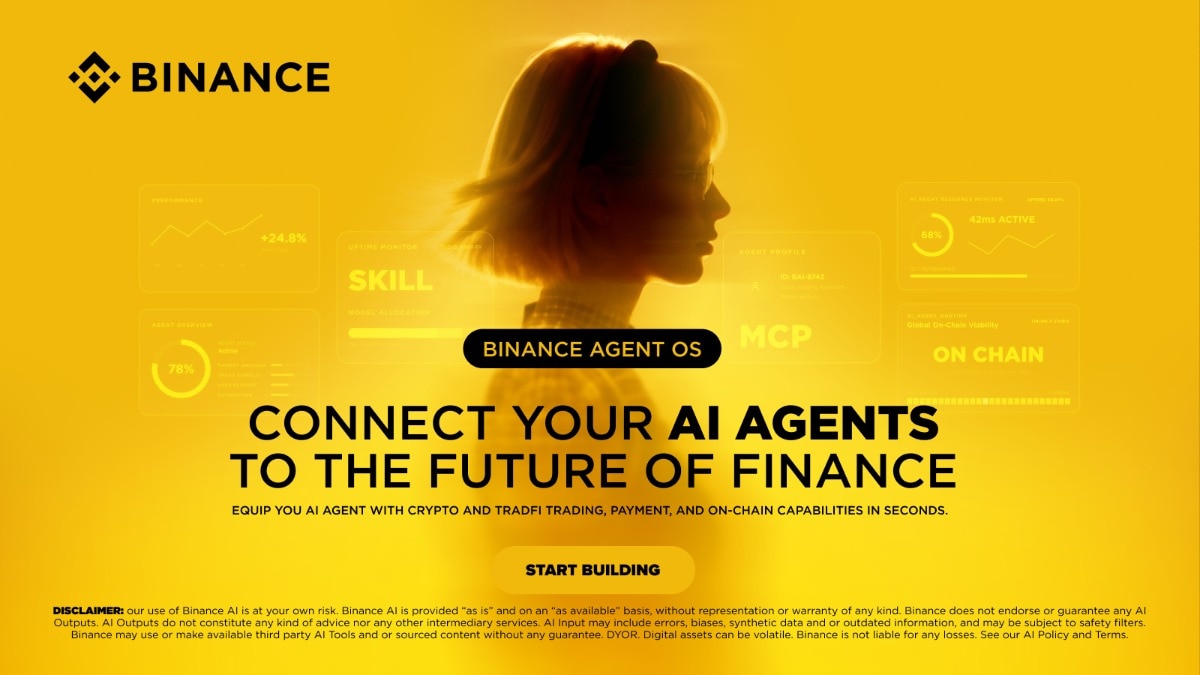
This shift creates a new infrastructure challenge. If software can act on a user's behalf, it requires access to the same systems people use to get things done, including market information, wallets, trading infrastructure, and payment rails. However, this access must be paired with permissions, safeguards, and an audit trail. Binance is targeting this space with Binance Agent OS, a developer platform introduced under Binance Intelligence to unify Binance APIs, the Binance Wallet Agentic Hub, Binance x402, Binance Skill Hub, and support for the Model Context Protocol (MCP).
The distinction between an AI assistant and an AI agent is becoming increasingly vital. While an assistant can inform a user about market conditions, an agent can monitor that market, interpret instructions, and interact with connected tools to execute tasks. The broader agent economy is experiencing significant growth, with industry estimates projecting the AI agent market to expand substantially through the end of the decade, while research firms like Gartner project a massive rise in enterprise software applications featuring agentic AI.
For agents to interact with the digital world at scale, they require a common framework to discover and use external tools. This is where the Model Context Protocol (MCP) plays a critical role. MCP is an open standard designed to normalize how AI applications connect with external tools and services. With widespread adoption across major technology companies and millions of SDK downloads, standardized connection layers reduce the need for developers to build individual integrations for every separate service.
Binance Agent OS is designed as a comprehensive platform for this emerging environment, utilizing MCP alongside other core components. These include Binance APIs for programmatic access to trading and market data, the Binance Wallet Agentic Hub for wallet capabilities, Binance x402 for agent-driven payment flows, and the Binance Skill Hub for modular developer capabilities. Jeff Li, VP of Product at Binance, noted that the platform addresses fragmentation by providing reliable data, low-latency infrastructure, and standardized interfaces for AI-driven strategies.
The financial dimension of these technologies makes safety and control paramount. Through the Binance MCP Server, compatible AI applications can access supported Binance functions subject to user authorization, account eligibility, and regional availability. At a basic level, agents can read market data or, with user authorization, access balances, positions, and bills inside an Agentic sub-account.
Depending on supported products and scopes, the integration permits trading functions across Spot, Margin, Convert, USD-M Futures, and COIN-M Futures, as well as internal transfers within the Agentic sub-account. Crucially, the architecture excludes withdrawal scopes, meaning connected agents cannot move funds to external addresses. Furthermore, the system relies on an isolated Agentic sub-account rather than direct access to a user's main account, leaving individuals in control of which assets and permissions are made available.