


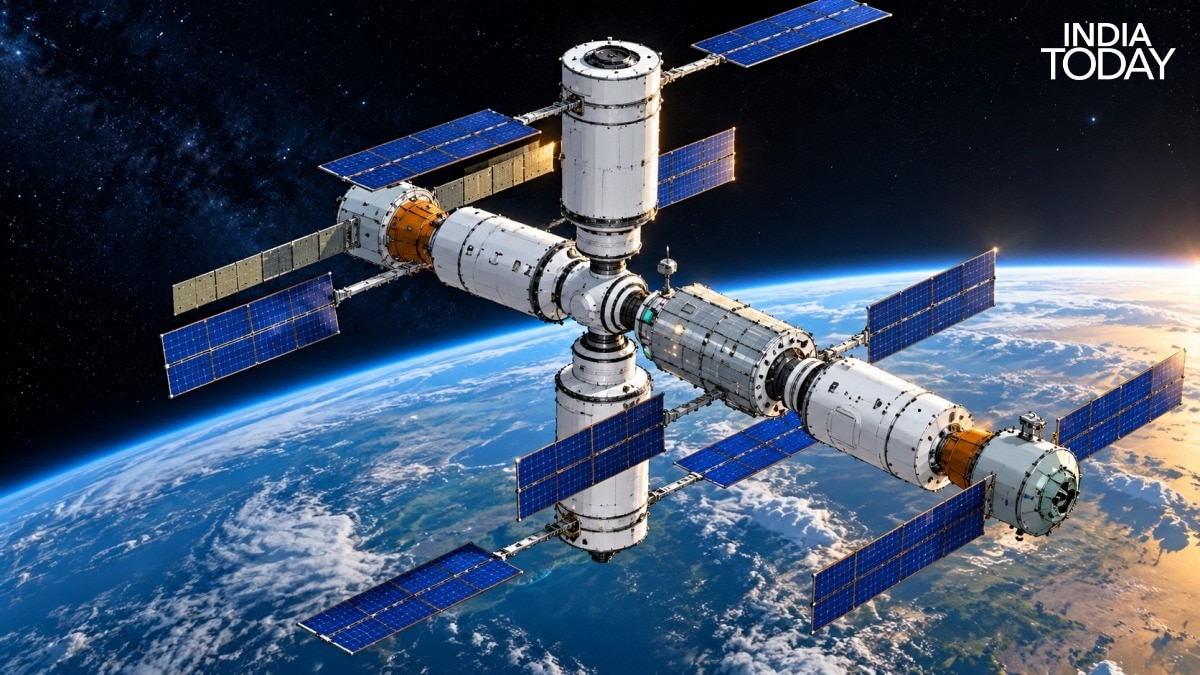
India’s planned Bharatiya Antariksh Station (BAS) is being designed with robotic capabilities that could help astronauts handle operations outside the station, inspect its structure and support future expansion.New technical details presented by K Kalpana, BAS Project Director at ISRO, during the Space Science and Technologies session of ESTIC 2026 in New Delhi on October 29, point to a station equipped with internal and external robotic arms, alongside free-flying systems and humanoid robots.The presentation also outlines a five-module station in low Earth orbit, with provisions for docking across all modules.The station is planned to support long-duration human stays and microgravity research, marking a major step in India’s ambition to build an independent human spaceflight infrastructure. A model of the Bharatiya Antariksh Station.
FIVE MODULES, 54-TONNE STATIONAccording to the presentation, the station will comprise five modules, orbiting Earth at an altitude of around 450 km and an inclination of 51.5 degrees. Its overall mass is estimated at approximately 54 tonnes, with dimensions of about 27 metres by 20 metres.The station is expected to accommodate three to four crew members for continuous stays, with space for around three additional astronauts during short-duration missions.
Its habitable volume is projected at approximately 100 cubic metres, with a power-generation capacity of 60 kilowatts.The five modules have distinct roles.BAS-01, the Base Module, is designed as a test bed for technologies and will support station servicing, crew habitat requirements and payload racks.BAS-02 will serve as the Core Module, featuring docking infrastructure, payload racks and exercise equipment to counter the effects of living in microgravity.BAS-03, the Science Module, will support spacewalks, payload racks and regenerative environmental control and life-support systems.BAS-04, the Lab Module, will include a cupola for Earth observation, additional crew quarters and payload facilities.BAS-05 will serve as the Berthing Module, providing a common berthing mechanism to enable future expansion and cargo-module docking.ROBOTIC OPERATIONS AND RESEARCHThe station’s planned robotic systems are intended to expand its operational capabilities. The presentation lists internal and external robotic arms, free-flying systems and humanoid robots among the planned features.
However, it does not specify the exact configuration or operational roles of each arm.Other features include docking provisions across all modules, regenerative environmental control and life-support systems, and protection against radiation, extreme temperatures and micrometeoroids and orbital debris.The station is also expected to provide a platform for microgravity experiments, potentially supporting research in areas such as life sciences, pharmaceuticals, materials science and advanced manufacturing. These are among the research priorities identified for the BAS programme by the government.
A scale model of the Bharatiya Antariksh Station. India has set a target of launching its first station module, BAS-01, by 2028 and making the complete five-module station operational by 2035.
The first module has received an approved development and launch budget of Rs 1,763 crore for 2025-2028.The robotic systems will be an important part of building and maintaining the orbital outpost, as India moves from demonstrating human spaceflight through Gaganyaan towards sustained human presence in low Earth orbit.- Ends