


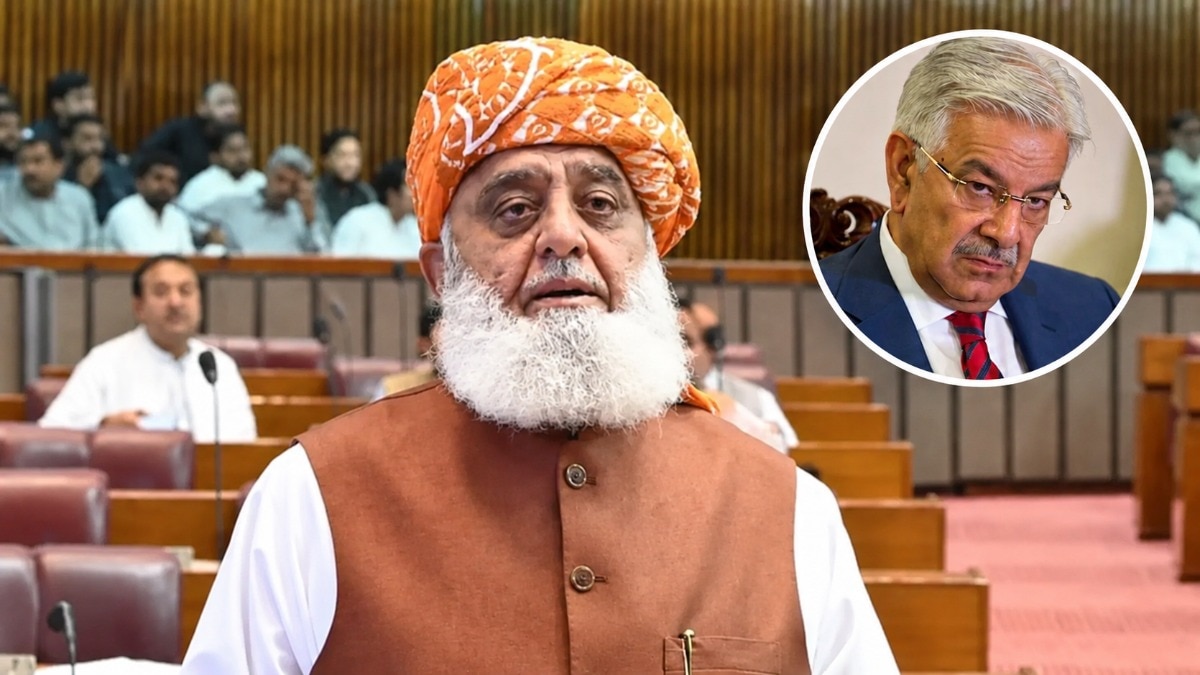
Pakistan's Defence Minister Khawaja Asif found himself at the receiving end of a parliamentary jibe, when Jamiat Ulema-e-Islam-Fazl (JUI-F) chief Maulana Fazlur Rehman questioned why a defence agreement was being discussed in Iran while the minister was sitting in Parliament.Taking a dig at Asif during a speech in the National Assembly, Rehman said, "A defence agreement is being made in Iran, and the defence minister is sitting here."He then turned Asif's own famous political catchphrase against him, asking, "Koi sharam hoti hai, koi haya hoti hai" — a Hindi-Urdu expression meaning, "Have some shame, have some decency?"The remark drew laughter in the House, and a clip of the exchange circulated on social media. Rehman's comments have again put the spotlight on the division of responsibilities between Pakistan's civilian government and its powerful military leadership, particularly when decisions involving national security and foreign policy are being discussed.
Maulana Fazlur Rehman is a prominent Pashtun (Pathan) cleric-turned-politician from Dera Ismail Khan in Pakistan's Khyber Pakhtunkhwa province.He leads JUI-F, a Sunni Deobandi religious party that draws much of its support from the Pashtun-majority areas of Khyber Pakhtunkhwa and Balochistan, with its grassroots network rooted in religious seminaries and institutions. Unlike Imran Khan's Pakistan Tehreek-e-Insaf (PTI), which emerged as a populist party centred on Khan's leadership, or the Pakistan Peoples Party (PPP), a centre-left party with a dynastic political legacy, JUI-F combines religious conservatism and advocacy of Sharia law with electoral politics.WHY WAS ASIM MUNIR IN IRAN?Rehman's jibe came against the backdrop of high-level diplomatic talks in Tehran on October 26, involving representatives of Pakistan, Saudi Arabia and Turkey.
The meeting brought together Pakistan's Chief of Defence Forces, Field Marshal Asim Munir, Saudi Defence Minister Prince Khalid bin Salman, and Turkish intelligence chief, Ibrahim Kalin, who met Iranian President Masoud Pezeshkian and other senior officials.The talks took place under the framework of the Makkah Joint Defence Agreement, signed by Pakistan, Saudi Arabia and Turkey in August. The pact provides for collective defence, with an attack on one member to be treated as an attack on all three.The Tehran discussions were aimed at preventing a fresh escalation in the region, addressing security concerns linked to the attacks by Houthis on Saudi Arabia and exploring ways to revive negotiations between the United States and Iran.
Pakistan has played a mediating role in efforts to bring Washington and Tehran back to the negotiating table.Munir's presence at the talks highlighted the central role Pakistan's military leadership has assumed in diplomacy involving regional security. Interior Minister Mohsin Naqvi also accompanied Munir on an earlier visit to Iran in August and has participated in Islamabad's efforts to mediate between Washington and Tehran.Rehman's criticism, therefore, was not just about a minister's absence from a meeting.
It also drew attention to the question of who represents Pakistan in negotiations involving defence commitments, regional security and foreign policy.KHAWAJA ASIF URGES MAULANA FAZLUR REHMAN TO SHOW RESTRAINTDefence Minister Khawaja Asif responded to Rehman's criticism in the National Assembly on Thursday, denying that a defence pact was being negotiated in Tehran or that the discussions concerned Pakistan's defence ministry, reported Karachi-based daily Dawn.Asif said Field Marshal Asim Munir had taken on the role of promoting peace and dialogue in the region, and had helped bring the regional countries together. Asif argued that the Tehran meeting fell outside his ministry's mandate and that he was not required to attend.Asif said Pakistan had signed two defence pacts — the Makkah Defence Alliance and the Badr MoU. "I was involved in those pacts as I am the defence minister,” he was quoted as saying by Dawn.
Asif also said the meeting in Tehran was "not the defence ministry's mandate", according to Dawn.He also hit back at Rehman, calling his criticism misplaced and accusing the JUI-F chief of political opportunism. Asif urged Rehman to show restraint, saying Pakistan's diplomatic efforts should be acknowledged despite political differences.REHMAN QUESTIONED GOVERNMENT'S DECISIONSThe exchange with Asif was part of a broader speech in which Rehman questioned the federal government's handling of political and security matters.
He criticised what he described as the misuse of constitutional provisions and challenged the government's argument that its actions were justified by the need to tackle terrorism.Rehman argued that constitutional powers could not be exercised in a manner that undermined democratic representation. "There is a difference between using it and misusing the Constitution," he said, referring to the government's reliance on constitutional provisions to justify its decisions.He also questioned the suggestion that a provincial government could be removed because of its failure to address terrorism, arguing that security challenges elsewhere in Pakistan warranted similar scrutiny. "If it's about failure, then Balochistan is two degrees ahead in the failure of the war against terrorism," Rehman said, asking why emergency measures had not been imposed there."The way to bring about change is not to bring a revolution and overturn everything; rather, even for that, one must go to the people," he said.The episode comes at a time when Pakistan's military leadership is playing a prominent role in both security policy and diplomacy. Munir, who serves as the country's chief of defence forces as well as army chief, has been involved in efforts to manage regional tensions and facilitate talks between Washington and Tehran.Pakistan's Makkah defence pact with Saudi Arabia and Turkey has also raised questions about the scope of its obligations and the extent of parliamentary scrutiny over security decisions.Claiming that JUI-F had suffered significant losses in violence, Rehman also said, "Is your blood sacred, and my blood wasted?
This won't do; you will have to give respect."The immediate political takeaway is Rehman's pointed use of Asif's own words against him. By invoking "koi sharam hoti hai, koi haya hoti hai" in the National Assembly, Rehman turned the political taunt into a criticism of the government's handling of sensitive defence diplomacy.- Ends