


When Odisha ran a road safety campaign in June 2025, the slogan did not bark like a traffic sign. It spoke softly, in the tone of a close family member.
The line was ‘Come Home Safe’, and the messenger was meant to be a mother, a sister or a daughter, someone who could say to a father, a brother or a son what no signboard ever can.Behind that gentle line sits a hard idea. The campaign was run with the Centre of Excellence for Road Safety (CoERS) at IIT Madras, and its head, Professor Venkatesh Balasubramanian, believes something that sounds almost impolite at first.
Most road deaths, he says, are not accidents. “I don’t like to call it an accident,” Professor Balasubramanian told India Today Digital in an exclusive interview at the IIT Madras campus.A crash, in his telling, is the last frame of a long film. Somewhere earlier, a person made a choice, and what one person decides, another can sometimes persuade them to decide differently.WHY ARE MOST ROAD ACCIDENTS NOT REALLY ACCIDENTS?Because most crashes begin with a choice, and a choice can be changed.
He sorts crashes into two kinds. The first kind, called volitional errors, are mistakes that begin with a decision. “Tell people not to drink and drive, and some will drink and drive.
Ask them not to speed, and they will speed. Ask them to wear a helmet, and they will refuse,” Professor Balasubramanian says.The second kind, the true accident, is a freak, tail-end event, rare and far between, the sort of bad luck that visits once in a very long while.
Most crashes are a chain of events, and the first link is usually a human choice. (Representational image: Getty Images) Even a volitional crash has more than one author. It is a row of dominoes, each fall setting off the next, and the row can be interrupted.Take a crash barrier.
It needs all four of its bolts to do its job. On an ordinary day, three seem enough, Professor Balasubramanian says, and the fourth matters only on the day a vehicle actually hits.
But the steel studs that hold the posts can be sold as scrap, and some are taken away. Nobody notices the missing bolt until a vehicle crashes into the barrier and it gives way.That is why his centre does not look for someone to blame.
It looks for the weak link, the one step that can be fixed to break the chain. A small shortcut goes unnoticed for months.
Then, on the day it matters, it decides whether the barrier holds.HOW MANY PEOPLE DIE IN ROAD ACCIDENTS IN INDIA?The transport ministry counted 1,77,175 deaths in 2024, and two in three of the dead were aged 18 to 45.The ministry’s Road Accidents in India 2024 report records 4,87,707 crashes, 1,77,175 deaths and 4,71,441 injuries. Behind every number is a person, and the report is clear about who they mostly are.Over-speeding was behind 70.3 per cent of the deaths.
Two-wheeler riders made up 46.2 per cent, and pedestrians 20.6 per cent.Professor Balasubramanian sums up the age pattern in one sentence: you finish college, buy a bike on EMI, ride, and die.CAN A TIRED DRIVER CAUSE A ROAD ACCIDENT?Tiredness slows the mind long before the driver feels sleepy.Driving, he explains, is a matter of demand and supply. The road demands attention and quick decisions, and the driver supplies mental and physical energy.
As fatigue builds, the supply runs low while the demand stays exactly where it was. The mind begins to take shortcuts, and “that’s how errors come in.” India recorded 1,77,175 road deaths in 2024, according to the transport ministry. (Representational image: Getty Images) His lab watched this happen on a simulator.
In a study in Applied Ergonomics, 20 men drove for 60 minutes while sensors followed them. Electromyography, which reads the faint electrical signals that muscles give off, showed fatigue creeping into the back and shoulders, and brain waves slowed.The pressure on the seat changed too, a clue that led to IntelliSeat, a driver seat that senses fatigue.WHY IS DRIVING AT NIGHT MORE DANGEROUS?After dark, the eye misjudges both the speed and the kind of vehicle coming towards it.The night does not only hide the road.
It misleads the eye. On a dark highway, Professor Balasubramanian says, we see two lights and assume two bikes.
Humans, he argues, evolved around slow speeds and are still catching up with fast roads. In poor light, the eye struggles to judge the distance, speed and type of approaching vehicle. (Representational image: Getty Images) In a study with 30 volunteers, a lit strip between a car’s two headlights helped.
Volunteers recognised a low-beam car in 7.62 seconds on average, against 20.55 seconds without it. For a high-beam car, the figures were 11.23 seconds and 25.57 seconds.DOES SPEED REALLY KILL?It is the sudden stop, not the speed itself, that does the damage.“You don’t die because you are driving fast,” Professor Balasubramanian says. “You die when you stop very fast.” A moving car carries energy, and doubling its speed quadruples that energy.
In a crash, every bit of it is dissipated within a fraction of a second. That abrupt loss of speed is called deceleration, and the human body can survive only so much of it.WHY DO PEOPLE BREAK TRAFFIC RULES?Often because the rule costs them more than the risk seems to.Take a road with a good divider, where the next U-turn is 20 km away and the office is 5 km ahead.
Most people will drive the wrong way for 5 km rather than add 35 km to the trip. “What is the incentive for him to violate?” Professor Balasubramanian asks. “How do we reduce that incentive?” In a crash, all of a car's energy must go in a fraction of a second, and that sudden stop does the damage. (Representational image: Getty Images) An analysis of 5,254 crash records from Chennai looks at speeding which, the study notes, accounts for 66.5 per cent of driver-error faults in India. His answer is not ‘blame’.
It is forgiving roads, built so that an ordinary mistake does not cost a life.WHAT HAPPENS WHEN EVERYTHING ELSE FAILS?Then the ambulance, and the hospital it reaches, decide who lives.When every other safeguard has failed, the last hope arrives with a siren. That last layer is trauma care, the emergency treatment of a serious injury.
A head injury taken to a hospital without a neurosurgeon, Professor Balasubramanian points out, is time lost.In Tamil Nadu, his team built a network called THAI, short for Tamil Nadu Accident and Emergency Care Initiative, and thai also means mother in Tamil. When a hospital is told in advance that a head injury is on its way, the neurosurgeon can be waiting.CAN BEHAVIOUR CHANGE REDUCE ROAD ACCIDENTS?CoERS believes it can, one city and one district at a time.Its instrument is the ‘Zero Accident Day’ campaign, built on local data and run with the police.
The aim, Professor Balasubramanian says, is not literally “days without a crash.” It is that “everybody must think what is the one thing they can do to ensure they do not cause an accident.”When ‘Zero is Good’ posters went up across Chennai in August 2024, a senior police officer, he recalls, wondered whether the zero was a comment on the police. It was not.
CoERS and the Greater Chennai Traffic Police had picked out the riskiest groups, such as city bus drivers with the most crash records, and trained 70 of them on simulators.On International Traffic Lights Day, red signals turned heart-shaped to stand for empathy. The campaign report counts six days with no road deaths between August 5 and August 26, 2024, but gives no percentage fall.
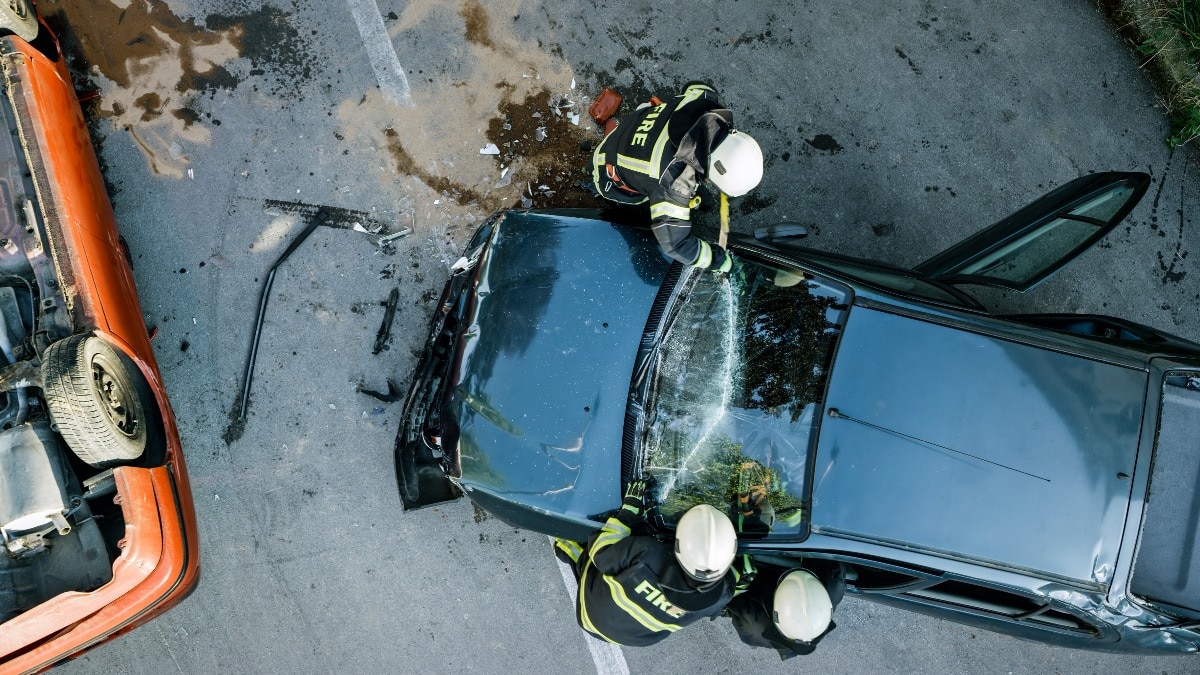
When every other safeguard fails, rescue and trauma care decide who lives. (Representational image: Getty Images) In Odisha, the campaign ran for 23 days from June 3, 2025, with women at its heart and a protector character named Surakshya. Bus crews took a breath test every day.
Khordha district, which includes Bhubaneswar, recorded 23.33 per cent fewer crashes and 15.8 per cent fewer deaths than in the same period a year earlier, says the state’s campaign report. One month cannot prove cause, but the pattern is encouraging.In July 2026, Ambedkar Nagar in Uttar Pradesh took up the model with District Magistrate Eesha Priya.
There, 8,000 women volunteers carried road safety into homes, and eight crash-prone stretches were reworked by engineers. The impact figures are yet to be announced.At the centre of the framework Professor Balasubramanian draws for road safety sits empathy, ringed by four Es: education, enforcement, engineering and emergency care.
The question behind each, he says, is the one engineers forget: who is going to use it?When evidence and empathy unite, he writes in the Odisha report, “we can change social norms and save lives.” In Odisha, it began with three words, spoken by the people who wait at home.- Ends