


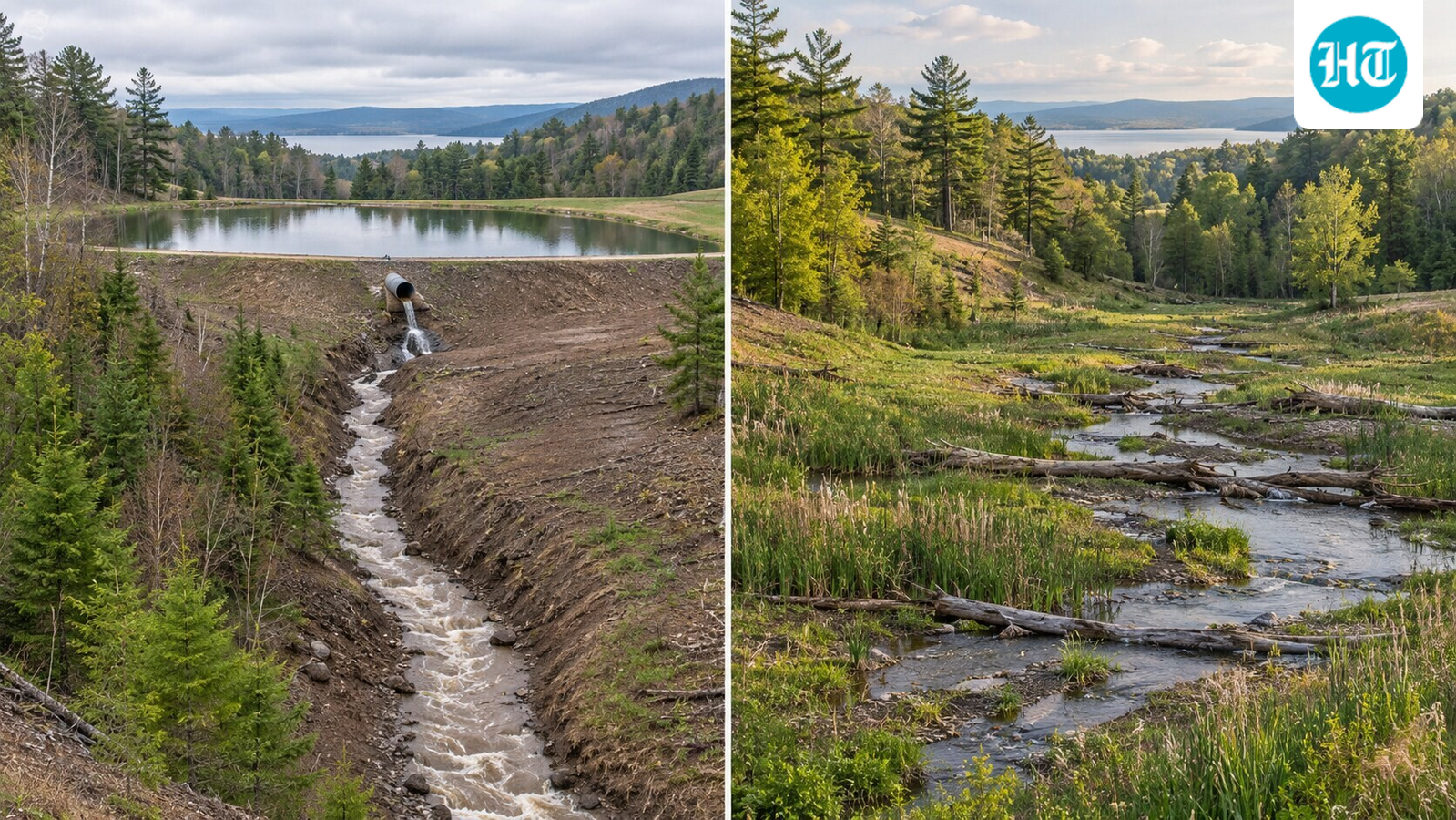
That was the problem with a small Vermont creek for decades. The fix began with taking something out.
According to the Vermont Land Trust, a dairy farmer in Colchester built an earthen dam in the early 1950s to create an irrigation pond. The pond gave the farm a way to hold water for irrigation.
But over time, the dam altered the creek’s flow, impacting water quality, wildlife habitat, and the lake fed by the creek.A dam built in the early 1950s for an irrigation pond came out in 2022, and the valley below was reshaped into a wide floodplain and wetland. (AI-generated/ChatGPT)What one dam did to the valleyBelow the dam, the valley floor was treeless pastureland, and the cows tramped down the soil as they wandered. The water flowed down from the dam’s outlet pipe each year, eroding the creek more deeply.
Because of the deep, narrow channel, the creek could not reach the floodplain, which is the low-ground area that the water flows into after a storm or a thaw. Instead, the water would gush out of the valleys as if it were being flushed through a pipe.
It brought soil and nutrients, such as phosphorus, into Lake Champlain, and it also damaged habitat for fish, insects, and other animals.Lake Champlain, where Crooked Creek empties after flowing about a mile from the Colchester farm valley. (Wikimedia Commons)Why muddy runoff mattersIn Vermont’s Mad River, researchers study what happens when a huge storm tears up stream banks. The river is in Washington County and drains into the Winooski River before reaching Lake Champlain, making it a different watershed from Colchester Creek.
In their paper published in the Journal of Geophysical Research: Biogeosciences, they looked at damage from Tropical Storm Irene in 2011. The study found that six erosion sites in the 0.87 kilometres of stream banks were responsible for the release of about 15.8 metric tons of phosphorus.
That, plus about 17,600 metric tons of sediment, was about the same as the average annual export estimated for the watershed. Besides, the authors mentioned that higher concentrations of phosphorus could accelerate algal blooms in lakes.
These figures come from an extreme storm on a much larger river, so they don’t describe what the Colchester Creek released. But they do show how much sediment and phosphorus unstable banks can deliver to the lake system.Starting small with logs and willowIn 2021, with help from students at the University of Vermont, the team first worked below the dam.
They built about 25 beaver dam analogs, or wooden structures modeled on beaver dams, as an early trial of the approach. When heavy rain came down that fall, the water slowed, pooling behind the structures and spreading into the floodplain.
Scientists have tried the same idea elsewhere too. In a Scientific Reports study, an experiment at the watershed scale in Oregon’s Bridge Creek saw large increases in the density, survival, and production of young steelhead after installing dams like these.The 2022 dam removalContractors breached the dam and drained the pond in the summer of 2022.
They spread the accumulated sediment to form a wide valley with interlinked dips, and they planted tree trunks at the valley bottom to act as natural weirs. The trust said the logs were helping the stream spread as intended after September rains, and cattails soon popped back up.
The restored valley bottom is about 25 to 35 feet wide, and the creek is usually only four to six feet wide. This lets water take different routes rather than always hitting the same spot.
By restoring the creek, its floodplain, and wetland, there's room to slow stormwater before it reaches Lake Champlain. The trust notes that it will take decades, even centuries, for the valley’s full return to a highly functional ecosystem, and that healthy watersheds handle the intense storms better.The Hindustan Times US Desk brings you the latest news and developments from across the United States.
The team covers everything from breaking news and politics to sports, business, entertainment and stories that are trending across the country. Our coverage includes the White House, Congress, US elections, immigration and visa updates, H-1B, green cards, Social Security, education, jobs, layoffs, the economy, technology and major policy changes.
We also closely follow stories that matter to Indian and South Asian communities in the US. The desk covers major US sports, including the NFL, NBA, MLB and NHL, along with player news, injuries, schedules, results and major events.
Entertainment coverage includes Hollywood, celebrities, television, streaming, music and pop culture. We also report on breaking developments, major incidents, weather, public safety, court cases and other stories making headlines across the country.
When a major policy or news development affects people's everyday lives, the team works to explain what happened, what it means and what readers need to know. Alongside breaking news, the US Desk produces explainers and practical stories on topics such as immigration, Social Security, taxes, education, employment and government programmes.
The team also works on science, tech, business and AI stories analyzing the impact they may have on people. The team follows developments throughout the day, keeping an eye on official announcements, public records, reliable news sources and what people are talking about across the US.Read More