


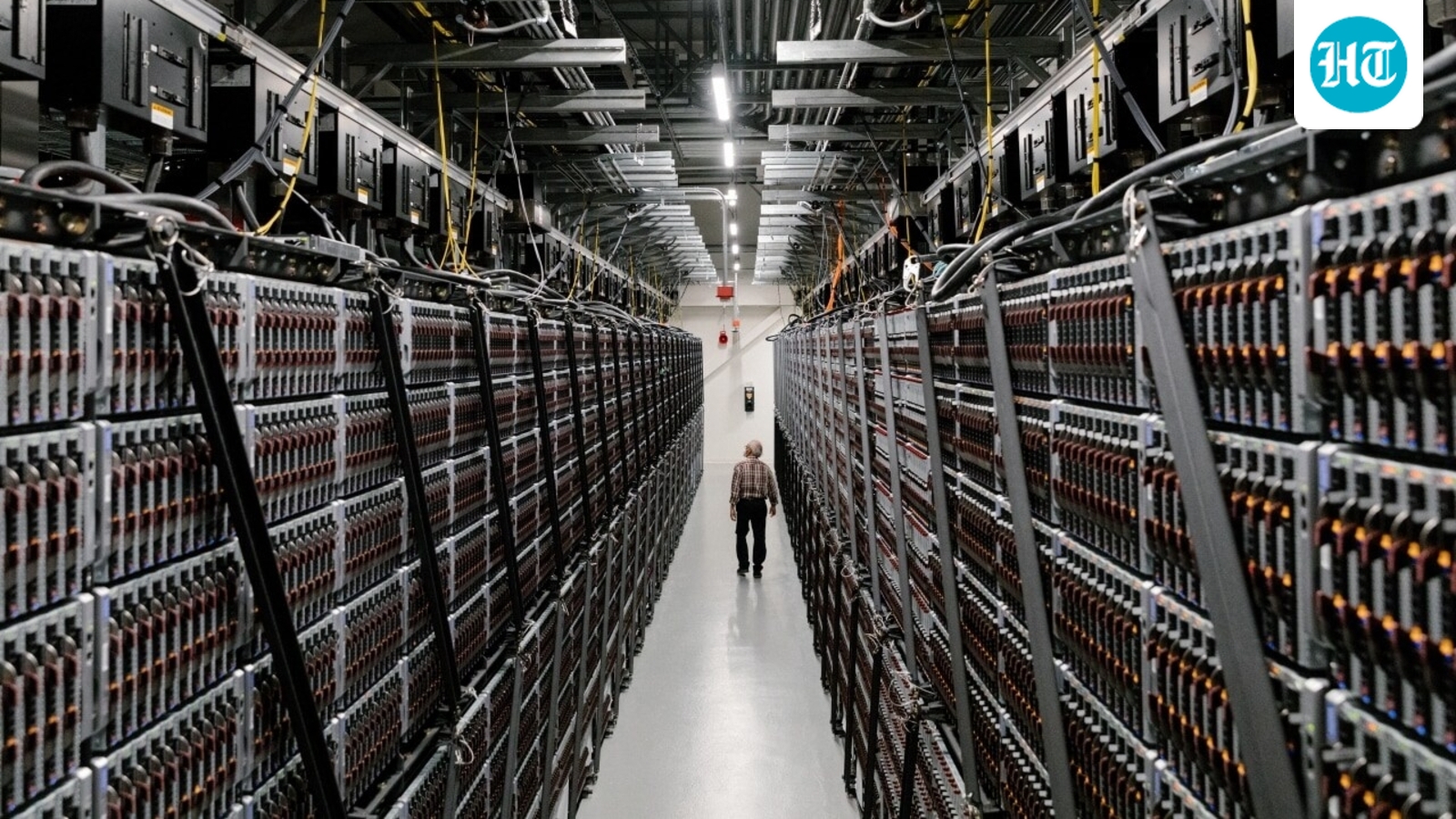
Some investors are desperate to take the other side.A data center at Intel headquarters in Santa Clara, Calif. The chip maker just had its worst month since March 2025.The trade has proved a lasting winner up to now.
Excitement about AI’s potential to transform the economy has lifted stocks from tech heavyweights to utilities and chip makers, while driving a speculative frenzy in other corners of the market.Some of these optimistic forecasts got a recent reality check, with big and small players alike failing to meet the market’s expectations. Now, investors are sizing up how to protect themselves against the risk of a larger unraveling.“We’re seeing really significant demand from folks looking to protect downside,” said Stephen Solaka, a senior vice president at Gateway Investment Advisers.The jitters are starting to show up in a number of ways: the yields lenders demand to finance big data-center projects and chip purchases; the plunging stock and bond prices of some AI “neocloud” companies, such as CoreWeave that are borrowing heavily; and steep selloffs from tech darlings including Alphabet and Intel, which just recorded some of their biggest one-day drops ever.
The tech-heavy Nasdaq lost 2.9% Friday, capping its worst month since March 2025.Solaka oversees portfolios for individuals who often have concentrated bets in individual stocks, including the tech giants that have powered markets in recent years. Increasingly, he said, his clients—some of whom are former employees of those very technology companies—are looking for something else: insurance.“These people have made so much money, they’re quitting to hedge their stock,” Solaka said, adding that some companies have restrictions around employees’ trades.Investors and tech executives alike are turning to options and credit-default swaps for protection.Put options, which give investors the right to sell stock at a specific price at a future date, are growing in volume.
Contracts tied to the neocloud CoreWeave surged to the highest level on record this month and have stayed elevated, Cboe Global Markets data show.ChartSome of the most popular bets tied to CoreWeave have been put options expiring in 2028, paying out if the shares plunged to $35. The shares hovered at around $55 this week.Meanwhile, the cost to protect against a debt default in hyperscalers Amazon, Alphabet, Microsoft, Meta and Oracle widened over the past month to the highest levels going back to 2021, according to the bond data provider Solve. “There were no exceptions, suggesting broad market concern about the sector rather than idiosyncratic credit events at individual companies,” said Eugene Grinberg, a co-founder of Solve.The recalibration in Oracle credit-default spreads was especially stark, widening by more than 1 percentage point.The AI build-out is expected to grow so large that traders are cooking up other ways to hedge its risks.Quant trading firm Jump Trading recently launched a trading desk for computing power.
The nascent operation has been taking advantage of wide price differences across providers, the types of inefficiencies that have been tougher to come by in mainstream markets such as stocks and options. It has also been structuring over-the-counter derivatives, including for those who want to hedge against a big collapse in prices going forward.The cost to rent Nvidia B300 chips has surged this year.“Folks are becoming more discerning about which participants are winners and losers, and asking tougher questions,” said Dave Olsen, president of Jump. “People are drilling deeper into the economic models.”Here’s how a trade would work.A neocloud or AI infrastructure developer that rents out Nvidia chips might buy a put option to hedge against the possibility that the hourly rental rates they pocket will plunge if demand drops.It would have the right to sell that compute power at a specific price by a stated date, buffering itself from a steeper hit to profits.
Jump would agree to take the other side. Jump could also negotiate a cash-settled contract, simply paying the provider in cash.
Or the trading firm could agree to rent the compute, or find someone else to rent it to for a profit.The cost to rent Nvidia B300 chips has surged around 56% this year to $7.56 an hour, according to a Silicon Data index. Jump, for example, could agree to buy if prices fell to $4 an hour.ChartOlsen and his traders are closely scrutinizing the creditworthiness of those they cut deals with, and the likelihood that they might default on their obligations.Big exchanges and trading firms are also looking to launch a web of derivatives tied to compute, as it is known in the industry.Susquehanna International Group, one of the largest trading firms on Wall Street, has fielded interest—both directly and through intermediaries such as brokers—from data centers and privately held neoclouds seeking to hedge their exposure to semiconductor chips, said Nick Volbi, head of institutional prediction markets at the trading firm.
If compute prices sank because of decreased demand or increased supply, the trades would pay out, hedging an option buyer against losses in other parts of its business.That includes put option trades tied to a compute index, which can serve as insurance to assuage lenders at banks, he said.Chart 3“I’m going to go to a potential lender and say, ‘Hey, if I buy this structure and I get this form of insurance, can you now give me financing? And what would that financing look like?’ ” Volbi said.There has been some thin trading in prediction markets tied to data-center moratoriums in certain states.
Kalshi offers trades on which states might halt new data-center developments before 2028, including New Hampshire, Michigan and Maine. So far, though, trades have been sparse.Olsen said hedging strategies as a whole are still dwarfed by the AI trade.
Many remain bullish.“I don’t think my house is going to catch on fire, but I still have insurance,” Olsen said. “You don’t need to be bearish to want some insurance.”Write to Gunjan Banerji at gunjan.banerji@wsj.comGet the latest World News, breaking headlines and global updates from the US, UK, Pakistan, Bangladesh, Russia and other countries. Follow major international events on Hindustan Times.