


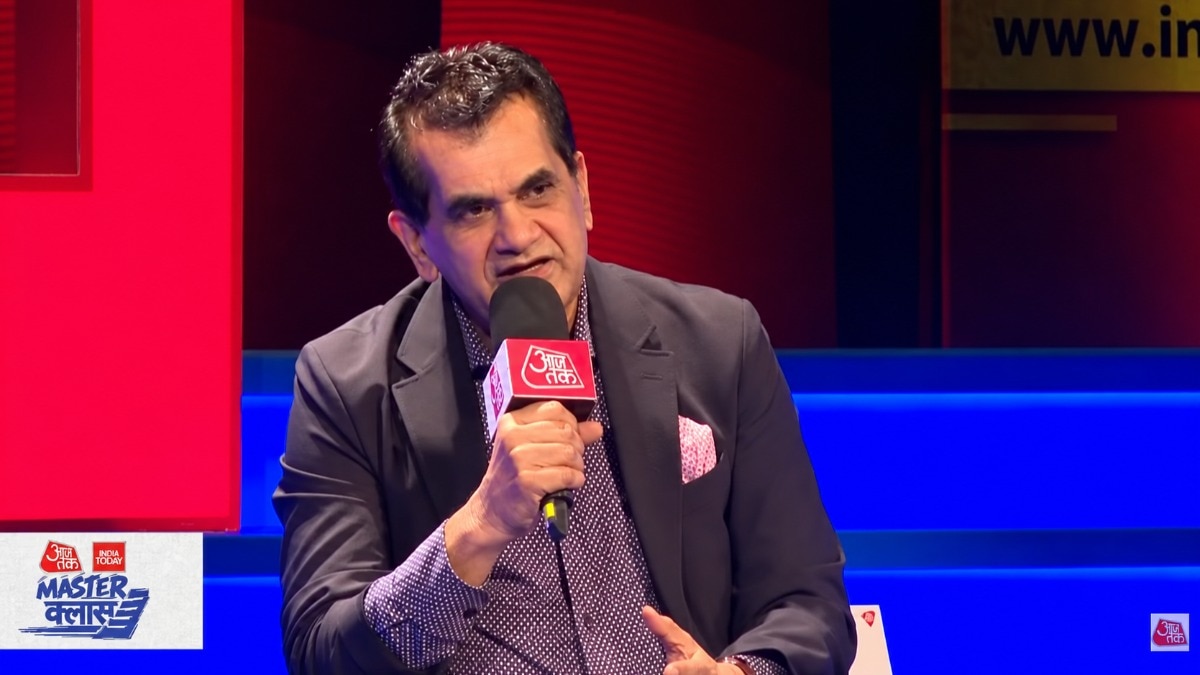
Former NITI Aayog CEO and India's former G20 Sherpa, Amitabh Kant, on Friday revealed that he once came close to resigning from the Indian Administrative Service (IAS) after being left without a posting for 11 months in Keralam following a political backlash against his anti-encroachment drive.Speaking at the India Today Masterclass, an interactive session with students and young professionals, the 1980-batch IAS officer reflected candidly on the highs and lows of his 45-year career in public service, much of which was shaped by his formative and tumultuous years in Keralam.Recalling his tenure as District Collector of Kozhikode, Kant noted that the historic coastal city, where Vasco da Gama once landed, had seen little urban renewal for decades."It used to be said that if Vasco da Gama came back today, he would see Calicut (Kozhikode) city looking exactly the same as he left it. No change had happened," Kant said.
Determined to reclaim public spaces, Kant launched a massive cleanup drive in the city's central green belt, which had been taken over by buildings and tea stalls. He oversaw the removal of around 450 encroachments to restore the area into what is now the iconic Mananchira Maidan.
During the same tenure, he expanded 29 roads, built a city bypass and worked on developing the Kozhikode airport.However, the drive came at a steep professional cost. Among the structures demolished during the campaign was a five-star hotel whose owner later became a minister and Deputy Chief Minister of the state.
Kant, however, did not identify the leader. "When he became Deputy Chief Minister, he initiated action against me, filed cases against me and I was without a posting for about 11 months," Kant recounted.The sudden isolation shook the young officer's confidence. "At that time, I felt my entire career was over," he admitted. "I had reached a point where I thought it was better to just resign."However, instead of quitting, Kant weathered the storm. After 11 months without a posting, the state government assigned him what was widely viewed at the time as a "punishment posting" as Secretary of Tourism."Nobody had ever heard of tourism in Kerala; nobody went there.
Everyone went to Kashmir or Rajasthan," Kant said, noting that Kovalam beach was the state's sole tourist attraction at the time and drew only low-value tourism.Kant shut down and redeveloped the Kovalam stretch while shifting the state's tourism strategy towards its backwaters and traditional heritage. Rejecting Western-style resort templates, he championed an authentic identity that eventually became the globally recognised "God's Own Country" campaign."We said Kerala will not ape any other Western destination; Kerala will go back to its roots," Kant explained. "Our philosophy was to develop Kerala as a unique destination."Under his leadership, the state's branding highlighted indigenous art forms such as Kathakali, Mohiniyattam and Kalaripayattu, which he described as "the mother of martial arts", alongside Ayurveda and local cuisine, which few outside the state had heard of at the time.'MOST SATISFYING CAREER EXPERIENCE WAS IN KERALAM'Kant also spoke warmly about his early days in Keralam, admitting that he was initially dismayed when he was allotted the state cadre in 1980 after completing his education in Uttar Pradesh and Delhi."I was very sad because I had done all my schooling in UP and Delhi and I ended up in Kerala," he said.To integrate into the state, Kant studied Malayalam every day for two years.
His subsequent field assignment, during which he lived and worked alongside the state's coastal fishing community for nearly four years, became the defining chapter of his career.At the time, fishermen received just 18 per cent of the market price for their catch, with nearly 18 middlemen taking cuts along the supply chain. Kant introduced outboard motors, fiberglass crafts and new fishing nets known as "disco nets".
He also established beach-level auctions and dedicated bus services for fisherwomen. Additionally, he travelled from village to village, opening bank accounts for fishermen to help them save their earnings.These interventions increased the community's share of the market price from 18 per cent to nearly 90 per cent."In my view, the most satisfying experience of my entire life was living and working with those fishermen," Kant told the audience.Kant moved to New Delhi on central deputation in 2001, joining the Union Ministry of Tourism as Joint Secretary.In Delhi, he further established his reputation as a policy reformer and brand builder through some of the Government of India's most prominent national and global initiatives.
He began with the Incredible India campaign in 2002 during his tenure at the Ministry of Tourism (2001–2007). He subsequently headed the Delhi-Mumbai Industrial Corridor (DMIC) and served as Secretary of the Department of Industrial Policy and Promotion (DIPP), where he spearheaded the Make in India and Startup India initiatives.From 2016 to 2022, he led the country's premier policy think tank as the second CEO of NITI Aayog, driving flagship programmes such as the Aspirational Districts Programme, the Production-Linked Incentive (PLI) schemes, India's first National AI Strategy and the National EV Mission.Capping his 45-year career in government, Kant served as India's G20 Sherpa from July 2022 to June 2025, playing a pivotal role in building consensus around the New Delhi Leaders' Declaration during India's 2023 G20 Presidency.- Ends