


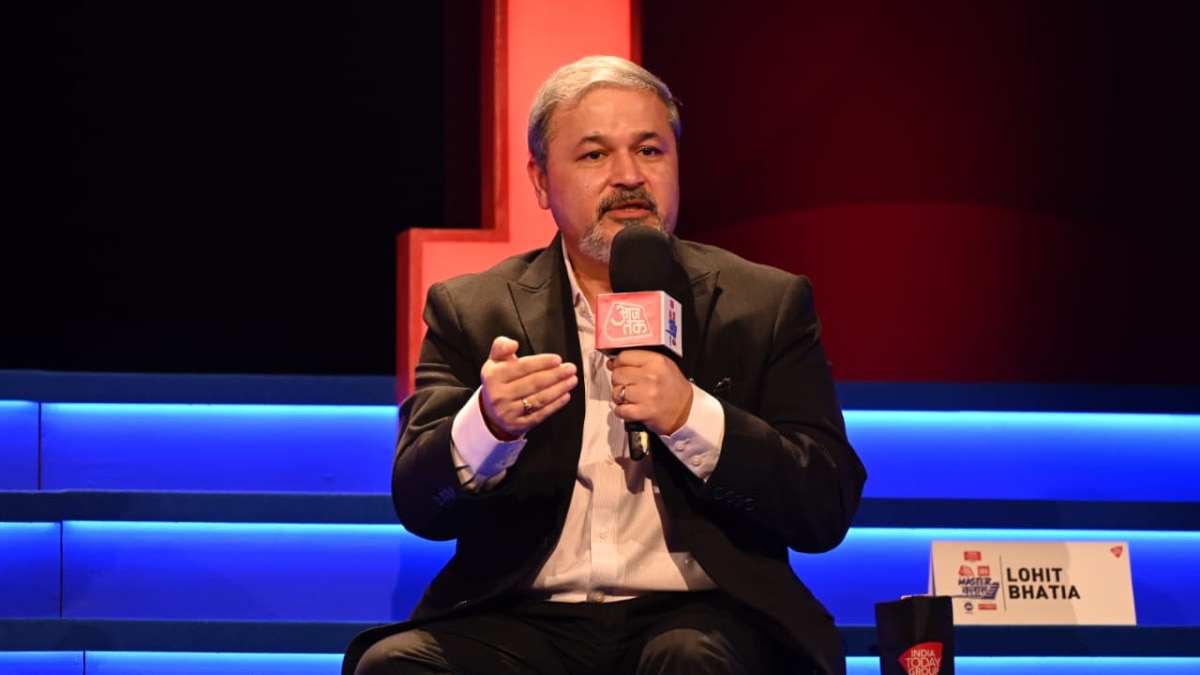
As concerns over employability, changing hiring trends and AI-driven disruption grow, industry leaders are emphasising the need for young professionals to focus on skills and adaptability. Speaking at the Aaj Tak Masterclass 2026, Lohit Bhatia, Executive Director and Group CEO of Quess Corp, said skills, passion, adaptability and a willingness to learn are becoming more important than academic qualifications in determining employability.Bhatia discussed the changing dynamics of the job market, the growing importance of artificial intelligence (AI), workplace politics, the skills gap between graduates and employers, and the challenges faced by freshers entering the workforce.Explaining the changing job market, Bhatia said companies are increasingly assessing candidates on their skills, potential and ability to deliver results rather than just their educational backgrounds.“Earlier, your education was the biggest proof of your capability.
Today, your skills, your standing and your willingness to do something have become much bigger indicators,” he said. He urged candidates to continuously upgrade their capabilities and focus on how they can add value to potential employers.
WORKPLACE POLITICS AND THE IMPORTANCE OF ETHICSAddressing concerns about workplace politics, particularly among young professionals entering corporate environments straight out of college, Bhatia said employees should focus on improving their own performance rather than getting involved in discussions about colleagues.With nearly 30 years of professional experience, he said workplace politics can be reduced when individuals take responsibility for their own behaviour. “Compete with yourself. Compete with who you were yesterday.
If you keep improving every day, the people around you will gradually change as well,” he said. He pointed out that employees often become part of the problem when they spend time discussing colleagues instead of finding solutions to workplace challenges.
Bhatia also highlighted three qualities employers look for during recruitment: passion for a particular field, resilience during difficult situations and ethical conduct.Employers want to know whether a candidate is passionate about sales, finance, technology or another area, and whether they can maintain their commitment when things do not go according to plan.He emphasised that integrity is equally important, particularly when employees are working without direct supervision. Sharing his philosophy on professional priorities, Bhatia said, “First, the Taj Mahal should be built for the country.
Second, it should be built for the company. And third, it should be built for us.”He said employees should understand the larger purpose of their work and prioritise collective success over individual gains.
On the issue of work-life balance, Bhatia acknowledged that the expectations of younger employees are different from those of previous generations.However, he stressed that flexibility and accountability must go hand in hand. Work-life balance does not mean employees should be expected to work every Sunday, nor does it mean that organisational responsibilities can be ignored.Companies must build trust and offer flexibility while ensuring that their commitments to clients and customers are fulfilled.AI WILL CREATE NEW JOBS, NOT ELIMINATE HUMAN CONTRIBUTIONDiscussing the impact of artificial intelligence on employment, Bhatia said AI should not be viewed as a threat but as a technology that can make work easier and improve productivity.He compared the current AI transformation with the introduction of computers and digital technology in India several decades ago.
At that time, many people, particularly in the banking sector, feared that automation would eliminate jobs.However, the expansion of banking, digital payments, mobile applications, data centres and cloud infrastructure created new employment opportunities. “Whenever technology transforms, it creates new jobs in large numbers. Some existing jobs change, some expand, but new jobs definitely get created,” he said.Bhatia encouraged young professionals to learn how to use AI effectively, particularly for research, productivity and problem-solving, rather than limiting its use to writing personal messages.He also identified AI-related services, data centres, semiconductors, green energy and electric vehicles as sectors likely to generate significant employment opportunities in the coming years.According to him, the growth of AI infrastructure will also increase demand for electricity and create opportunities in the power and renewable energy sectors. “AI is not a ghost or something to be afraid of.
It is there to make our work easier,” he said, adding that human intelligence and emotions together would remain a powerful combination.He also maintained that India's expanding economy would continue to support employment growth across traditional sectors such as banking, mutual funds and insurance, alongside emerging technology-driven industries.SKILLS GAP, LANGUAGE BARRIERS AND OPPORTUNITIES FOR FRESHERSOn the gap between the skills employers seek and what educational institutions produce, Bhatia said the education system is gradually shifting towards practical learning, critical thinking and skill development. Referring to the National Education Policy (NEP), he highlighted the flexibility it offers students to pursue practical training, acquire skills and credentials, and return to formal education.He said employers look beyond academic scores and rote learning, prioritising candidates who can think critically, manage emotions, demonstrate resilience and contribute to an organisation.Addressing language barriers, Bhatia said English is not mandatory for every job, as many businesses operate comfortably in regional languages.
However, communication skills remain important, particularly during recruitment and in client-facing roles. He encouraged young people to practise communication for 15–20 minutes daily and use AI applications to build confidence.On employers seeking experience even for entry-level positions, Bhatia urged companies to give freshers an opportunity.
Recalling his own career beginnings, he said he too started as a fresher and received a chance from someone who believed in him.“Our company gives a lot of opportunities to freshers. In fact, our entire business model is built around providing freshers and skilled professionals to organisations,” he said.He advised candidates to remind recruiters that every experienced professional was once a fresher who needed a first opportunity.Bhatia also shared resume-building tips, recommending that candidates highlight their education, background, passions, career goals and the value they can bring to an organisation.
He stressed the importance of researching a company before an interview and explaining how their skills and interests align with its requirements.Bhatia's central message to young job seekers was that employability goes beyond degrees and academic credentials. Skills, passion, resilience, ethical conduct, communication and the ability to adapt to technological changes will increasingly determine career success.As India's economy and technology landscape evolve, he urged young professionals to remain confident, continuously upgrade their skills and focus on creating value for both themselves and their organisations.- Ends