


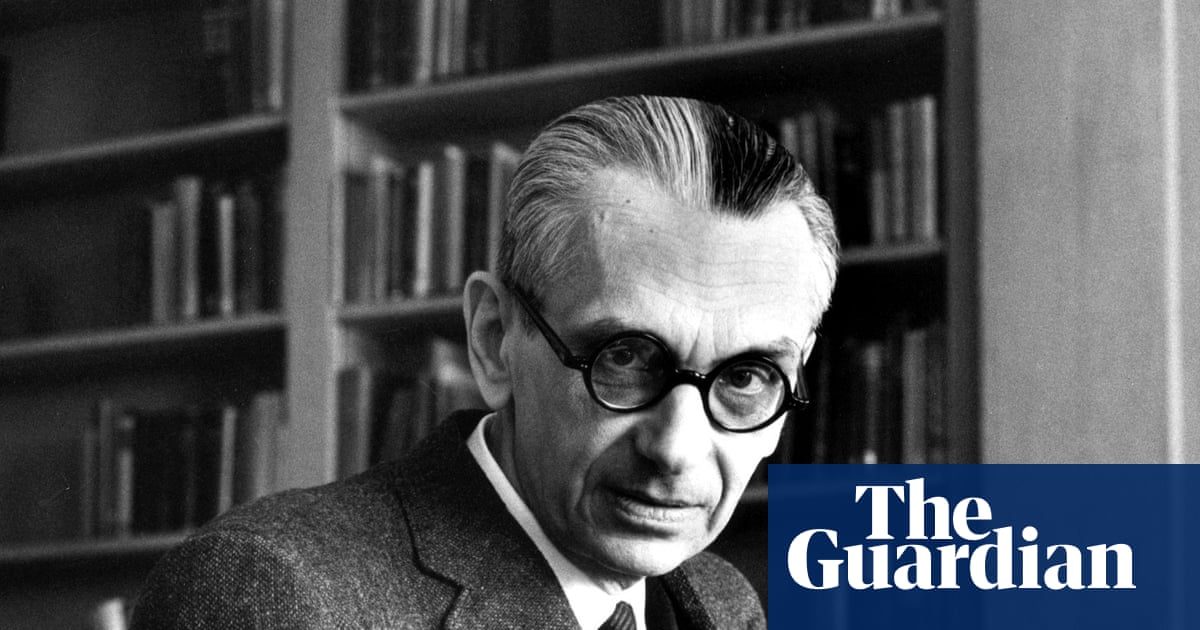
The Austrian logician Kurt Gödel was one of the most original thinkers of the 20th century. His two incompleteness theorems, published in 1931, transformed mathematics and paved the way for the digital age.After his seminal results of the 1930s, Gödel published only a few papers.
His unpublished work, however, runs to tens of thousands of pages, and is of great interest to historians of science.Since 2017, the Finnish logician Jan von Plato has led a project at Helsinki University to understand the contents of 16 notebooks that Gödel wrote in the early 1940s. This material – the “workbooks” – is 1,009 pages of densely written text about maths and logic.
Much of it is written in a German shorthand, Gabelsberger, that was obsolete even when Gödel was using it.Progress in the mathematical understanding of the text was painfully slow – about a page a week – until September, when von Plato enlisted the help of the AI model Claude. Within a couple of days, Claude had provided a comprehensive digest of the entire material, revealing the Gödel had proved hundreds of theorems that no one knew about.The most famous logician of modern times had, in fact, discovered significantly more than anyone had thought.Albert Einstein presenting Kurt Gödel (second from right) with an award at Princeton University, where the two became friends.
Photograph: Bettmann/Bettmann Archive“I was flabbergasted,” said von Plato. “The workbooks not only contain dozens of anticipations of results not known until the 70s and 80s, but they also contain 14 themes in logic that have not been pursued. Gödel was far ahead of his time.”Gödel changed the course of logic because he revealed the limits of mathematical knowledge.
His incompleteness theorems show that in all mathematical systems there are true statements that can neither be proved or disproved. Yet while this result was a blow to previous generations of logicians, who had hoped that all truths were verifiable, Gödel’s work pushed the field in new directions, inspiring Alan Turing to write his 1936 paper that began the theory of modern computation.In 1940, Gödel fled Austria under the Nazis.
He settled in Princeton, New Jersey, and became a close friend of Albert Einstein at the Institute of Advanced Study. Increasingly paranoid in his later years, he refused to each food that was not cooked by his wife, and died of starvation in 1978.Jan von Plato said he started his Gödel project in 2017 because he was facing mandatory retirement from Helsinki University. “What should I do to make myself indispensable?
Oh yes, I’ll start reading Gödel’s enigmatic shorthand pages!” He received a €2.5m (£2.1m) grant from the European Research Council, taught himself Gabelsberger shorthand – “I am one of only six people who can read it in the world” – and assembled a small team.In August, at a conference in France about AI and theorem proving, von Plato met computer scientists who suggested that he co-opt the help of Claude in trying to make sense of the workbooks. On his return to Helsinki he began the process, showing Claude his transcriptions of the workbooks, as well as six books he had previously written on Gödel, and other secondary scientific literature.“In a couple of days, I got to see a 650-page explanation of the workbooks.
It had to be controlled page for page, but it’s basically, a work that is impossible to do for human beings,” he said. “Humans read one page at a time and we tend to forget things. It takes us a year to read about 50 pages.
We just are not able to keep in mind all the different parts.“The AI can connect all the pieces in a thousand pages. It can see all of Gödel’s writings as one piece.”A microfilm image of an example of Gödel’s shorthand from one of his notebooks.
Photograph: Institute for Advanced StudyGödel’s incompleteness theorems revealed the existence of statements whose truths were independent of the system they were written in: that is, they could not be proved or disproved within the system. In 1966, the American mathematician Paul Cohen won the Fields medal, the highest honour in maths, for showing the independence of two well-known mathematical statements: the continuum hypothesis and the axiom of choice.Gödel reacted to Cohen’s Fields medal by saying that he had already proved the result in the 1940s.
Yet when pushed for a proof by his peers, Gödel was unable to reconstruct one from his notes.The first task von Plato set Claude was to discover if Gödel’s workbooks had a proof of the independence of the axiom of choice, which would reveal that Gödel had been telling the truth in 1966. The answer came back: yes, almost. “He was just one step away,” said von Plato. “There’s one definition that Gödel got wrong, but he had the right definition two years earlier, and so the thought is that he would have arrived at the right definition anyway if he had just continued for a few months.
For me, the architecture of his proof is just wonderful. It makes all of these results of set theory follow a uniform pattern.“What strikes me especially is that he starts from ideas.
He’s not like someone who plays with formulas and hopes to arrive somewhere. He has very, very clear ideas, and then he’s methodical.
Step after step he goes ahead and he manages to fulfil the aims that he has in this formal work.”Von Plato said that when Claude presented him with the reconstructed proof of the independence of the axiom of choice, he ran it through the proof assistant Coq, a program that verifies the validity of mathematical proofs, and it passed. Von Plato believes that had Gödel published his work on the axiom of choice he would have won the 1940 Fields medal.“Maybe he felt that when Cohen got the medal, that that was something he sort of missed.”In further discussions with Claude, von Plato asked the AI model to extract all theorems in the workbooks for which Gödel either had a proof, had sketched a proof or had an idea for a proof.
Claude found 663. When these results were put into Coq: “About 400 were verified as stated, about 200 were repaired, meaning that perhaps the statement of the theorem had to be made more precise, or some assumption had to be added.
About fifty were false, and this is no wonder. Gödel himself, when rereading his notes, would occasionally add a marginal remark: falsch! or schlecht! [bad].”Von Plato added: “I am sure that the continued study of Gödel’s manuscripts will reveal further treasures.
The workbooks contain, Claude says, more than a dozen themes in logic and foundations of mathematics that have not been found in the 80-plus years since they were written down. So this is one thing to explore.
But there are many others. His physics and cosmology notebooks are an unknown territory I plan to start exploring once I am finished with my present logic projects.”Joel David Hamkins, a professor of logic at the University of Notre Dame, has not seen Claude’s reconstruction of Gödel’s proof of the independence of the axiom of choice, but said that if it stood up “it is remarkable and historically interesting.
Although how much is Claude and how much is Gödel is a job for the historians.”He said: “The fact that there are things in there that resemble [Cohen’s proof] does not mean he had it. It shows he was on the path.
You don’t get credit for work you don’t tell anyone about. But Gödel had so many ground-breaking ideas that it is maybe not surprising that his notebooks are full of exciting things.”