


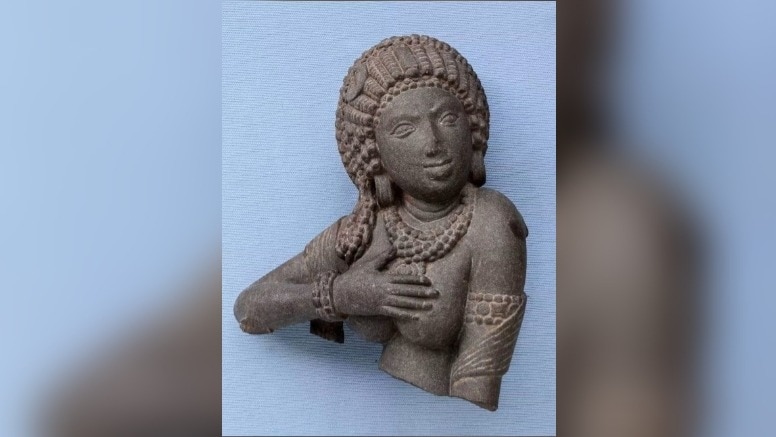
A 1,500-year-old statue depicting a woman adorning herself has been discovered in Madhya Pradesh's Panna district, offering a rare glimpse into the aesthetics, jewellery traditions and cultural practices of women during the Gupta era.Unearthed during excavations by the Archaeological Survey of India (ASI) at Nachna village in Saleha tehsil, the 4th–5th-century sculpture stands out for its intricate craftsmanship and remarkable detailing of ornaments and hairstyle, reflecting the refined artistic sensibilities of the period.The approximately 20-centimetre-tall sculpture, carved out of grey sandstone, depicts a woman seemingly engaged in the act of grooming or decorating herself.Its finely polished surface and delicate features make it a striking example of ancient Indian artistry. The figure is adorned with a decorative clip-like accessory in her hair, while a seven-stranded necklace rests around her neck.
Bangles encircle her wrists, and beautifully carved armlets adorn her upper arms.The attention given to these details offers an intriguing picture of how women dressed and accessorised themselves nearly 15 centuries ago. From the carefully arranged hairstyle to the elaborate jewellery, the sculpture captures an aesthetic tradition in which personal adornment was closely associated with beauty, elegance and cultural expression.RARE TESTAMENT TO GUPTA-ERA ARTAccording to experts, Superintending Archaeologist with the ASI, the sculpture dates back approximately 1,500 years and belongs to the Gupta period.The 4th–5th-century artefact is considered significant for its artistic and historical value, particularly because representations of women engaged in self-adornment are relatively uncommon in Gupta-era sculptures.The precision with which the ornaments, hairstyle and other features have been carved into the stone highlights the exceptional craftsmanship of artisans of the time.Despite its relatively small size, the sculpture preserves intricate details that provide valuable clues about contemporary fashion, jewellery-making traditions and aesthetic preferences.In the broader history of Indian sculpture, notable examples of similar depictions include the 'Lady of Gyaraspur' and the 'Sukhnayika', housed in the Khajuraho Museum.However, the newly discovered Nachna sculpture is believed to be considerably older than both, potentially making it an important addition to the study of the evolution of Indian sculptural art.NACHNA’S HISTORICAL HERITAGE: NEW DIMENSIONNachna is already recognised for its rich Gupta-era architectural heritage, particularly the Parvati Temple and the Chaumukhnath Temple, both of which hold considerable historical and religious significance.The discovery of the statue adds another dimension to the village's archaeological importance.While its temples offer insights into the architectural and religious traditions of the period, the newly unearthed sculpture provides a more intimate understanding of everyday aesthetics, women's adornment and prevailing cultural practices.The figure also demonstrates how artistic representations of human life and beauty were integrated into the sculptural traditions of ancient India.PRESERVING INVALUABLE HERITAGEThe ASI is planning to preserve the sculpture and display it in a museum, enabling researchers, historians and visitors to appreciate this rare example of Gupta-period craftsmanship.Beyond its artistic appeal, the discovery is valuable for the historical insights it offers into women's appearance, jewellery and beauty traditions during the Gupta era.Once preserved and made accessible to the public, the sculpture is expected to attract interest from archaeologists and history enthusiasts.- EndsInputs by Dharmendra Sahu