


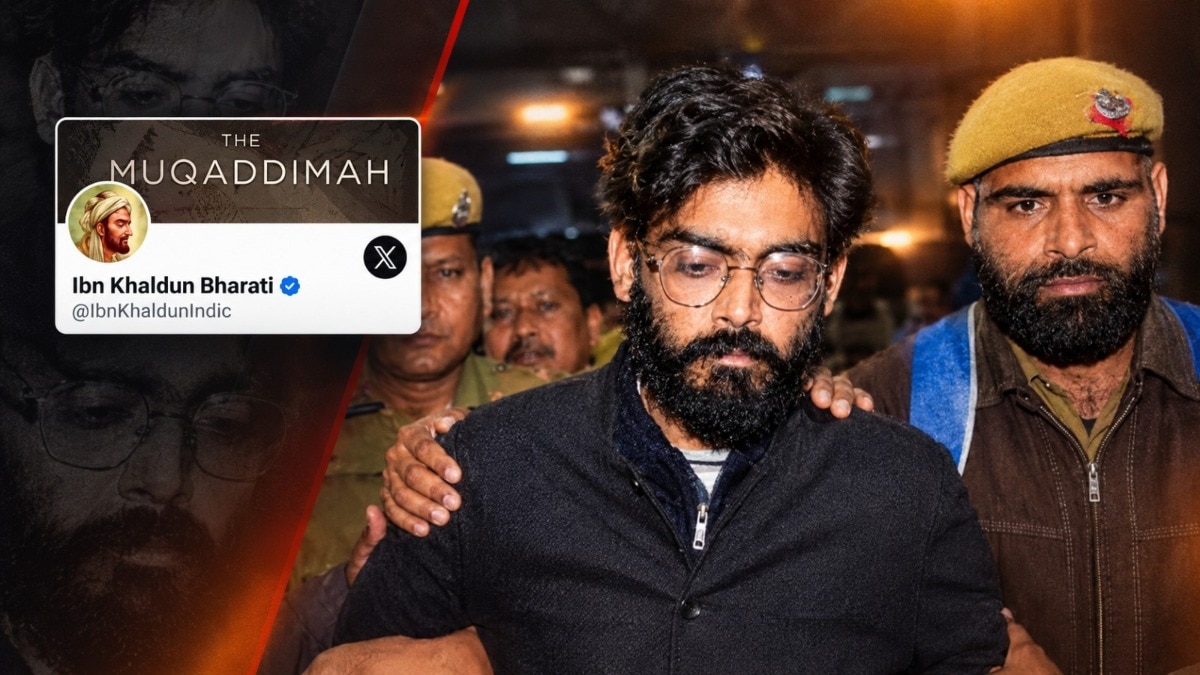
Delhi riots plot-accused Sharjeel Imam attacked India's Constitution, its founding principles and secularism in an interview. An opinion, written under the pen name Ibn Khaldun Bharati, countering those views has triggered a massive debate.
Here's a detailed look into the controversy.Ibn Khaldun Bharati's rebuttal to Sharjeel Imam's views sparked a row over the former's anonymity. An interview and an opinion countering it have opened old wounds and triggered a fresh debate.
The spark was lit by an interview of Sharjeel Imam, who is being tried in the 2020 North-East Delhi riots larger conspiracy case, in news portal The Quint. An opinion piece published in ThePrint under the pseudonym Ibn Khaldun Bharati, a name the author writes under, challenged Sharjeel Imam's radical arguments and drew criticism from a section of readers who questioned the writer's anonymity.While the interview was published almost three weeks ago, it was the critical opinion piece and its amplification on social media that drew attention to it.
However, more than the content of the argument, it was the anonymity that seemed to trigger a section of people, with some trying to dox the author.A word of caution. This piece will be riddled with quotation marks because of texts from both the pieces and the reactions of a diverse section of people, including from experts, politicians and activists.Let us start from where it all began, the Sharjeel Imam interview which was published on September 29 with the headline 'Sharjeel Imam on Jail, Politics, Secularism & What Lies Ahead for Indian Muslims'.
SHARJEEL IMAM'S VIEWS ON PARTITION AND SECULAR FRAMEWORKOn Partition, Sharjeel Imam said, "...The actual truth is that the Brahminical forces in Congress, along with capitalist cliques wanted a centralised India to exploit the resources with impunity, and hence rejected Muslim League's demand for decentralisation and partitioned the country...""The Secular framework is devoid of any real understanding of history and is particularly Islamophobic and parochial," he wrote. Sharjeel challenged "the existence of an ancient Indian nation as a myth, arguing, "Nehru's 'Discovery of India' was a very good example of an exercise in this falsehood and mythmaking."Despite his extreme views on the Constitution, the country's founding principles and its secular framework, the interview didn't cause a major backlash as it went largely unnoticed.IBN KHALDUN BHARATI COUNTERS SHARJEEL IMAM, LIBERALSOn October 17, an opinion piece, titled "Sharjeel Imam's Islamist manifesto will be forgotten, The silence of liberals will not", was published in The Print.
The piece, published under the pseudonym of Ibn Khaldun Bharati, called Sharjeel's views "anti-national", and questioned the liberals.The opinion itself expressed surprise that "no storm has been kicked up over [Sharjeel's] pronouncements.""This piece — not the first in his brazen oeuvre — is a litany of indictments against the liberal class: its philosophy, ethos, and politics. He contemptuously rejects any suggestion of a difference between liberals and Hindutvadis.
For him, both are simply Hindus," wrote Ibn Khaldun Bharati.In the opinion, Bharati attacked the left-liberals, saying, "Already debilitated by such pseudo-philosophy, the Indian left-liberals — dependent as they are on the Muslim vote bank for survival — would rather risk Islamist domination than tolerate nationalist politics."The author's profile page has a one-line bio, introducing them as "Ibn Khaldun Bharati is a student of Islam, and looks at Islamic history from an Indian perspective."MASSIVE DEBATE OVER IBN KHALDUN BHARATI'S ANONYMITYThe debate spread like wildfire after Shekhar Gupta, the founder and editor-in-chief of The Print, shared the opinion piece on X with some excerpts on October 19."I agree with some of the points raised but who is this anonymous character calling himself Ibn Khaldun Bharati to raise such serious concerns," wrote historian S Irfan Habib.Journalist Parth MN shared Shekhar Gupta's post and asked who Ibn Khaldun Bharti was. "Couldn't you find someone who is an expert on Islam and is not hiding behind a pseudonym?"Mujib Mashal, the South Asia bureau chief of The New York Times, questioned the need to have a "pseudonym" columnist, saying such a practice was understandable for a "whistleblower" or "personal story of risk". Mashal questioned the "accountability".However, under India's media laws, accountability rests as much with a publisher and a platform as much with reporters and columnists.Ibn Khaldun Bharati countered Mashal, "Say this that you didn't want this article to be written, and Sharjeel's doctrine to be challenged.
If you did, you would have written one yourself."Bharati said that instead of engaging with the arguments in his opinion piece, Mashal was "obsessed with the Aadhaar Card behind the pen-name".Bharati also invited Irfan Habib to write a rejoinder to his article.Former Trinamool Congress MP Saket Gokhale attributed Sharjeel Imam's "bitterness" to him being "locked up and deprived of his basic freedom to move for six years without trial".When Ibn Khaldun Bharati countered Gokhale, saying that Sharjeel held such views long before his incarceration, the politician refused to engage with him, referring to his pseudonym. Gokhale also accused the columnist of "dogwhistling".Some even tried to dox the columnist and called them an IPS officer.
Some others, like journalist Ghazala Wahab, attached a name to him, which we will not amplify."When a Hindu criticises his religion, he can do that openly. But when a Muslim does it to his, he needs a pseudonym.
You know very well why," author Amit Schandillia wrote on X.PEOPLE BACK CHOICE OF ANONYMITY TO EXPRESS OPINIONVeteran journalist R Jagannathan questioned Parth MN and others, asking why the columnist's identity mattered more than his arguments.Analyst and columnist Amana Begam Ansari called out people "obsessing" over the author's identity but not getting into the merits of his arguments."Having read Ibn Khaldun for years, I find the obsession with the author's real identity to be a glaring indictment of our community's failure to protect and understand its dissent voices," wrote Ansari, who works for The Print."Yet, instead of engaging with the actual arguments or addressing Sharjeel's stand, people are wasting energy policing a pseudonym," Ansari said on X, adding that she stood "firmly" with Ibn Bharati.Sharjeel Imam was arrested in January 2020 for delivering inflammatory speeches during the protests against the Citizenship Amendment Act (CAA) and the proposed National Register of Citizens (NRC).In a speech at Aligarh Muslim University on January 16, 2020, he called for blockading roads and railway lines along the strategically important Siliguri Corridor to cut off Assam and the Northeast from the rest of India and intensify the anti-CAA protests. He was subsequently charged under the Unlawful Activities (Prevention) Act (UAPA) in the larger conspiracy case linked to the February 2020 Northeast Delhi riots.A Delhi court in 2025 framed charges against Sharjeel Imam and 10 others for their involvement in violence that broke out during the 2019 anti-Citizenship Amendment Act (CAA) protests in the national capital's Jamia Nagar area.As the issue snowballed into a controversy, Assam Congress spokesperson Reetam Singh spoke about how he met a 22-year-old IIT Guwahati student in Guwahati Jail who had been radicalised by Sharjeel's videos.Lodged in jail for over six years, Sharjeel Imam has occasionally been giving interviews and getting his pieces published on certain platforms.
However, it is the counter to his radical views that has now triggered a bigger storm, not over the arguments, but over the anonymity of the author.- Ends(Written by Sushim Mukul)