


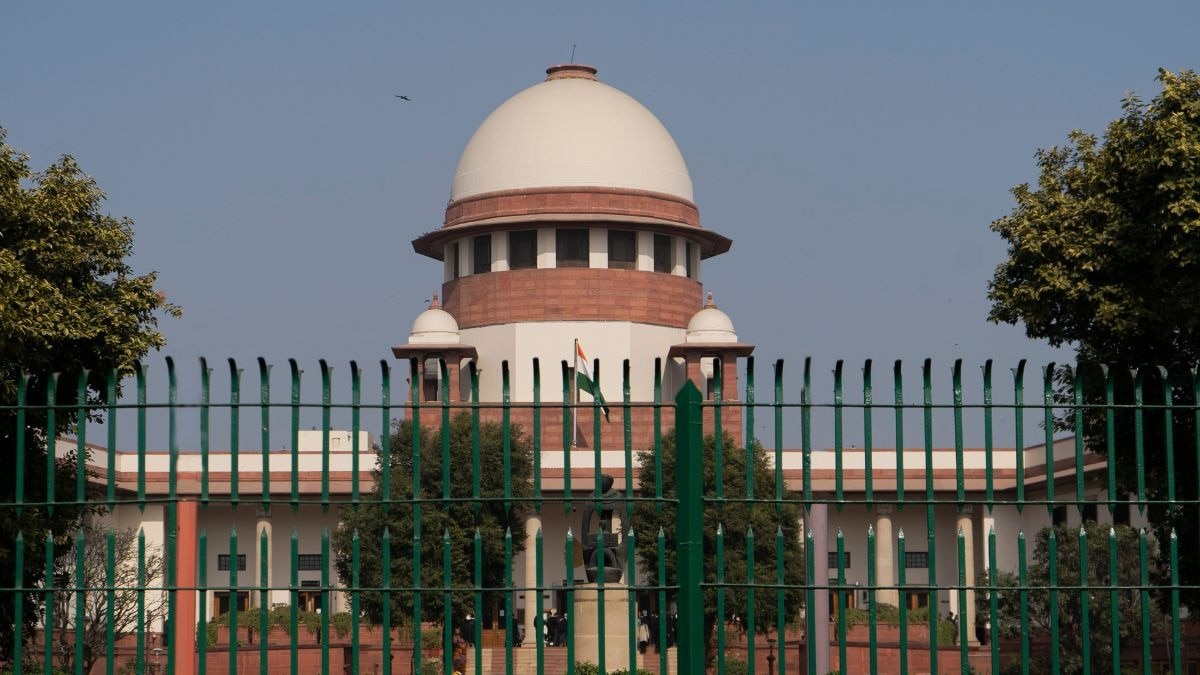
Pardiwala and K.V. Viswanathan on October 16 warned the additional solicitor general that if the problem wasn’t solved before the next date of hearing, they would sit on a “dharna” at the high court’s main gate and “not go home until you [the state government] complete the work”.
While the remark was made in a lighter vein, it highlighted the delay in resolving a problem that impacted thousands of pedestrians every day and which the court had been pursuing for over a year.In October 2025, the bench had delivered an order in a landmark public interest litigation (PIL) on road safety (S. Rajaseekaran Vs Union of India) in which it issued directions on five key aspects aimed at reducing road accidents and fatalities—safety of pedestrians while walking on footpaths; making pedestrian crossings safe; wearing of helmets; wrong lane driving and unsafe overtaking; and the use of dazzling headlights, unauthorised strobe lights and illegal hooters.With reference to the 50 cities for which the Ministry of Road Transport and Highways (MORTH) publishes annual road accident statistics, it directed the road-owning agencies in these cities to start an audit of existing footpaths and pedestrian crossings to ensure they complied with the Indian Roads Congress guidelines wherever possible.
Noting there were a number of instances where foot overbridges or subways were not being used or well-maintained, the court said the situation had “fostered behavioural inertia, with many pedestrians choosing to cross at grade even where such facilities exist, highlighting the urgent need for a combination of design improvements, public awareness initiatives, and enforcement measures to ensure better utilization and safer pedestrian movement”.It also directed the road-owning agencies in these 50 cities to draw up an action plan and start a phase-wise survey to assess the requirement for additional pedestrian crossing facilities in high-volume zones. “We direct that first priority be given to the road-crossing at the Delhi High Court and the National Zoological Garden on the Mathura Road,” said the October 7, 2025 order, giving authorities a deadline of seven months. A year later, in a review on September 15, the court again directed the authorities to design safety measures urgently, followed by another reminder on September 28.
The apex court has been pushing authorities for basic pedestrian amenities on numerous occasions. On June 19, a bench comprising Justices P.S.
Narasimha and Atul S. Chandurkar held that the right to walk on safe, demarcated footpaths is a fundamental right flowing from the Constitution’s Article 19(1)(d), which provides for freedom of movement, and Article 21, which guarantees the right to life.
The court declared pedestrian rights were “primary” and must take precedence over motorised traffic.Hence, every municipal corporation, urban development authority and panchayat now has an enforceable legal duty to build and maintain safe footpaths. “If a road exists, there must then be a duty to ensure that a footpath is demarcated and maintained for the walkers. This is an enforceable duty,” said the judgment. “It is necessary, rather compelling, that we first disabuse our minds of associating this ‘right to move’ only with movement on wheels.”While the June 19 judgment arose from the tragic death in 2014 of a school-going, five-year-old child who was forced to walk on a road because there was no footpath, the bench is now pursuing the matter via a PIL titled ‘Fundamental Right to Walk and Footpath’.On October 5, the bench comprising Justices Narasimha and Alok Aradhe directed the Centre to identify an authority, which would be responsible for implementing the need for establishing footpaths. “We are of the opinion that at least five towns can be identified in the country to start a pilot project for provisioning footpaths wherever the road exists,” it said in an order.Subscribe to India Today Magazine- Ends