


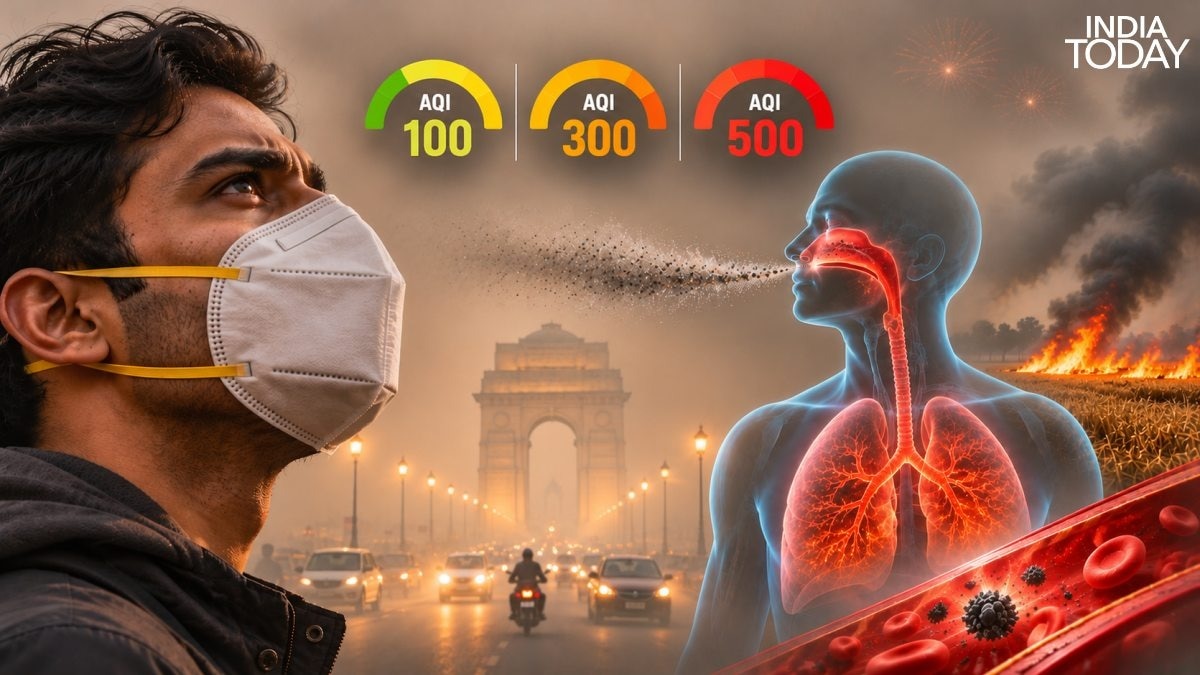
A sore throat, burning eyes or persistent cough can be among the first signs that polluted air is affecting the body.Delhi woke up to severe air pollution on Monday, November 9, after a night of Diwali celebrations and firecracker bursts pushed its Air Quality Index (AQI) above 400, into the 'severe' category, according to the Central Pollution Control Board (CPCB).The alarming deterioration followed an already prolonged spell of poor air quality across Delhi-NCR, with pollution worsening in the days leading up to the festival.But what happens to the human body as air pollution rises? What changes when the AQI crosses 200, 300 or 400, and when does breathing polluted air begin to take a serious toll?
A person shows the present AQI during a protest against the government's lack of action to combat air pollution in the capital city New Delhi. For starters, the AQI rises when one or more pollutant concentrations increase.India’s Central Pollution Control Board (CPCB) classifies AQI into six categories: Good (0–50), Satisfactory (51–100), Moderate (101–200), Poor (201–300), Very Poor (301–400) and Severe (401–500).
In India, high readings are often driven by PM2.5 and PM10, though their concentrations do not necessarily rise together. The pollutant with the highest relevant sub-index determines the overall AQI.However, it's not just the concentration of pollutants that plays a role.“Pollution episodes may involve higher concentrations of existing pollutants, but their chemical composition can also change depending on emissions, atmospheric reactions and meteorological conditions,” says Sachchida Nand Tripathi, professor at IIT Kanpur. "Combustion emissions can increase primary organic aerosols, while atmospheric processing can produce secondary aerosols." Children look on as an anti-smog gun sprays water to disperse pollutants in Delhi.
This means that two days with the same AQI may not have identical pollution mixtures or health implications. Furthermore, the risks also depend on how long people are exposed and their individual health.“There is no universally accepted ‘safe threshold’ below which air pollution has zero health effects,” says Dr Arindam Datta, Senior Fellow and Fulbright Scholar at TERI’s Centre for Air Quality Research.Risks generally rise with exposure rather than appearing suddenly at a particular AQI reading.
Which brings us to the readings.AQI 100–200: THE FIRST STAGEAt 100, air quality is at the upper end of the Satisfactory category.According to CPCB, this AQI level may cause minor breathing discomfort in sensitive people. Traffic moves on a road shrouded in smog as air pollution spikes, in New Delhi.
At 200, CPCB's advisory identifies people with lung or heart disease, children and older adults as more vulnerable.PM2.5 can travel deep into the lungs, reaching the air sacs where oxygen passes into the bloodstream. These particles can irritate the eyes, nose and throat.With greater exposure, airways can become inflamed and produce more mucus.
People with asthma or chronic obstructive pulmonary disease (COPD) may experience worsening symptoms, while healthy people may notice irritation or breathlessness during physical activity.Dr Prasanna Kumar T, head of respiratory medicine at Ramaiah Memorial Hospital in Bengaluru, says air pollution affects several organs, not just the lungs. Commuters wade as smog envelops the area amid deteriorating air quality in Delhi-NCR.
AQI 200–300: BEYOND THE LUNGSAs exposure increases, fine particles can trigger inflammation and oxidative stress, which is an imbalance in which reactive molecules overwhelm the body’s antioxidant defences and damage cells.These responses can affect blood vessels, placing additional strain on the cardiovascular system.People with asthma, COPD or heart disease may experience flare-ups, while healthy people may notice coughing, chest tightness or reduced exercise tolerance. People exercise in a park shrouded in smog as air pollution spikes, in New Delhi.
Dr Kumar says particle exposure can contribute to blood vessel inflammation and increase the risk of complications such as heart attacks and strokes, particularly among susceptible people.AQI 300–400: CONSEQUENCES OF CONTINUOUS EXPOSUREAQI 301–400 falls in the Very Poor category.CPCB warns that prolonged exposure can cause respiratory illness.At these levels, repeated exposure can make existing respiratory conditions harder to manage and increase the strain on people with underlying heart disease. Pedestrians wear masks as a layer of smog engulfs the city amid deterioration in the capital's air quality.
The consequences can extend across stages of life.Dr Kumar points to links between long-term air pollution and impaired lung development in children.Exposure during pregnancy has also been associated with premature birth and low birth weight.AQI 400–500: EVEN THE HEALTHY AT RISKAQI 401–500 is classified as Severe, the highest category on India’s national scale.CPCB warns that respiratory effects can occur even among healthy people, while those with existing diseases may face serious health impacts.“At AQI 400–500, pollution represents a serious health concern even for healthy individuals,” says Tripathi. "Exposure can cause airway irritation, reduced lung function and cardiovascular stress." A digital board shows high AQI levels recorded in Delhi-NCR. The immediate symptoms may include coughing, throat irritation, wheezing, chest tightness and breathing difficulties.Fine-particle exposure is also associated with increased risks of heart attacks, irregular heart rhythms and strokes.But the danger can grow further when severe pollution persists for several days.Repeated exposure can prolong respiratory inflammation, worsen asthma and COPD, and increase cardiovascular complications and emergency hospital visits.Children, older adults and people with existing illnesses are particularly vulnerable.
Outdoor workers, including traffic police, construction workers and delivery riders, may face additional risks because their work keeps them outside for extended periods. Commuters walk past amid low visibility due to a thick layer of smog.
NUMBERS DON'T TELL THE WHOLE STORYAn AQI reading cannot capture every aspect of exposure or individual health risk.Tripathi says India’s AQI system communicates pollution severity, but even a Satisfactory reading does not mean air is free from health risks.At the category’s upper end, an AQI of 100 can correspond to PM2.5 concentrations of 60 micrograms per cubic metre, which is four times the World Health Organisation’s 24-hour limit of 15 micrograms per cubic metre.CPCB’s health categories offer basic warnings, but Tripathi says they could better explain cardiovascular risks, cumulative exposure, vulnerable populations and effects below AQI 100.Duration matters too. A motorist wearing a face mask drives through evening smog in New Delhi.
A few hours at AQI 400 may cause acute effects, while several days at 250–300 may produce greater cumulative exposure. But AQI values cannot simply be multiplied by time.Inhaled dose of polluted air depends on pollutant concentration, exposure time and breathing rate.Physical activity increases breathing rate, so someone exercising outdoors may inhale more pollution than someone resting nearby.Limiting strenuous outdoor activity during severe episodes, using a well-fitted N95 or FFP2 mask outdoors and reducing indoor sources such as smoking and incense can help lower exposure.The bottom line is that a reading of 199 is not automatically safe, just as 201 does not mark a sudden medical turning point.Pollutant type, chemical composition, concentration, exposure duration and individual susceptibility all matter.The AQI, at the end of the day. is a warning system, not a complete account of health risk.- Ends