


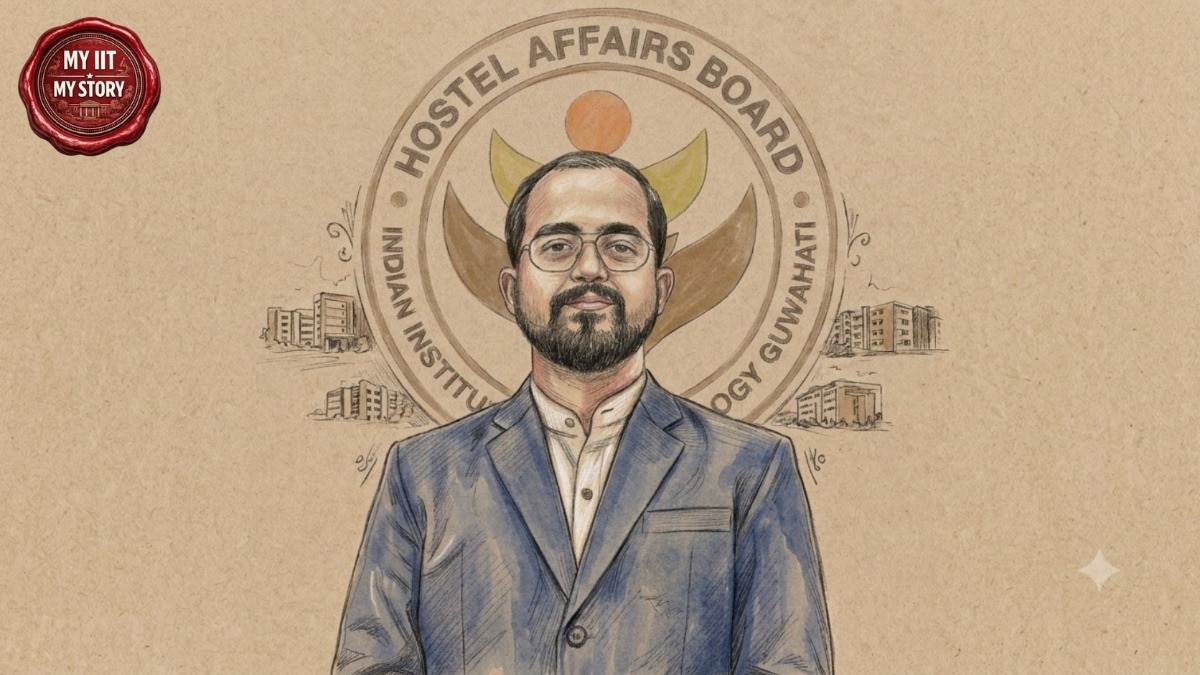
There are two very different kinds of problems Rahul Deka deals with at the Indian Institute of Technology (IIT) Guwahati. One involves studying how cancer cells behave in laboratory models.
The other can involve a hostel-related complaint, an infrastructure issue or a student waiting for something to get fixed.The first takes him to a laboratory on the third floor of the Centre for Nanotechnology. The second can take him into hostel corridors, administrative offices and meetings where the concerns of students are discussed.Somewhere between the two, there is time for a cup of chai, a walk by the lake or a late-night visit to the hostel canteen.A seventh-semester PhD scholar at the Jyoti and Bhupat Mehta School of Health Sciences and Technology, Deka is also the General Secretary of the Hostel Affairs Board, Students' Gymkhana Council, for 2026–27.
A Guwahati native, he has come to inhabit two sides of campus life: the intensely focused world of research and the unpredictable business of student administration. His day does not always follow a timetable.
An experiment may require his attention in the morning, while an unexpected hostel issue could change the day's plans. A view of the hostel "As General Secretary of the Hostel Affairs Board, you may face unexpected issues at any time," he says. "A day can shift quickly from experiments and data analysis to hostel inspections, meetings, or student concerns." It is an unusual combination of responsibilities, but perhaps an especially revealing way to experience an IIT.
Because while the laboratories are busy producing research, somebody also has to ensure that the residential campus functions, that student concerns are heard and that everyday problems find solutions.And not every problem comes with a straightforward answer.THE SCIENCE OF CELLS AND THE BUSINESS OF CAMPUS LIFEInside the Soft Materials and Micro/ Nanofluidics Laboratory, Deka works on research involving the mechanical properties of cancer-cell systems in laboratory models. The broad interest is in understanding how the physical characteristics of cells and tissues relate to their behaviour, including invasion.The laboratory works across several interdisciplinary areas, including microfluidics, soft matter, rheology, biomaterials and point-of-care diagnostics.One of the interesting things about the space is its range of printing technologies.
There are conventional 3D printers, a CELLINK 3D bioprinter and a Fujifilm electronic-materials printer. The technologies serve different purposes, bringing together engineering, biology and materials science."I like the range of printing technologies in our laboratory," Deka says. "Each serves a very different research purpose, so seeing the same basic idea — printing — translate into engineering, biology, and materials science is fascinating."He also works with the department's confocal microscopy platform, an advanced imaging system, and is trained as a system operator.His research is guided by Prof.
Dipankar Bandyopadhyay, whose mentorship, Deka says, encourages students at different levels to engage deeply with research.Outside the laboratory, however, the problems are less likely to be solved with an instrument.Deka has a particularly amusing observation about campus administration: even a seemingly minor infrastructure change can involve multiple levels of approvals and paperwork."There are good reasons for institutional processes, but students often discover that something which looks like a ten-minute job can take much longer once it enters the formal system," he says.It is a small but telling detail about life inside an institution, he notes, adding: "An IIT may look like a well-oiled academic machine from the outside, but students encounter the everyday imperfections that come with running a large residential campus.""Even a premier institution is always a work in progress," Deka says. "What makes the experience meaningful is that people here are constantly trying to improve systems, opportunities and campus life rather than assuming excellence is automatic."A MINIATURE INDIA, THREE LAKES AND A MIDNIGHT CANTEENAsk Deka to describe hostel life and he does not begin with the rooms, furniture or facilities."A hostel floor is really a miniature version of India," he says.Students from different states, academic programmes, languages and cultural backgrounds live just a few doors apart. Over time, the corridor becomes a meeting place for different food habits, conversations and personalities.There are also the familiar negotiations of hostel living.
During placement season, black shoes, white shirts, ties and suits become some of the most commonly borrowed items. Before examinations, reading rooms and multipurpose halls suddenly come alive.There is a long-running IIT joke that serious studying begins the night before an examination.
Deka thinks hostel life often makes that joke look surprisingly accurate.Food, meanwhile, is an important part of the daily routine. His breakfast preference is uttapam, while lunch means cabbage-matar sabji with roti and egg poach.
For dinner, he has a particular fondness for Assamese-style chicken with peas pulao, preferably followed by hot gulab jamuns.And when the clock moves past midnight, hostel canteens become social spaces of their own."Students can usually find quick comfort food such as parathas, Maggi, fried rice and similar snacks while studying or taking a break," he says.But not every break involves food. IIT Guwahati has three lakes, and their surroundings are among the popular places to unwind.
Some students head towards the indoor sports complex; others walk along the old Guest House road towards an area fondly called Mini Goa.Deka's favourite hidden corner is the upper floor of the IIT Guwahati Research Park."From there, you can see the vast Brahmaputra in the distance," he says. "It is one of those places where the scale of the landscape immediately slows you down and gives you a moment of calm."The campus also has its own nighttime beauty. The administrative building precinct, the Lakshminath Bezbaroa Central Library and Dr.
Bhupen Hazarika Auditorium look different when illuminated after dark.THE PEOPLE WHO MAKE AN IIT FEEL LIKE HOMEDeka's responsibilities have also made him look beyond the familiar campus characters — students, researchers and professors.He remembers security personnel who formed a Bihu dance team and performed during campus occasions. Their performances, he says, were warmly received by students, faculty and staff.It is a reminder that campus culture is not created by students alone.He also mentions Narayan Kalita, a non-teaching staff member who has been on campus long enough to be familiar to people across generations.And then there are the teams working in infrastructure, maintenance, sanitation, gardening, water supply and electricity."Their work often happens in the background, but the campus could not function for even a day without them," Deka says.This wider understanding of campus life also informs his idea of student leadership.
For him, the tradition of students taking responsibility for their surroundings should never disappear.The annual cultural festival Alcheringa is another expression of that student energy. One of the major celebrations at IIT Guwahati, it brings a different atmosphere to campus.
Deka is particularly looking forward to the 2027 edition during his tenure as a Gymkhana executive.His favourite observation from such festivals is the stamina of students who dance through one performance after another. Watching them, he says, makes a music festival look like a serious cardio workout.There is, however, no suggestion that life at an IIT is effortless.
Deka believes one of the biggest misconceptions is that getting into the institute automatically makes everything fall into place."The environment is highly competitive and opportunities still require sustained effort, initiative and resilience," he says.When he eventually leaves IIT Guwahati, his laboratory and department will be among the first things he misses. But he is clear that the campus itself will matter more than any one building."I would miss the campus itself — the freedom it gave me to discover what I enjoy, what I value, and what I may want to do in the future."For someone whose days move between examining cancer cells and addressing the concerns of hostel residents, perhaps that freedom is the most important part of the experience.An IIT, after all, is not just a place where people learn to solve problems in laboratories.
It is also where they learn to recognise the problems around them — and sometimes take responsibility for fixing them.- Ends