


There are two mysteries that human beings are still struggling to fathom. One is small, the human brain.
The other is the limitless universe. In his quest for knowledge, man has tried to slice through the brain, and sent probes into space.
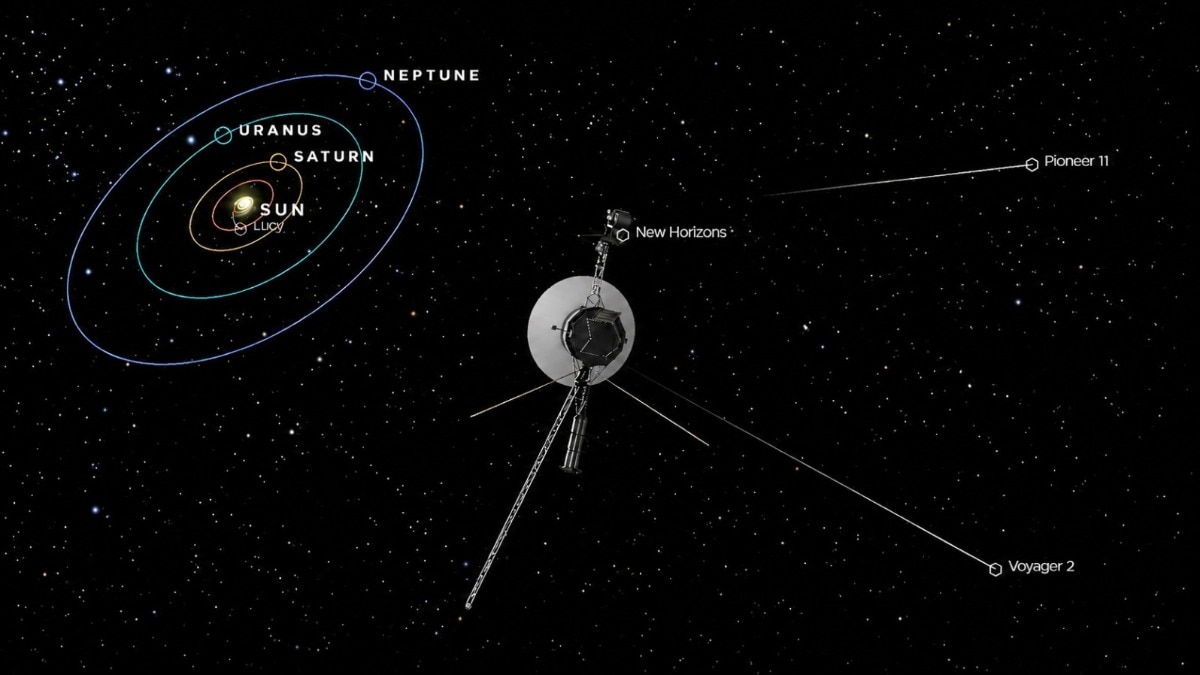
The Voyager 1, was one such. Today, at 3:46:07 PM India time, it became the first man-made object to reach a distance of one light day.Space is so vast that our traditional metrics to measure distances fall way short.
So, we use the speed of light to measure distances. On November 18, 2026, at 10:16:07 GMT, Voyager 1 travelled to a light day away from Earth.Light is the fastest moving entity in the universe.
A light day is the distance light takes to travel in vacuum in one Earth day or 24 hours.One light day, or the distance which Voyager 1 has travelled now is 25.9 billion kilometres away from Earth. This is the farthest that any man-made object has ever reached.
Nasa launched Voyager 1 on September 5, 1977, to fly by Jupiter and Saturn. According to Nasa, Voyager 1 was speeding out of the solar system "when mission managers commanded it to look back toward home for a final time".
The 60 images it clicked was used to create the first "family portrait" of our solar system.That was when Voyager 1 was about 6 billion kilometres from the Sun. It was astronomer Carl Sagan's original idea in 1981, according to Nasa, to use the Voyager cameras to image Earth.The image clicked on February 14, 1990, in which earth appeared as "just a point of light about a pixel in size" came to be known as Pale Blue Dot.
Those were the last images Voyager 1 would click as mission planners switched off its cameras to save energy for the long journey ahead.Sagan, says Nasa, knew the earth would appear as a tiny speck. "This was precisely why Sagan and other members of the Voyager team felt the images were needed — they wanted humanity to see Earth's vulnerability, and that our home world is just a tiny, fragile speck in the cosmic ocean."Sagan published the Pale Blue Dot: A Vision of the Human Future in Space in 1994 and used philosophy to interpret the image of Earth. He critiqued the "folly of human conceits"."That's here.
That's home. That's us.
On it everyone you love, everyone you know, everyone you ever heard of, every human being who ever was, lived out their lives on a mote of dust suspended in a sunbeam," Sagan wrote of the image, according to the Nasa website."There is perhaps no better demonstration of the folly of human conceits than this distant image of our tiny world," he said. "To me, it underscores our responsibility to deal more kindly with one another, and to preserve and cherish the pale blue dot, the only home we've ever known."Sagan died in 1996, two years after his book was out. He was 62.Since the Pale Blue Dot was clicked, Voyager 1 has travelled billions of kilometres.
It entered interstellar space, beyond the vast, bubble-like region of space surrounding the Sun and the solar system, in August 2012. It is now 26 billion kilometres away from Earth, from where the Pale Blue Dot won't even be visible.To celebrate the day, Nasa asked people around the world to send a signal skyward and "celebrate Voyager 1's incredible journey and its milestone of reaching one light-day from Earth".Today is historic because Voyager 1, a man-made object has travelled the farthest from Earth, making it to a place where commands to it would take more than an earth day to reach.
This reveals human enterprise. But also provides the opportunity for a sobering thought.
Man isn't even a speck on the Pale Blue Dot, which, in isn't even a speck in the cosmos.- Ends(Written by Yudhajit Shankar Das)