


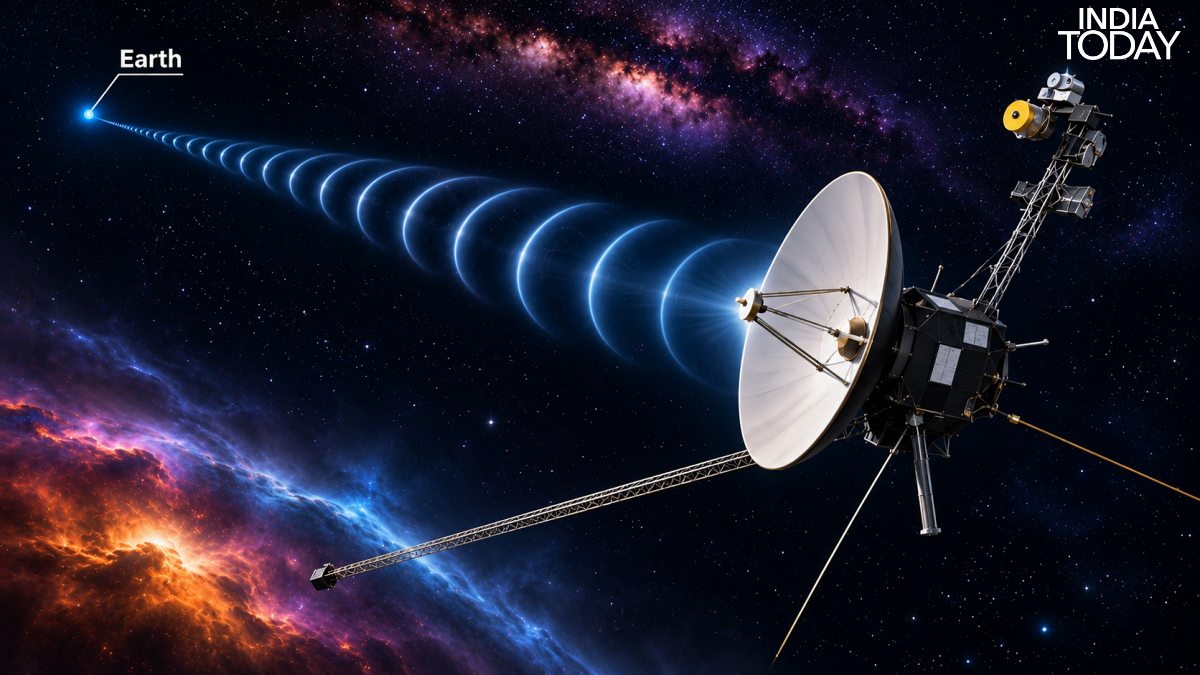
Voyager 1 has travelled farther than any human-made object. Find out how its 1970s technology, nuclear power source and ageing systems keep it going.Nearly 49 years after leaving Earth, Nasa's Voyager 1 has crossed a milestone that puts the sheer scale of interstellar space into perspective.
On November 18 at 3:46 PM IST, the spacecraft became the first human-made object to travel one light-day away from Earth, reaching a distance of approximately 25.9 billion kilometres.But this is not a milestone measured in time. It is a milestone of distance.A light-day is the distance light travels in 24 hours at approximately 3,00,000 kilometres per second.
For Voyager 1, travelling at around 61,000 kilometres per hour, reaching this distance has taken nearly five decades.The milestone also means that a radio signal sent from Earth will take approximately 24 hours to reach the spacecraft. Any response from Voyager 1 will take another 24 hours to return, making even a simple exchange with the spacecraft a two-day affair.
According to Nasa, Voyager 1 reached the one-light-day mark at 3:46 PM IST on November 18.A JOURNEY THAT BEGAN IN 1977Voyager 1 was launched on September 5, 1977, just 16 days after its twin, Voyager 2. The two spacecraft were designed to explore the outer planets, taking advantage of a rare planetary alignment that allowed them to use gravitational assists to travel between worlds.
Voyager 1 flew past Jupiter in 1979 and Saturn in 1980, sending back remarkable observations of the planets, their moons and rings. Its encounter with Saturn's moon Titan also placed it on a trajectory that sent it out of the plane of the planets and towards interstellar space.In August 2012, Voyager 1 crossed the heliopause, the boundary marking the outer edge of the Sun's protective bubble of particles and magnetic fields, becoming the first spacecraft to enter interstellar space.It has continued travelling outward ever since.
This is a developing story. It will be updated.- Ends