


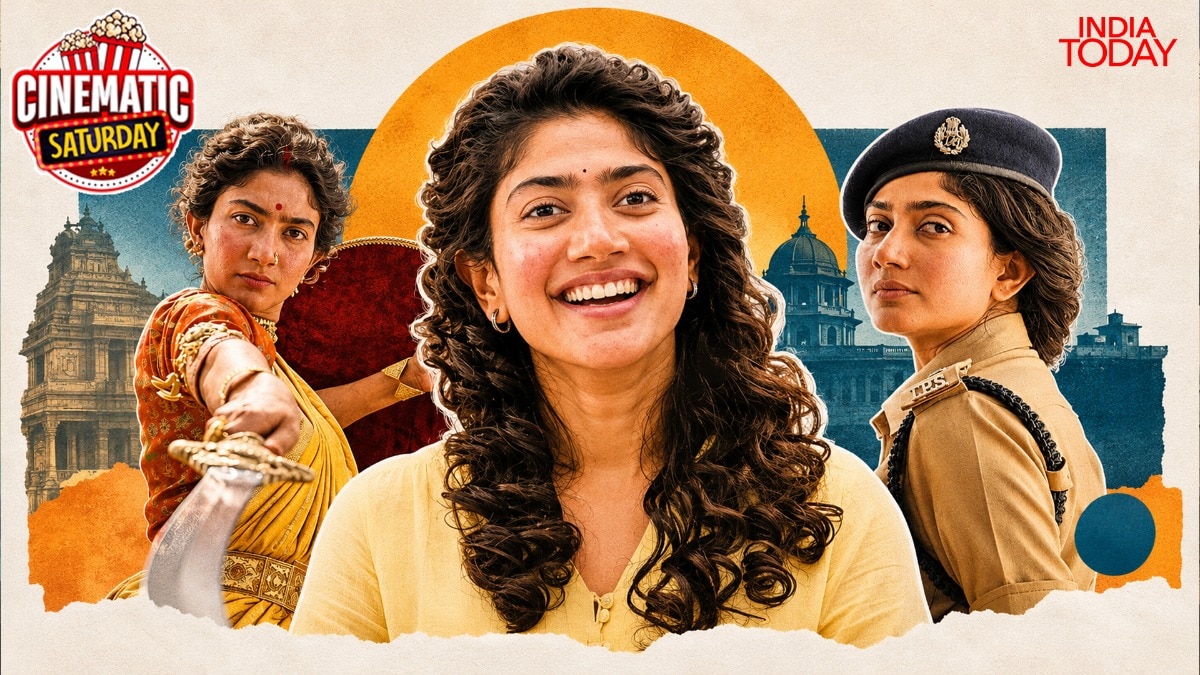
Now that we know who Hollywood's next 007 is, here's an actor from Indian cinema who could give him a run for his money when it comes to switching roles. Much like Robert Pattinson, Sai Pallavi seems equally willing to take on just about anything, at any stage of her career.
A love story in Japan. Godess Sita in one of Indian cinema's most ambitious re-tellings of the Ramayana.
And now, a woman in uniform, carrying the weight of a high-stakes operation. Sai Pallavi's 2026 has moved between three worlds that barely seem to belong to the same actor.And perhaps that's her biggest charm: she never stays in one frame for too long.
In an industry where an actor's success can quickly become a reason to keep repeating the same roles, Sai seems to have little interest in staying put. In 2026 alone, she made the unprecedented move from her Bollywood debut with Ek Din to the enormous expectations surrounding Ramayana, and now to OM: Chapter 1, where she steps into a very different space as a hardened police officer.These three films couldn't be more different, and that's what makes Sai's choices interesting.
But what is it about a story that makes her take the plunge, especially when it means stepping into unfamiliar territory? Sai Pallavi as Godess Sita in Nitesh Tiwari's Ramayana It would be tempting to call it a deliberate attempt to break out of a mould.
But filmmaker Gautham Ramachandran, who directed her in the 2022 legal drama Gargi, offers a more revealing explanation. While speaking exclusively to India Today Digital, he said he isn't sure if Sai consciously thinks about breaking stereotypes or choosing something radically different each time. "She says yes when something connects with her.
Something about the character should excite her, irrespective of the box-office prospects. She considers how the character engages her and the audience, and what the film is trying to say."Sai isn't changing things just for the sake of it.
She seems to follow a story, even when it takes her out of her comfort zone.The roles that don't come with a safety net In times when your every move is judged, zoomed over and scrutinised on social media, making a bold move as a debutant also speaks volumes of the fact that Sai Pallavi doesn't care about any cushioning. Consider Ek Din, her Bollywood debut this year.
A Hindi romantic drama set against the snow-covered landscape of Japan, it placed Sai in an unfamiliar cinematic language and opposite Aamir Khan's son Junaid Khan.It was not the most obvious commercial move for an actor whose strongest audience connection has been built across South Indian cinema. Nor was it the sort of project that came with a guaranteed box-office cushion.
The film's reception may not have matched its promise, but the choice itself says something about her willingness to step into a space where the outcome isn't assured.That instinct isn't new. Go back to her debut film Premam (2015), where she played Malar, the young lecturer who became one of Malayalam cinema's most memorable characters.
Or look at her Telugu films Fidaa (2017), Love Story (2021), Shyam Singha Roy (2021) and Tamil film Amaran (2024). The characters are different, but there is a certain emotional honesty she brings to them.
She doesn't seem particularly interested in making a performance look like a performance. Premam is a coming-of-age Malayalam movie starring Sai Pallavi and Nivin Pauly Director Gautham recognised that quality when he was casting for Gargi.
The film was far from an easy proposition. At its centre was an ordinary young woman, a teacher from a socially disadvantaged background, who finds herself battling an emotional and moral crisis after discovering that her father is a sexual abuser.
She must grapple with her personal loyalties while choosing to stand by the victim and fight for justice. The filmmakers had initially explored other casting possibilities, but questions around Sai's Tamil market appeal came up.
Eventually, Gautham decided to take the film forward independently and approached her.He remembered her understanding the character without needing to be dressed up into someone else. The film didn't need a glamorous star entering the frame.
It needed a woman who could make the audience believe she was Gargi."These aren't commercially driven decisions. They happen because something inside you connects with the story when you read it, and you want to be part of that film," he told India Today.There is a small but telling detail from that experience as well.
Sai didn't take her salary until the film was completed, choosing to back the project because she believed in it. It is an unusually hands-on way of navigating an industry that often places several layers between an actor and a film.
It also makes his description of her choices feel less like a neat theory and more like something he has witnessed. There's a difference between taking on a role that looks different on paper and actually putting something on the line for it.
Gargi shows that Sai was willing to do the latter. And that instinct seems to run through her other choices, too.
Whether it's a Hindi romance, a mythological character or a police officer navigating an undercover operation, she doesn't appear to need the comfort of a familiar formula before saying yes.Taking on Sita meant taking on expectationsPlaying Goddess Sita, however, was a different ball game altogether. Ramayana was a project where the stakes are of an entirely different kind.
Playing somebody as revered is no ordinary addition to a filmography. It comes with years of cultural memory, devotion and expectation.
The casting announcement invited reactions, and not all of them were welcoming.Television actor and voice artist Ami Trivedi, who has dubbed for Sai in the Hindi version, understands the conversation from both sides. She admits she had reservations of her own before stepping into the dubbing studio.
Having grown up watching Hindi cinema, she had imagined that a North Indian actor (female) might play Sita.But the experience changed her mind."Honestly, having grown up watching Bollywood films and being familiar with the Bollywood industry, I think I was also a little biased as an audience member. Somewhere in my heart, I thought perhaps a North Indian actress would play Sita," Ami told India Today.
Sai Pallavi underwent sword-fighting practice for these sequences in Ramayana: Rise of a Legend When she eventually stepped into the dubbing studio, however, her reservations gave way to admiration. She explained, "But when I went to dub for Sai, I was floored.
I told Nitesh Sir, 'Now I understand why you guys are such top-notch creatives. You can see what everybody else cannot.'" Her conclusion was unequivocal: "I genuinely felt that nobody else could play Sita as beautifully as Sai Pallavi," she said.It is a particularly interesting endorsement because Ami wasn't responding to a poster or a casting announcement.
She was responding to the performance itself. She spoke about Sai's naturalness, the absence of an artificial quality and the simplicity with which she carries herself.
When they met, Sai was in a sweatshirt and trousers. For Ami, that quality felt right for Sita."I find something very real about her.
Perhaps it's the way she carries herself. She doesn't rely on make-up or have an artificial, plastic quality about her," she said.The work of dubbing, meanwhile, required Ami to follow Sai rather than impose her own interpretation. "I didn't want to impose my own interpretation on the character.
I wanted to put my voice to the performance she had already created." Sai revealed that she would meditate before filming and pray to Sita Maa to guide her performance She also noticed how Sai's voice naturally drew hers into a lower register. Sita, she felt, needed a certain calmness and maturity.
Director Nitesh Tiwari would repeatedly remind her to lower her voice, keeping the dubbing aligned with what Sai had done on screen.Ami told us that there was this particular scene that stayed with her. Sai had spoken about how Sita's anger and playful side should come through in the Surpanakha sequence.
Even while portraying someone else, she felt Sita's essence shouldn't get lost. "There should never be a seductive element to her character. It's a very fine line," Ami recalled Sai explaining.It may sound like a small difference, but it revealed the attention Sai brings to a role that could easily be reduced to its grandest, most familiar images.
She thought about the person beneath the mythology, and about the details that make a performance feel truthful.From mythology to the world of undercover operationsFrom Sita, Sai moved straight into the world of undercover operations with Tamil director Rajkumar Periasamy's OM: Chapter 1. Released on November 20, the film cast her as Nithya Reddy, head of the Special Task Force, who is tasked with bringing down a smuggling network in Andhra Pradesh.
It's a striking shift for Sai, taking her from a character steeped in mythology to a police officer navigating a dangerous world of crime, deception and undercover work.Sai is cast alongside giants like Dhanush and Mammootty in a film laced with grit, and a world unchartered by her. Consider it an added pressure for you and me, but for Sai, it is a cakewalk.Perhaps the most telling thing about Sai's career is that she hasn't built it around one easily marketable version of herself.
She has played the romantic lead, the woman fighting a deeply personal battle, the vulnerable lover, the teacher seeking justice, and now characters who belong to worlds of myth and action. There is no single template that neatly contains all of them.That doesn't mean every choice will work, or that every film will find its audience.
Gautham's observation offered the simplest way to understand it. Sai may not be sitting down and planning how to defy expectations.
She reads a story, finds something in it, and follows that feeling. The risks come with the territory.Maybe Sai's biggest strength is that she hasn't settled on one version of herself that she wants the world to remember.
She is still curious enough to experiment, to surprise and to begin again. And in an industry that often rewards familiarity, that's a risk worth taking.The equation remains unpredictable.
And that, increasingly, is the point.- Ends