


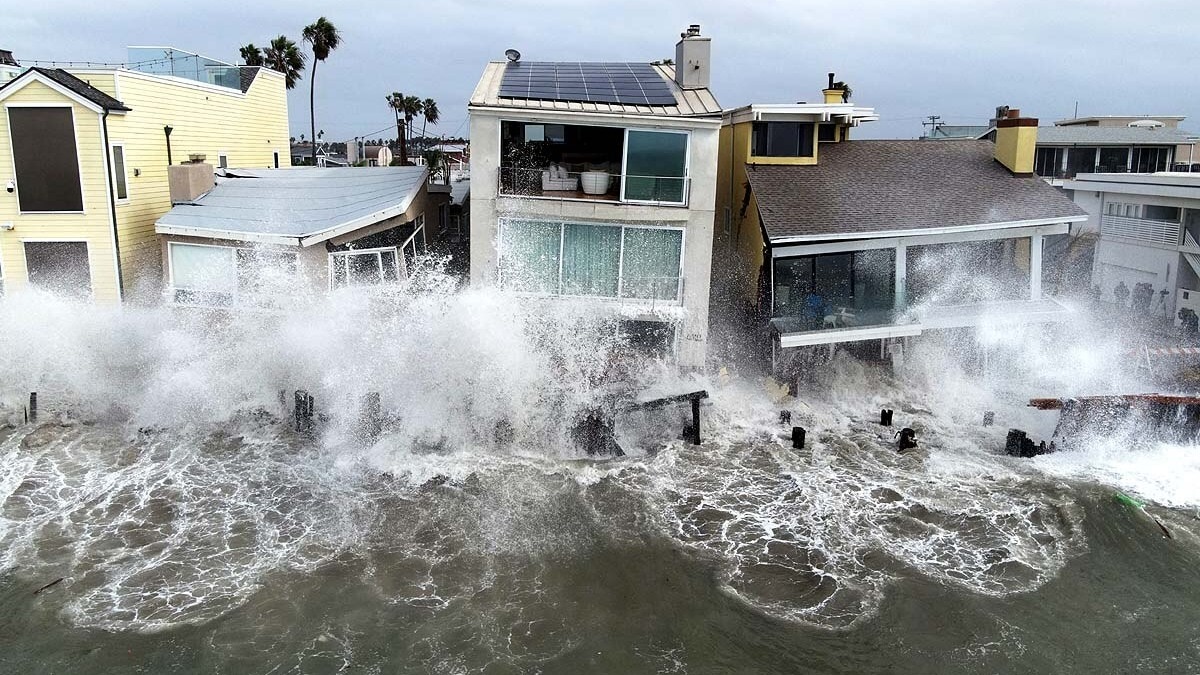
Giant waves hit California as three cyclones approached or struck India's eastern coast. The events have sharpened attention on El Nino and coastal preparedness.Coastal flooding could remain a concern with another period of potentially extreme coastal flooding expected between November 23 and 27.
Massive waves battering California's Pacific coastline have offered a glimpse of how a powerful El Nino can amplify coastal hazards, raising concerns about vulnerable shorelines around the world.While the United States deals with waves exceeding 40 feet, India's eastern coastline has just experienced an extraordinary spell of its own, with three cyclones — Arnab, Murasu and Akvan — approaching or hitting the coast in less than a month.The back-to-back storms have put coastal communities in Andhra Pradesh and Odisha on alert, with heavy rainfall, powerful winds, rough seas and the threat of coastal flooding.The developments have also raised an important question: Could the strengthening El Nino make India's coastal waters more dangerous in the coming months? JUST IN: Evacuation warning has been issued in certain areas along the Pacific Coast Highway in California as the state continues to get rocked by massive waves.
The massive waves are caused by multiple storms throughout the Pacific. Surfers are taking advantage, some traveling a mile off the coast to offshore oil rigs to surf massive waves.
This is insane.— Collin Rugg (@CollinRugg) December 30, 2023 CALIFORNIA'S COASTLINE BATTERED BY GIANT WAVESCalifornia has witnessed powerful ocean swells, with waves exceeding 50 feet recorded in parts of San Mateo County during the November 14-15 episode. The National Weather Service warned that waves along parts of the Bay Area could reach 35 feet, prompting beach and pier closures.Coastal communities faced flooding as seawater surged over beaches, streets and coastal infrastructure.
Authorities also issued evacuation warnings in parts of Santa Cruz County, while several popular piers were closed because of dangerous surf and rip currents. The situation is being closely watched as a strong El Nino develops across the Pacific.More "alarm bells" on the weather mapsfor Oregon and California.
Early next week -- Tuesday -- massive Category 3+ atmospheric river crashes into the West Coast -- long-lasting and strong. Super El Nio is cranking up the Pineapple Express https://t.co/prEY3NEai3— Ryan Maue (@RyanWeather) November 19, 2026El Nino is a periodic warming of the central and eastern equatorial Pacific Ocean that alters atmospheric circulation, wind patterns and storm tracks.
During strong events, the Pacific jet stream can shift southwards, increasing the likelihood of powerful winter storms affecting California.These storms generate energetic swells over the North Pacific, which can travel thousands of kilometres before reaching the American coastline.The danger increases when powerful waves coincide with unusually high tides, elevated ocean levels and storm surges. Warmer ocean water also expands, temporarily raising sea levels and allowing waves to penetrate further inland.Scientists warn that the combination of large waves, heavy rainfall and elevated sea levels could make California's 2026-27 winter particularly challenging.Laguna Beach has been destroyed!!! @SkidKidstv shows us the extent of El Nio hitting Orange County and the California Coast as massive #surf & relentless storm surge destroys our beaches!
When will these weather events end https://t.co/TqqOVpLFd9— California Conspiracy Theorist (@SCSharks71) November 19, 2026THREE CYCLONES IN LESS THAN A MONTH HIT INDIA'S EAST COASTIndia's eastern coastline has experienced a remarkable sequence of tropical storms.Cyclone Arnab struck the Andhra Pradesh coast in late October, followed by Cyclone Murasu, which made landfall near Ongole on November 3.Now, Cyclone Akvan has become the third cyclone in less than a month, crossing the north Andhra Pradesh and south Odisha coast on November 20.According to the India Meteorological Department (IMD), Akvan weakened before landfall, crossing with sustained winds of 70-80 kmph and gusts reaching 90 kmph. Hundreds of thousands of people were evacuated from vulnerable coastal areas in anticipation of the storm.
IMD The repeated formation of cyclones over the Bay of Bengal has drawn attention from meteorologists.IMD Director General Mrutyunjay Mohapatra said climate factors, including El Nino and the Indian Ocean Dipole, could be influencing the movement of these systems. He also pointed to a similar sequence in 1987, another El Nino year.However, three cyclones developing in quick succession does not automatically establish that El Nino caused them.
The post-monsoon season is naturally favourable for cyclone formation over the Bay of Bengal.COULD INDIA EXPERIENCE CALIFORNIA-LIKE COASTAL FLOODING?India faces a different but equally important coastal threat: powerful swells, storm surges and coastal inundation.One example is Kallakkadal, a phenomenon in which distant storms in the Southern Indian Ocean generate long-period swells that travel towards India's southwestern coast. These waves can cause coastal flooding even when local weather conditions appear relatively calm.Kerala, southern Tamil Nadu and parts of Karnataka are particularly vulnerable to such events.Along the eastern coast, powerful Bay of Bengal cyclones can generate destructive storm surges, pushing seawater inland and flooding low-lying settlements.El Nino can influence India's monsoon circulation and ocean-atmosphere conditions, but it does not automatically generate giant waves or increase cyclone frequency.
Its effects interact with other factors, including the Indian Ocean Dipole, the Madden-Julian Oscillation and regional sea-surface temperatures.WHY INDIA'S COASTAL PREPAREDNESS MATTERSWith El Nino expected to persist through the coming winter, scientists will be watching ocean temperatures, storm activity and coastal water levels closely.Agencies such as INCOIS and IMD play an important role in issuing swell, storm surge, cyclone and coastal inundation warnings.For India, the California episode and the recent sequence of Bay of Bengal cyclones underline a common vulnerability: when powerful ocean conditions meet exposed coastlines, the consequences can extend far beyond the beach.The challenge is not simply predicting the next cyclone or giant wave, but preparing coastal communities for the combined threat of rising sea levels, powerful swells, storm surges and increasingly vulnerable shorelines.- Ends