


The Polish prime minister, Donald Tusk, must occasionally look towards Budapest and sigh. A landslide victory in elections last spring enabled Hungary’s new prime minister, Péter Magyar, to act with ruthless determination to clean up the country’s politics after 16 years of corrupt Orbánisation.
Mr Tusk, whose centrist coalition ousted the far-right Law and Justice party (PiS) in 2023, is similarly taking on the legacy of a government which undermined the rule of law and democratic norms. But his efforts have been relentlessly boxed in by the blocking tactics of Poland’s (PiS)‑backed president, Karol Nawrocki.At the weekend, this standoff escalated into a crisis with wider implications for the European Union as well as Poland itself.
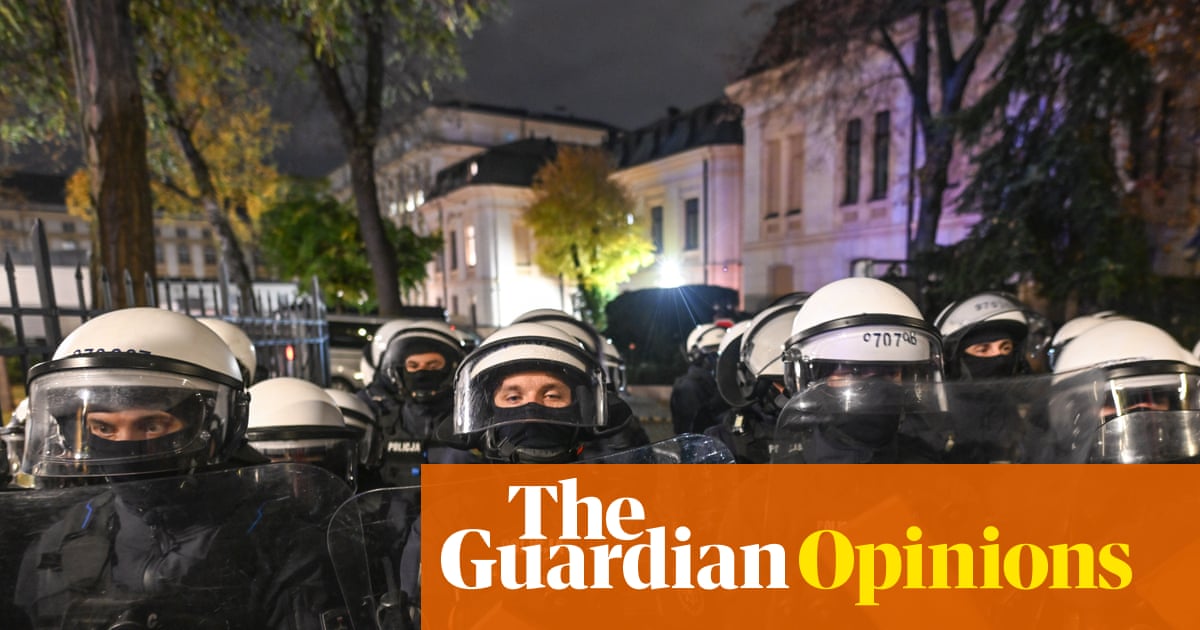
Exasperated by Mr Nawrocki’s attempts to veto the appointment of new judges to the country’s constitutional court – which has been illegitimately dominated since 2015 by PiS‑friendly appointees – Mr Tusk backed the enforced appointment of a new head, and the suspension of the court’s president and vice‑president. Extraordinary scenes followed, as rightwing demonstrators massed outside the court building in the early hours of Saturday morning and Mr Nawrocki pushed past security forces to protest.Donald Tusk.
Photograph: EPAAs a high-octane constitutional confrontation now plays out, the legal and moral facts of the case are on Mr Tusk’s side. Last month, the Venice Commission, an advisory body of the Council of Europe, ruled that the new judges had the constitutional right to take up their positions with or without Mr Nawrocki’s endorsement.
The European Commission, which spent years confronting PiS governments over rule-of-law issues, reaffirmed that position on Sunday. Over the course of two terms in office, PiS ministers made concerted attempts to intimidate judges and manipulate the judicial system to create an unlevel playing field for their political battles.
The weekend’s drama is the result of Mr Tusk’s legitimate attempt to deal with illegalities perpetrated in that period.Nevertheless, this feels like a risky move ahead of an election due by next autumn in a deeply polarised country. Mr Tusk’s decision to force the issue in such a way has potentially handed a political opportunity to PiS’s leader, Jarosław Kaczyński, who is in need of a cause to unite a far right that has split three ways.
More broadly, Marine Le Pen has used the crisis to decry a rise in “strong‑arm tactics” in the EU. The tone of her intervention echoed comments by Mr Kaczyński, who last week accused Brussels of wishing to turn the EU into a centralised state and suggested that like-minded nationalist governments may choose to rebel.With elections imminent in Spain and France, as well as Poland, Europe’s far right is manoeuvring ahead of a period that it hopes will change the balance of power in the continent’s politics and precipitate open confrontation with Brussels.
Given her intention to challenge the primacy of EU law on migration, Ms Le Pen will soon be involved in her own legal controversies should she win the French presidency in the spring. Playing fast and loose with the rule of law and attacking those who resist as “enemies of the people” was the go-to tactic for Poland’s far right throughout its eight years in office.
Its revival in Warsaw at the weekend feels like an ominous portent of confrontations to come.