


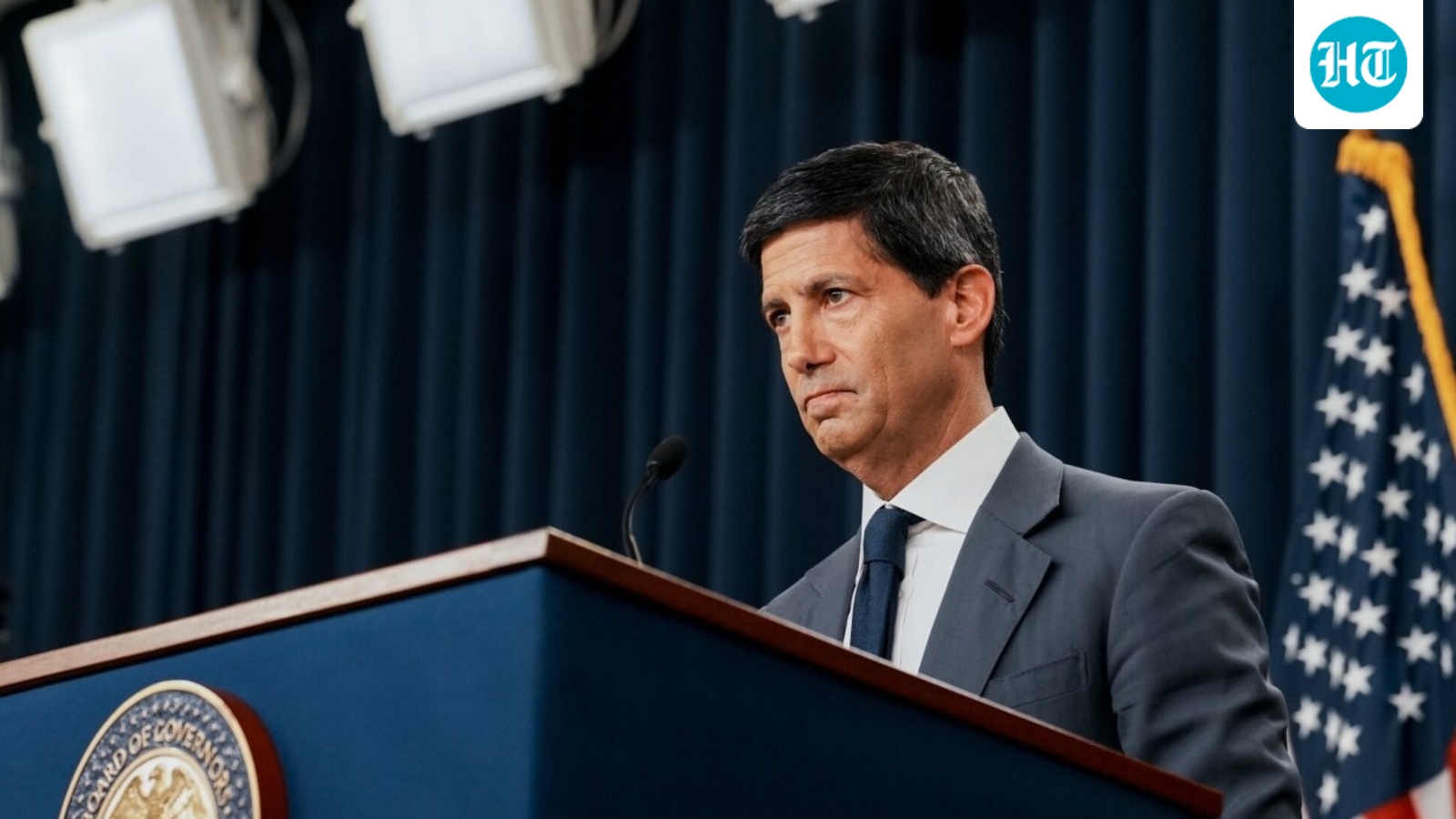
For months, a common view of the artificial-intelligence boom has been that it is propping up the U.S. economy and it is too big and too flush with cash to care about interest rates. Federal Reserve Chairman Kevin Warsh said Wednesday he wasn’t so sure about either assumption.Fed Chairman Kevin Warsh speaking to reporters after Wednesday’s policy meeting.The positions complicate the question of how much higher interest rates may have to go because they could point in opposite directions.
The Fed held rates steady Wednesday, as anticipated, with investors widely expecting an increase at the next meeting in December.When more of the economy is growing, it usually means more spending by consumers and businesses, which in the short run can push up prices. That would especially be the case if conflict abroad keeps energy and commodity prices high.But if the AI build-out, and the stock-market-fueled consumer spending it supports, turn out to be more sensitive to interest rates than many have assumed, each increase could do more to cool the economy.
That’s more likely as tech companies increasingly turn to bond and stock markets to finance growth they once paid for out of their own cash.The WSJ’s chief economics correspondent says there are three key takeaways from the central bank’s decision Wednesday. Jim Lo Scalzo/EPA/Shutterstock“There was a narrative for quite a while, maybe even in this room over the course of the last several press conferences,” that tighter monetary policy is “not going to have any effect on AI because the returns that investors are expecting are so different,” Warsh said. “I was skeptical of that view.
Interest rates get in the cracks. Interest rates affect, directly or indirectly, almost everything.”And since the Fed raised rates last month, there was evidence investors had become more discriminating about their investments, Warsh said, pointing to how borrowing costs for some riskier companies have jumped.Warsh’s explanation landed uneasily with bond investors, who are looking for signs that the Fed is committed to bringing inflation down to its 2% goal after two years in which it has made no progress.
While Warsh spoke Wednesday, investors scaled back bets on rate increases next year. Longer-term yields rose slightly, a sign of more worry about inflation down the road.Strategists at TD Securities said Warsh “did not clearly lay out why the committee preferred to wait until December” to raise rates.
His answers were “neither clear nor convincing,” said Mark Cabana, head of U.S. rates strategy at Bank of America. Warsh seemed to lean on recent wobbles in riskier assets and a slight decline in market-based inflation expectations, Cabana said, but those wobbles “were not that big.”Warsh’s remarks on AI bear on the question of how high rates ultimately need to go, and the answer may depend on how much the technology sector responds to borrowing costs.
The case that it is highly insensitive to modest increases in rates rests on the assumption that firms expect returns large enough to dwarf the cost of money, and they see the contest as winner-take-all. “You want to be one of the winners, and that means you’ve got to get there first,” said William English, a former Fed economist now at the Yale School of Management.If the boom shrugs off higher borrowing costs, the Fed would have to throttle housing, commercial real estate, small businesses, low- to middle-income consumers and other rate-sensitive sectors that weren’t big sources of inflation to begin with.This has been a growing worry as the Fed has turned from cutting rates last year to raising them this year. “It’s almost like the Fed needs two interest rates,” one for the AI boom and the stock-market wealth it is throwing off, and one for everything else, said Jonathan Pingle, chief U.S. economist at UBS.But if the boom is more sensitive to higher rates than commonly believed, as Warsh suggested, the Fed could be able to cool things down with fewer increases and less collateral damage.“The idea that there’s no interest-rate sensitivity from anything related to AI, to me, is very extreme,” said Marc Giannoni, chief U.S. economist at Barclays. The largest tech companies may not have to borrow to pay for their spending, but for data-center operators and other firms building alongside them that do, “interest rates on their debt is a big factor,” he said.The Fed’s challenge is that the boom as a whole can look unfazed while strains build at the edges.
As more of the build-out is financed with debt, higher rates reach it through credit markets, hitting the weakest borrowers first and the cash-rich giants last. Each increase might seem to do little until financial conditions suddenly crack.“There’s a point at which it breaks.
And at that point, the Fed may find that spending weakens more significantly” than their models predict, said Vincent Reinhart, a former senior Fed adviser who is now chief economist at BNY Investments.Warsh’s second position cuts the other way. “It is convenient to say that the strength of the economy is all about this new technology wave,” he said. In fact, business investment is “not just strong, but it is broadening.”Warsh was quick to note that he doesn’t see strong growth as something that would necessarily push up inflation, which would justify higher interest rates.“He’s basically saying, ‘We need to do more, but it may not be all that much more,’” said Reinhart.Still, Reinhart thinks the risks lean toward the Fed having to do more than it thinks in the short run, in part because energy and commodity prices appear to be settling in at a higher level. “Other prices are going to have to catch up to that, so they may find out that inflation is more durable, in which case, they get impatient in 2027 and have to tighten more,” he said.Write to Nick Timiraos at Nick.Timiraos@wsj.com