


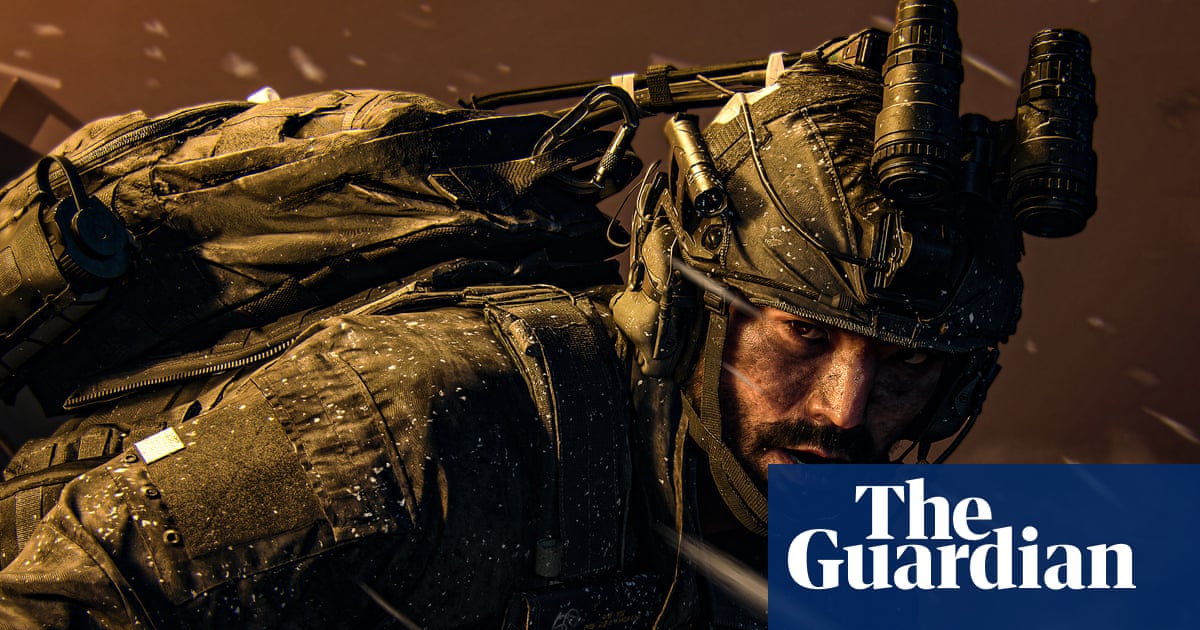
In these strange, subdued weeks before the much-anticipated release of Grand Theft Auto VI, there have still been some welcome surprises. Onimusha: Way of the Sword revived a half-forgotten samurai action series with much aplomb, while Silent Hill: Townfall transported all of the franchise’s bloody, dread-filled psychological horror to … the picturesque Scottish coast.
Even more shocking to games writers, though, is the fact that the forthcoming Modern Warfare 4 has one of the best Call of Duty campaign modes for at least six years – and might even be up there with the original Modern Warfare trilogy.The setting is an invasion of South Korea by its northern neighbour – a setup that could have fuelled a hundred instantly forgettable Netflix films, but has proved controversial in a video game. The authoritarian regime has a new (fictitious) ruler and a powerful experimental weapon, which it’s not afraid to use as the opening gambit in an explosive attack.
You take on the role of Park Hyun Jun, a conscripted South Korean soldier who, along with his small unit of similarly inexperienced grunts, gets caught in the firestorm as cities burn and enemy paratroopers fill the skies.On the other side of the globe, meanwhile, series hero Capt John Price has gone rogue, teaming up with cartel boss Valeria Garza to track down his nemesis, Makarov. How these narrative strands intertwine is the propulsive engine of the story, and along the way this game throws an arsenal of gigantic set-piece battles at you, edging you closer to a layered finale.Most positive reviews of the campaign mode have mentioned how the story combines its own ideas with themes and plots from the previous titles.
So how did the game’s lead developer, Infinity Ward, set about creating a story that could support a giant first-person juggernaut such as CoD? “The DNA of a Modern Warfare story is that it is something you believe could happen in the real world,” says narrative director Jeff Negus. “‘Does it feel grounded?’ is the first question. Additionally, we ask, ‘What is going to resonate with a modern audience?’ It was important to us not to tell the same story again, not to show the same characters being the same people, because what they’ve been through has deeply affected who they are.”Infinity Ward says the story of Modern Warfare 4 puts its characters and their relationships at the centre of the action.
Photograph: Infinity WardInfinity Ward brought in a range of military and cultural consultants to ensure the story’s accuracy. “Some of our actors were conscripted in Korea, so they’re able to identify with some of what’s happening,” says Negus. “We use a wide array of military consultants across many different branches and types of service. Our dialect coach, June Yoon, was invaluable because he understands the dialectical differences between North and South Korea, and he could help us reword lines in a more colloquially appropriate way.”One key element of the game is the combination of quieter, character-led narrative moments and apocalyptic action set-pieces. “There is a very healthy symbiosis between both parts,” says Negus. “We start with strong narrative and gameplay, and the very first thing that we ask is, ‘How can we interweave these things in a way that feels intentional?’ One must be complementary of the other, in such a way that we’re able to say, ‘I can’t imagine telling the story without this mechanic.’” Negus compares it to an explosion in an action movie, saying: “It can be spectacular, but if you don’t know the people who are a part of it, it won’t be meaningful.
Back when I was working at Naughty Dog, and now with the team here, we talk about player-protagonist parity, and how, when you feel what the character feels, you’re all a part of the same story – the audience gets to be in on it.”Surprisingly, iteration is an important part of the process – even though this is a game filled with cinematic sequences that may have to be filmed and animated early in the development process. “We certainly map out the story visually,” says Negus. “Justin [Harris], our lead writer, will put in these story beats, much like a season of television or a movie would do, but we do it with levels. And sometimes we’ll need to move things around, particularly in a story where we can shift the timeline in certain ways.
When someone comes up with something, it gets moved around, it gets debated and analysed, and it’s road-tested pretty hard before it becomes inked.”To me, the Modern Warfare 4 campaign is a story of dysfunctional families – the actual North Korean ruling family, Park Hyun Jun’s ragtag squad and Price’s Task Force 141. The tensions between these groups gives the story its human underpinning.
Disaster movies usually centre on one or two main characters so that we, the audience, get to experience the drama vicariously through them.Infinity Ward has successfully brought that structural and emotional toolkit to the finale of the Modern Warfare series, and that’s at least partly why it works. Call of Duty: Modern Warfare 4 might not be a Pulitzer prize-winning story, but in these odd days before the arrival of GTA VI it certainly gives you something to think about – and people to root for – as you blast away with your rifle, grenade launcher or helicopter gunship.What to playOver the Hill swaps military action for off-road exploration, inviting players to discover its landscapes at their own pace.
Photograph: Funselektor LabsIf you like the look of extreme off-road driving sims such as MudRunner, but are put off by their unyielding difficulty level, Over the Hill is definitely for you. It’s a cosy exploration game where you drive a 4x4 through a bright low-poly landscape of babbling brooks and lush woodlands, occasionally using a winch to get out of muddy puddles or up steep hills.Along the way, you unlock cabins to allow fast travel and visit a mechanic to customise your vehicle.
Spot an interesting bird or critter and you can photograph it, adding it to your scrapbook. The pace is slow and gentle, but there is a fulfilling challenge in mastering the winch and getting yourself out of tight spots.I wish more games simply gave you a world to explore and the tools to do it and then left you alone – although, if the solitude gets to you, there’s a co-op multiplayer mode too, so you can disappear into the wilderness with pals.
Bliss.Available on: PC (coming to Switch, PS5 and Xbox in 2027) Estimated playtime: 10-plus hoursskip past newsletter promotionafter newsletter promotionWhat to readThe Game Boy Museum’s catalogue has been adapted to run on a cartridge for Nintendo’s original handheld console. Photograph: Marcel Pflug “Let me be honest from the start: nobody was waiting for this.” Thus begins a lovely Eurogamer feature on the Game Boy Museum, or more accurately, the museum’s creator, Marcel Pflug, and his attempt to fit the whole of his website on to a cart that actually plays on a Game Boy.
I love projects like this, which use games and games hardware as repositories of information. See also: The Uncensored Library, which collects banned books inside a Minecraft server.
A question that haunts me, as a 55-year-old, is: “Why do I still play video games?” People are often ecstatic to tell me there are more constructive things I could be doing. I enjoyed this essay by Lene Clement about the non-utilitarian nature of games and the annoying lifestyle influencers who instruct us that “uselessness” is a bad thing because everything has to be productive now.
I am reading There Is No Antimemetics Division by Sam Hughes, better known as qntm. Now out in paperback, it’s a novel about a government agency tasked with finding and battling “antimemetic” entities that feed on humans but can’t be seen, remembered or recorded.
It’s a very video game-like premise and the staccato, almost episodic nature of the chapters reminds me of game missions. This is very much a recommendation.
What to click From Mario to machine guns: how Ubisoft Paris made Tom Clancy’s Rainbow Six Tactics The Legend of Zelda: Ocarina of Time preview – Link faces his scariest challenge yet: the 4K era Penguin Colony – an Antarctic odyssey of Nazis and Lovecraftian horrors | ★★★★☆ Question BlockGetting started on game design can be as easy as signing up for a course and building a prototype with software such as GameMaker. Illustration: Roman Motsak/Getty ImagesThis week’s question from Kate via email is something I think all gamers have wondered:“If I had an idea for a game but no idea of how to create it, who would you suggest I contact?
It’s more a game to learn things rather than [one with] combat or sci-fi, etc.”Remember that old saying, often attributed to Thomas Edison: “Genius is 10% inspiration, and 90% perspiration”? The same goes for video-game design, or indeed film-making, painting and writing novels.
Nobody will pay you for an idea, because everyone is having them practically all the time. The most realistic way to realise your idea is to sign up for a game development course, where you may find like-minded people who enjoy your concept and want to work with you.
You could invest in an application such as GameMaker and start building your own prototype, or you could study game design via books or YouTube videos.I also highly recommend A Theory of Fun by Raphy Koster, The Art of Game Design: A Book of Lenses by Jesse Schell and Challenges for Game Designers by Brenda Romero and Ian Schreiber. All of these provide a really good way to structure your ideas and think about how they may work as a functioning game.
This way you can work on a design document that lays out all the rules and systems of your game, and this will help you discover if a) there’s something practical in it, and b) you have the drive and time to work on a game project. A great idea is a great start, but it is really only ever that: a start.If you have a question for Question Block – or anything else to say about the newsletter – hit reply or email us at pushingbuttons@theguardian.com.