


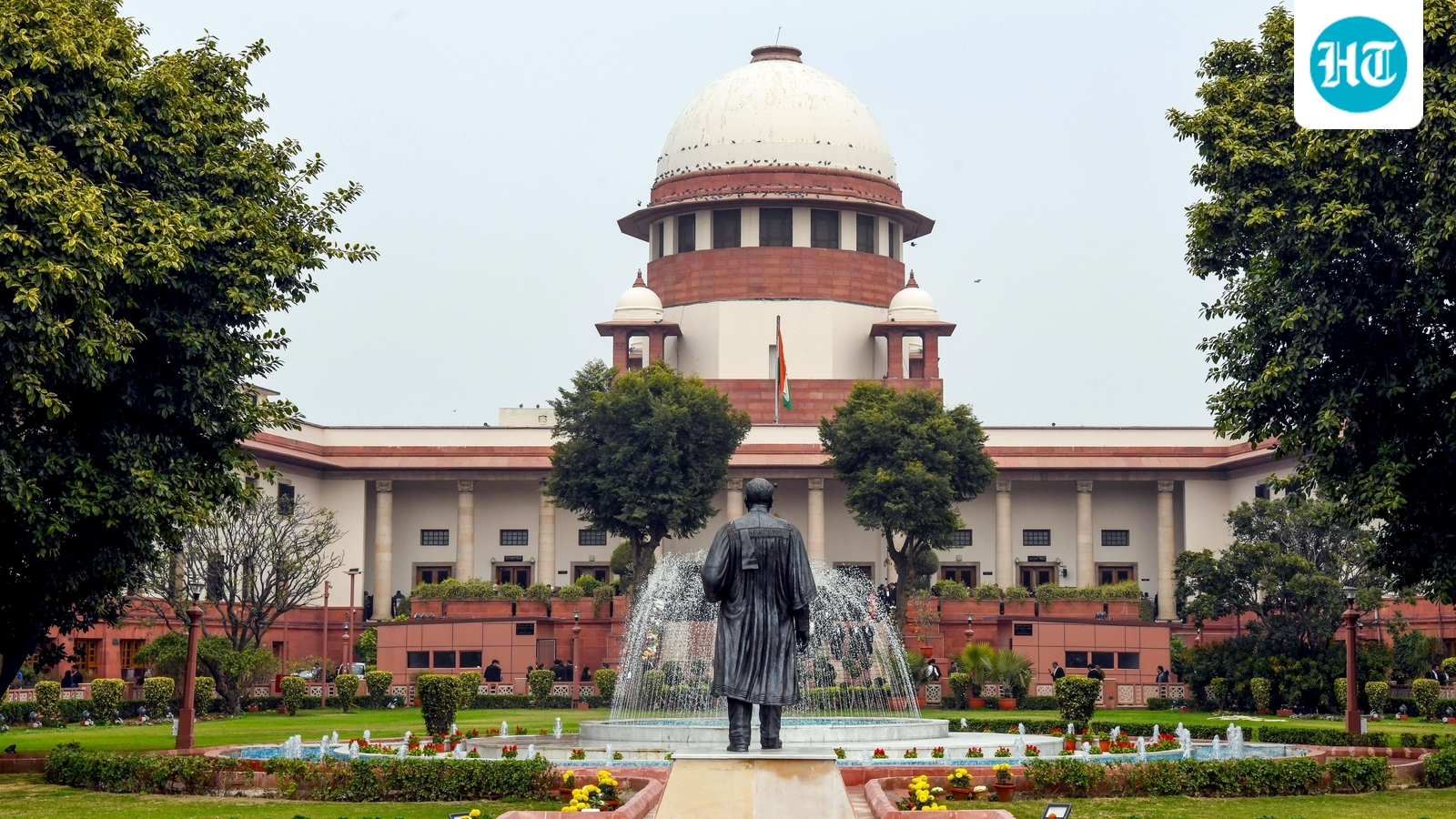
The Supreme Court on Thursday said any mechanism to curb digital arrest frauds must provide for the prosecution of bank officials found to have colluded with fraudsters, and must require financial institutions to compensate victims if a fraud resulted from the bank’s failure.India recorded 21,928 digital arrest fraud complaints involving more than ₹647 crore on the National Cybercrime Reporting Portal in the first eight months of the year (ANI)Digital arrest frauds, in which callers posing as police or central agency officers hold victims on video calls and coerce them into transferring money, drew 21,928 complaints involving more than ₹647 crore on the National Cybercrime Reporting Portal in the first eight months of this year, according to a status report filed in the court by the Indian Cybercrime Coordination Centre (I4C) and the Ministry of Home Affairs (MHA). The RBI’s new compensation rules for electronic banking fraud, which take effect in January, pay victims at most ₹25,000, and only for losses of up to ₹50,000.Also read: Delhi: 7 arrested for involvement in cyber fraud networkBanks must compensate victims for failures“The regulatory measures proposed by RBI must mandate for financial institutions to indemnify digital arrest or cyber fraud victims for providing suitable compensation not less than the amount lost by the customer on being found that the fraud has taken place as a result of failure of the financial institution in the commission of the act or incident,” said a bench headed by Chief Justice of India Surya Kant, and comprising justices Joymalya Bagchi and V Mohana.“Banks must be held accountable.
If there is no liability placed under the proposed guidelines, we will ensure it,” the bench said. It added that the Reserve Bank of India (RBI), as the banking regulator, should go beyond issuing guidelines and enforce them by imposing strict liability on banks.The court was told that the RBI is finalising draft Know Your Customer (KYC) guidelines, which are considering the due diligence banks must carry out, and expects to notify them by November 30.
The bench said it wanted to examine the document before it is finalised and would pass further orders after that.The bench pointed out that banks can recover their own losses through the Securitisation and Reconstruction of Financial Assets and Enforcement of Security Interest Act, 2002 (SARFAESI Act) and the Insolvency and Bankruptcy Code (IBC), while customers who lose money to fraud have no such remedy. “Thousands of crores are being looted and still you do not have strong measures in place. This money is being lost to the economy.
Where is the accountability clause in your regulations so that when a fraud takes place, compensation can be given to victims besides prosecuting the bank officials who are found to be involved,” it said.The court also cited cases involving a builder-bank nexus. In those cases an RBI master circular governs the lending, yet homebuyers hit by subvention schemes have been left without a remedy. “Strict liability of banks must be provided and in case of breach, accountability must be fixed,” it said.Also read: Seven arrested in ₹3.9 cr cyber fraud; police uncover USDT, hawala linksCourt seeks stronger safeguards against suspicious transactionsThe bench asked banks to build preventive systems that flag unusually large transactions against an account’s past history. “We can understand companies having crores of rupees of transactions but for accounts of private individuals who are senior citizens, if so much of the amount is being withdrawn, immediately the bank should be alerted and the transaction withheld.
The nearest police station can be asked to reach the person who is the account holder to verify the transaction,” it said.Attorney general R Venkataramani, appearing for the Centre, told the court that an inter-departmental committee (IDC) and the Indian Cybercrime Coordination Centre (I4C) were examining all aspects of the problem. He said the Ministry of Home Affairs (MHA) was preparing a standard operating procedure that would deal with the liability of banks.Venkataramani said digital arrest frauds had come down over the years.
He cited figures from a status report submitted by the I4C: 123,672 cases in 2024, 58,239 in 2025, and 21,928 this year until September 1.Senior advocate NS Nappinai, assisting the court as amicus curiae, said digital arrest cases were still taking place and that fixing liability on banks was essential. She said educated people were the main targets of such frauds.The bench said it was hard to believe that citizens in a democracy could imagine being arrested over a phone call, and asked how people were still being lured despite awareness campaigns on social media and in the public domain. “What is this fear of being arrested on your mobile phone?
You hit the mobile on the wall and the arrest goes. You are in a democracy, can’t they not understand this basic thing that you cannot be arrested over a mobile phone.
Something seems to be wrong with the psyche of these people,” it said.Also read: UP: ₹11.63 crore suspicious transactions linked to Satya Sanatan Trust detected; 8th person arrestedWhatsApp asked to suggest preventive measuresThe court allowed an intervention application by WhatsApp, represented by senior advocate Kapil Sibal, and asked the messaging platform to suggest preventive measures it could enforce at its end. Sibal said WhatsApp had banned 9,400 accounts on its own and was coordinating with the government on other possible interventions.The bench asked whether software could be devised to let the platform cut off prolonged video calls, a mechanism referred to as a “kill switch”.
Sibal said its practical feasibility would need to be assessed, since it could disrupt legitimate calls such as business meetings and doctors’ video consultations.The court directed all law enforcement agencies, including the Central Bureau of Investigation (CBI), to submit status reports on the digital arrest cases they are investigating. It had earlier directed the CBI to investigate digital arrest cases involving ₹10 crore or more.
Since December 1, 2025, the agency has arrested 49 people and filed charge sheets against more than 140, according to the I4C report.Case began after woman reported ₹1 crore fraudIn digital arrest frauds, callers posing as police or central agency officers hold victims on video calls, sometimes for days, and coerce them into transferring money.The Supreme Court took up the issue on its own in October last year, after a 73-year-old woman from Ambala wrote to it describing how fraudsters had used forged Supreme Court orders to extort more than ₹1 crore from her. On November 3, 2025, the MHA and the CBI told the court in a sealed-cover report that about ₹3,000 crore had been extorted from Indians through such frauds.
In July, Solicitor General Tushar Mehta told the court that the Centre was drafting a Bill to make digital arrest a standalone criminal offence.