


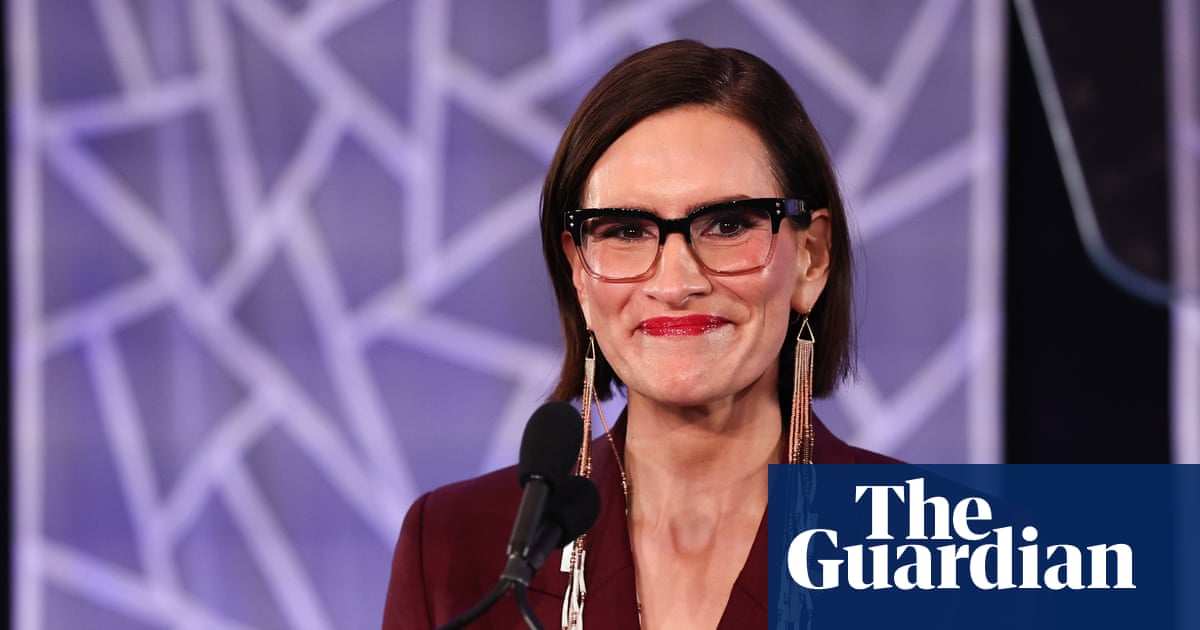
The US midterm elections saw voters elect a slew of historic representatives – from the country’s first Muslim senator to the first Black female governor – but among the most significant gains were those for Native American women.On Tuesday, voters elected the first Native American woman governor, senator and leaders of two tribal nations. Nationwide, voters elected at least 75 Native women or non-binary and Two Spirit candidates in the November midterms, according to Advance Native Political Leadership and the news site ICT.Deb Haaland, a citizen of Laguna Pueblo and Joe Biden’s former interior secretary, will lead the state of New Mexico.
Peggy Flanagan, a member of the White Earth band of Ojibwe and current Minnesota lt governor, will represent her state in the US Senate. Crystalyne Curley will become the first woman to lead the Navajo Nation, one of the country’s largest tribes.
And Tina Abrams will lead the Seneca Nation of Indians in western New York, also the first woman leader in the modern history of the state’s largest tribe.Mary Peltola, who is Yup’ik, could join Flanagan as another first Native woman in the US Senate pending the results of her still undecided race in Alaska.“This is a seismic shift that is happening in our communities,” Jordan James Harvill, a citizen of the Cherokee Nation and strategist with Advance Native Political Leadership, told the Associated Press.Although Native Americans have made significant gains in political power in recent years, it has been a long road to get here. Native Americans have only been allowed to vote across the entire United States since the 1960s.
In 1985, Wilma Mankiller became the first woman elected to serve as principal chief of the Cherokee Nation.In 2018, Haaland and Sharice Davids, a member of the Ho-Chunk Nation, became the first women elected to Congress when they both won seats in the House of Representatives alongside a wave of progressive freshmen lawmakers, including Alexandria Ocasio-Cortez, Ilhan Omar and Rashida Tlaib. Davids was easily re-elected last week in Kansas to a fifth term in Congress.“The first thing that made [running for office] feel really possible was seeing Deb Haaland, was seeing Sharice Davids on a national level,” New Mexico state senator Angel Charley, who is Laguna/Zuni/Diné, told the Guardian about her decision to enter state politics in 2024.In 2020, after an outpouring of voters from the Navajo and Hopi reservations in Arizona saw the long-red state vote for Biden, he named Haaland to lead the interior department, making her the first Indigenous cabinet secretary.The same year, Yvette Herrell, who is Cherokee, became the first Republican Native woman elected to Congress.
She served from 2021 to 2023.This election cycle, a record-setting 363 Indigenous candidates ran for office in local, state and federal elections across the country – with at least 180 of them winning their races. Among them were Claire Valdez, a citizen of Ysleta del Sur Pueblo and Democrat from New York, who will join Davids in the US House of Representatives.The Senate has seen four Native men represent their states in its 237 year history, but Flanagan will be the first Native woman to join the chamber in January.At her victory party in St Paul, Minnesota, Flanagan told supporters: “I could not run for the US Senate without Native women.
I could not exist in the way that I do without Native women.”For Haaland, the historic nature of the election isn’t lost on her – but in the final weeks of a hectic campaign she told the Guardian that she sometimes forgets she’s on the verge of a milestone.“Sometimes I forget about the fact that I would be the first Native woman. We’re in the throes of this statewide campaign and it’s so busy and we’re trying to be everywhere all at once,” she said in a recent interview. “But I recognize that for some people who feel like they haven’t ever been represented – I really, I’m grateful that I have this opportunity … I just hope that I can help folks to see that hard work still means something.
That anyone can be a leader regardless of where you come from or how much money you do or don’t have.”In 2023, New Mexico became the first and only state in the country to implement an updated Native American Voting Rights Act, which gave tribes greater input on polling locations and redistricting.For the Navajo Nation, the largest tribal nation by geography – spanning approximately 27,000 sq miles across parts of New Mexico, Arizona and Utah – Curley’s victory in tribal elections also held on Tuesday was significant. Curley is currently the speaker of the Navajo Nation council and became the first woman to hold that position in 2022.“As women, we have to work twice or triple as hard, especially within Navajo politics,” she told the AP, adding that she faced sexist rhetoric during her campaign. “This is a win for all Navajo women.”“I am humbled,” Abrams, the Seneca Nation’s president-elect said in a statement after her victory. “Tonight, at long last, a woman will now lead our Nation as president.
This is a moment inspired by generations of strong Seneca women who came before me, and one that I hope inspires generations of Seneca women who come after me.”