


Some stories are so deeply woven into a country's cultural memory that telling them again is probably the easiest part. The real challenge is making people feel them all over again.
Nitesh Tiwari's Ramayana takes on that mammoth responsibility. Armed with extraordinary scale, a celebrated ensemble and a story that generations have grown up listening to, the film doesn't just set out to recreate an epic; it attempts to bring India's most enduring tale to life on a canvas that promises to be larger than cinema itself.
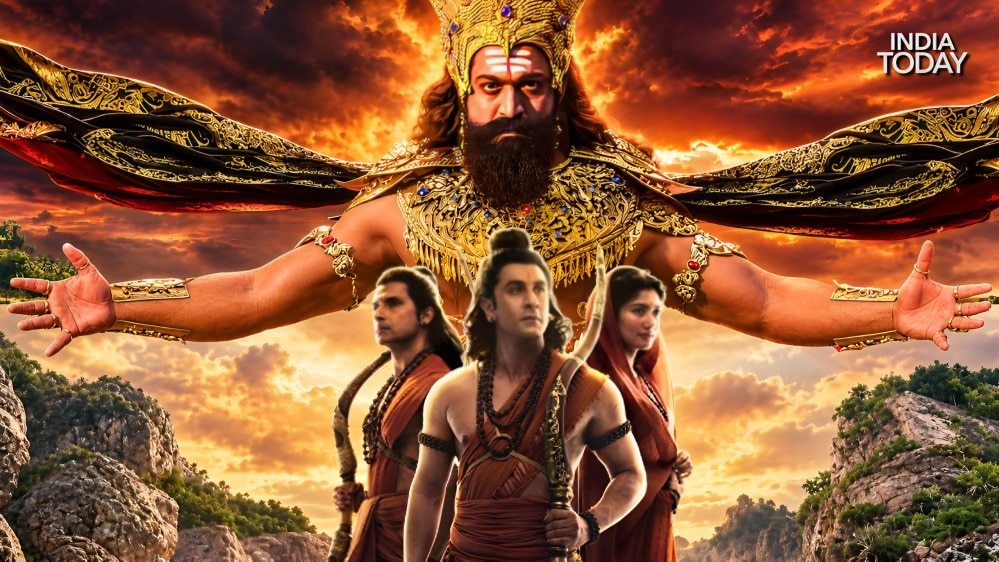
But does all that spectacle translate into storytelling that moves, mesmerises and stays with you?Largely, it does.Ramayana tells the story of Lord Rama (Ranbir Kapoor), Goddess Sita (Sai Pallavi) and their battle against evil, embodied by the demon king Ravana (Yash). Tiwari retains the spirit of the epic while adapting it for modern audiences.
There are moments that stand out for their sheer cinematic brilliance, while others take you right back to the nostalgia of watching Ramayana for the first time, perhaps on television, surrounded by family. And that is an emotion the film understands rather well.Lord Rama, the human avatar of Lord Vishnu, is born to King Dashrath and Queen Kaushalya.
He grows up as the heir to the throne of Ayodhya, learning the art of warfare and mastering weapons under revered gurus. But what truly sets him apart from others, including his three brothers and the many kings of his time, is not his prowess with a bow and arrow.
It is his faith in relationships, his love, his respect for others and, above everything else, his unwavering commitment to doing what is right. Rama is loved, revered and celebrated in Ayodhya.
He eventually marries Sita, the daughter of King Janak of Mithila, after winning her hand in a swayamvar. His younger brother Lakshman is his closest companion, almost an extension of himself.But fate has other plans.
Just when Rama is about to be crowned king of Ayodhya, his stepmother Kaikeyi invokes two promises made to her by Dashrath and demands that Rama be sent into exile for 14 years. Bound by his father's word and his own sense of duty, Rama accepts the decision without protest.
Sita and Lakshman choose to accompany him into the forest. What follows is a journey through unfamiliar lands, across forests and into a world where danger lurks at every turn.
Eventually, Sita is abducted by Ravana, the demon king of Lanka, who possesses formidable weapons, an invincible army and a boon from Lord Brahma that makes him extraordinarily difficult to defeat. Rama and Lakshman set out to find her, vowing to bring her back and destroy Ravana's reign.A story of this magnitude demands a visual language that can match its ambition.
And this is where Ramayana begins to make a rather compelling case for itself.Some of its action sequences, particularly those featuring Ranbir Kapoor as Rama battling the demons, are genuinely breathtaking. The scale, the choreography and the sheer imagination behind these sequences make you sit up.
These are also the moments when Hans Zimmer's background score elevates the drama to another level. His music doesn't just accompany the action; it gives it a sense of divinity, making the ordinary boundaries of a cinematic battle feel almost insignificant.Ramayana: Rise of Legend looks breathtaking from the word go.
And if there is one thing that becomes immediately apparent, it is where the much-discussed Rs 2,000 crore has gone. The film's scale is not restricted to a few sweeping establishing shots or elaborate battle sequences.
It is built into the very fabric of its world. The landscapes, the kingdoms, the architecture, the weapons, the creatures and the celestial realms all come together to create an experience that is quite unlike anything we have seen in Indian cinema.In fact, the biggest surprise is just how little the promotions revealed.
What we saw in the trailers and promotional material doesn't even seem like half of what unfolds on the big screen. There are entire worlds waiting to be discovered, and some of the visual revelations are best experienced without knowing what is coming next.That said, the film isn't without its shortcomings.
Its use of AI-generated imagery is occasionally too obvious, sometimes even distracting. A few creatures, particularly Khar-Dushan and Kumbhkaran, look caricature-like, sticking out in a world that otherwise demands visual authenticity.
Mythology offers limitless possibilities for fantasy, but the visual treatment needs to inspire wonder. In a few instances, the imagery feels too artificial to let that sense of awe take over.
When a film is aiming for the extraordinary, even a slightly jarring visual can pull you out of its carefully constructed universe.But these lapses don't entirely take away from what Tiwari and his team have achieved. The film understands that Ramayana isn't simply a story of gods, demons and extraordinary weapons.
At its heart, it is a story of human relationships, difficult choices, sacrifice and the price one pays for doing what is right.One of its most affecting stretches is the separation between Dashrath and Rama. The scenes around Rama's departure from Ayodhya, the helplessness of a father who cannot stop his son from leaving and Dashrath's eventual death bring a degree of emotional weight to the spectacle.
It is here that the film finds its heart. For all its grand battles and otherworldly imagery, it is the silent moments that remind you why this story has survived generations.And then there is the casting, which has perhaps attracted as much attention as the film itself.
After months of scrutiny, speculation and criticism surrounding almost every casting announcement, Ranbir Kapoor and Sai Pallavi gradually grow into their characters as you watch them.Ranbir, initially, does make you wonder whether he will break out of the character at any moment and slip into the familiar mannerisms of Bunny from Yeh Jawaani Hai Deewani. But that impression doesn't last.
He finds a certain stillness in Rama, a calmness in his movements and a restraint in his expressions that work beautifully for the character. He doesn't overplay the emotional scenes, nor does he lose his energy when the action demands it.
There is a quiet conviction to his portrayal, and that is the most important quality he brings to Rama.Sai Pallavi, too, makes Sita her own. Their chemistry develops organically, particularly during their journey through the forest.
But what makes her performance, and the characterisation itself, particularly interesting is the way Tiwari refuses to reduce Sita to a damsel in distress.Sita is a healer, a woman of immense strength and, importantly, a warrior in her own right. Even when Ravana abducts her and takes her to Lanka in his divine Pushpak Vimana, she doesn't surrender her dignity or her spirit.
Sai is never dolled up to look like an ornamental goddess. There is a simplicity to her appearance that works beautifully, allowing the character's strength to shine through.More importantly, Tiwari gives Sita an agency that many earlier cinematic and television interpretations have not explored to this extent.
She doesn't just follow Rama into the forest or remain confined to the role of a devoted wife. She fights alongside him, takes on enemies and is ready for whatever comes her way.
The action sequences featuring her are a welcome surprise, and Sai carries them with conviction.It is a particularly refreshing interpretation of a character whose strength has too often been understood only through her endurance and sacrifice. Here, Sita is both a devoted partner and a formidable force in her own right.
The film allows her to be both without making one diminish the other.But if there is one performance that deserves special mention, it is Ravie Dubey's Lakshman. He is perhaps the brightest light in an already impressive ensemble.
Ravie looks remarkably suited to the character and brings together Lakshman's many shades with ease. He is emotional, occasionally dramatic, practical when the situation demands it and fiercely protective of his brother and Sita.There is a scene in which he tries to explain to Sita why he cannot leave her alone when Rama goes after the golden deer.
Ravie's eyes convey a thousand emotions, and the clarity with which he delivers his dialogues is almost as sharp as the sword he carries. He understands that Lakshman's devotion is not just about following Rama everywhere; it comes from a deep emotional attachment and an almost instinctive sense of responsibility.
It is a performance that stays with you.And then there is Yash as Ravana, a casting choice that feels almost impossible to imagine differently once you see him on screen. He brings together the character's anger, frustration, pride and undeniable charm with remarkable ease.
There is an imposing quality to his presence, a physicality that makes him look every bit the ruler who can call himself the 'Trilokpati' – the lord of the three worlds.His eyes do much of the talking, particularly in the scene where he sees Sita for the first time. There is fascination, desire, arrogance and an unsettling sense of entitlement in that gaze.
Yash doesn't have to raise his voice or constantly assert his authority to dominate a scene. His presence is enough.
Ravana is meant to command fear, fascination and awe in equal measure, and Yash understands that balance rather well. He is powerful, intimidating and, in moments, almost enchanting – exactly the kind of presence this character demands.The world of Ramayana is another major achievement.
The VFX comes into its own in several sequences, particularly Rama's battle with Khar-Dushan, Ravana's confrontation with Lord Indra and Indra's visit to Vaikunth Lok. Tiwari and his team have created distinct worlds within the larger universe of the epic, each with its own visual identity.
Most of them are genuinely otherworldly.There is also a certain ambition in the way the film moves between the earthly and the celestial. It doesn't just want you to see a kingdom or a battlefield; it wants you to believe that these worlds exist beyond the frame.
And for the most part, it succeeds.The music deserves a review of its own. Hans Zimmer is arguably the film's biggest creative asset, bringing a sense of novelty and scale that is difficult to put into words.
His score gives the film an almost spiritual dimension, particularly during the action sequences and moments that demand a larger-than-life treatment. There is an emotional sweep to the music, a sense of grandeur that makes several scenes feel considerably bigger than what is unfolding on screen.At nearly three hours, Ramayana gives you plenty to celebrate, a fair amount to question and enough to look forward to.
Some of its visual choices could have been more refined, and the occasional reliance on artificial-looking imagery is difficult to overlook. But the ambition is undeniable, and so is the achievement of creating a cinematic universe that feels this expansive.The biggest challenge Ramayana faced was that it arrived with expectations unlike those attached to an ordinary film.
It had to answer for its casting, its music, its visual effects, its interpretation of characters and, sometimes, even for the audience's own deeply personal relationship with the epic. Almost every promotional reveal invited a debate.
But a film, ultimately, deserves to be judged for what it puts on screen, not just for the noise surrounding its making.And that is where Ramayana finds its footing. It may not get every detail right, but it understands the enormity of the story it is telling.
More importantly, it knows that the Ramayana is not just about the triumph of Rama over Ravana. It is about the choices that define Rama, the strength that defines Sita, the devotion that defines Lakshman and the faith that makes millions return to this story, generation after generation.
There is a beautiful line in the Ramcharitmanas: "Siya Ramamaya Sab Jag Jaani, Karahun Pranaam Jori Jug Paani." It speaks of seeing Sita and Rama in all of creation and bowing to it with folded hands.That is the feeling Tiwari's Ramayana hopes to evoke. Not just the awe of watching a familiar story unfold on an enormous screen, but the joy of finding something familiar in it all over again.
And when the music swells, the worlds open up and Rama draws his bow, you realise why some stories are never really over. They are just waiting to be told again.- Ends