


Palestine Action was banned as a terrorist group after using tactics similar to – or less extreme than – the suffragettes, the UK’s highest court has heard.Huda Ammori, a co-founder of Palestine Action, is challenging last year’s decision to proscribe the direct action organisation, placing it alongside groups such as al-Qaida and Boko Haram.On the first day of the supreme court hearing in central London, Raza Husain KC, representing Ammori, told the five judges: “Palestine Action never advocated for violence against the person and the home secretary has never advocated – and could not advocate – to the contrary.“The uncontroverted evidence shows moreover that [the] suffragettes, anti-war groups, environmental groups, animal rights protesters all used tactics similar to or more extreme than Palestine Action yet they were not regarded as terrorists or proscribed.”He said the suffragettes’ activities included arson and bombing attacks but they were now venerated as being on the right side of history. The court of appeal had erred by saying that Palestine Action’s tactics had “little or nothing in common with the suffragettes … or Iraq war protest groups”, Husain told the court.Ammori has argued that proscription represents a disproportionate interference with the rights to freedom of speech and protest.Husain said the ban had affected the entire Palestinian solidarity movement, regardless of any connection with Palestine Action, and chilled the expression of journalists, academics and artists.In written submissions for the home secretary, Sir James Eadie KC said the court of appeal’s decision – against which Ammori is appealing – was lawful and proportionate and had been reinforced in two ways.A person is carried away by police during a protest in support of Palestine Action outside the supreme court in London.
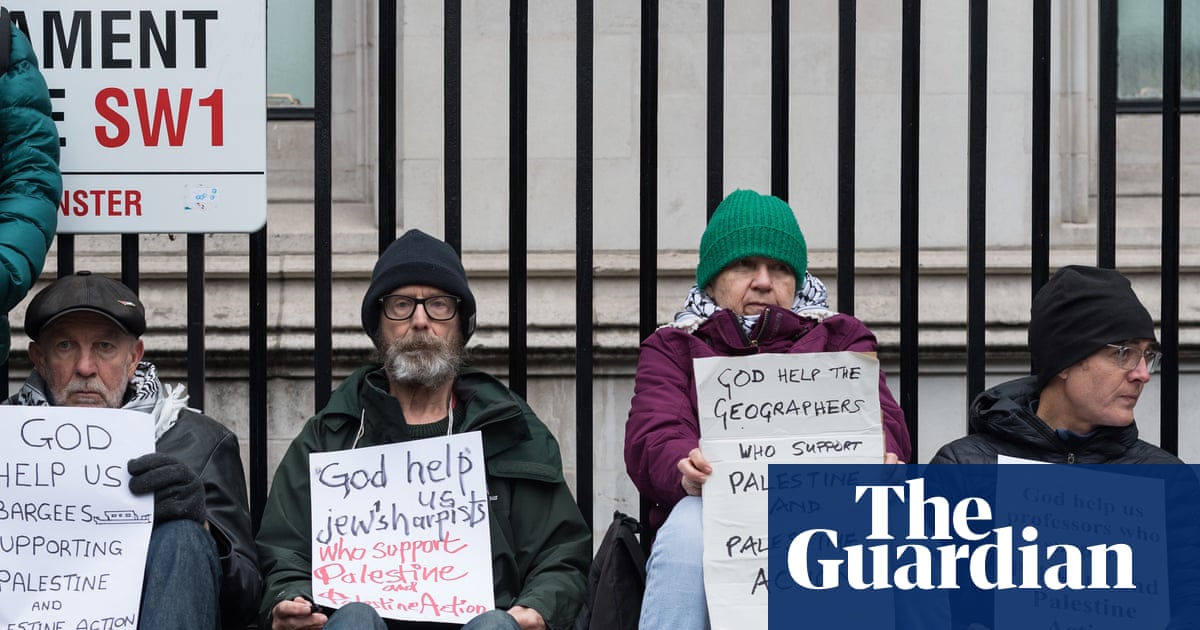
Photograph: Toby Shepheard/ReutersHe cited the convictions (including one for grievous bodily harm) of four people and the finding of a “terrorist connection” in the case of the Palestine Action activist’s raid on a factory owned by the Israeli arms company Elbit Systems in Filton, near Bristol. It was also reinforced by US sanctions imposed on Palestine Action as a global terrorist group, said Eadie.“As a matter of law, the proscription of PA [Palestine Action] does not prevent public expressions of support for the Palestinian cause or opposition to Israel and to the Israel Defense Forces, or demonstrations targeted at Elbit,” he said.Sir Jonathan Porritt, a former director of Friends of the Earth, who was an adviser to the Prince of Wales – now King Charles – for more than 30 years was among at least 25 protesters arrested outside the court on Wednesday.They held placards emulating a tweet by Sarah Helm, the wife of the prime minister’s national security adviser, which the police deemed not to meet the criminal threshold for supporting a terrorist organisation.Helm, a journalist and author who is married to Jonathan Powell, wrote: “God help us authors who support Palestine and Palestine Action.” Porritt replaced the word “authors” with “CBEs” while others swapped it with “normal people”, “professors”, “Jews”, “holocaust survivors”, and “bartenders”.The last protester to be arrested held a placard reading: “God help us who are not married to the UK’s national security adviser who support Palestine and Palestine Action.”The court case is due to conclude on Thursday with judgment expected at a later date.