


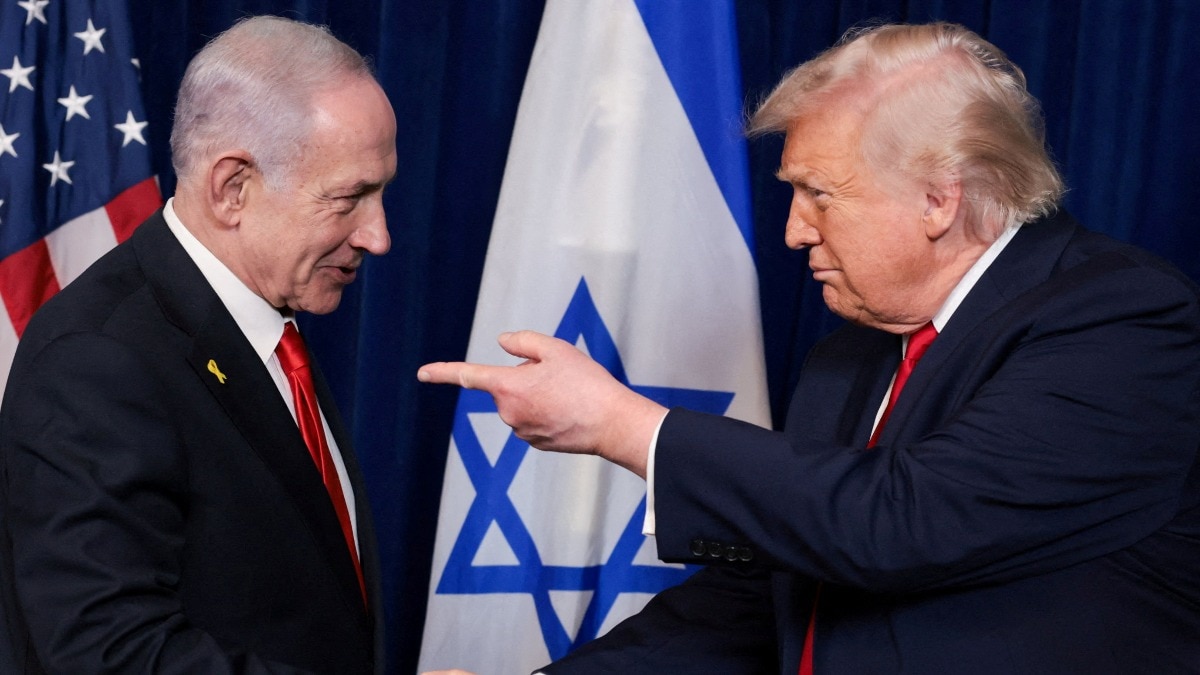
US President Donald Trump has said Benjamin Netanyahu remains in a strong position despite an election result that has left the Israeli prime minister short of a parliamentary majority.Netanyahu's Likud-led coalition pulled ahead of opposition leader Gadi Eisenkot's bloc as 85 per cent of the vote was counted, overturning initial exit polls that had put the opposition in front. However, neither side appeared capable of securing the 61 seats needed to command a majority in Israel's 120-member Knesset, leaving the country facing potentially weeks of coalition negotiations.Speaking to Axios on Wednesday, Trump said he had initially received "horror reports" about Netanyahu's electoral prospects.
But the US president struck a more optimistic note as the count progressed."He's in pretty good shape now," Trump said, adding: "I heard my endorsement made a big difference for Bibi." Asked whether he would intervene to help broker a unity government led by Netanyahu, Trump said he had not yet considered the idea. "I will take a look," he said.The result leaves Netanyahu weakened but still in contention, with his bloc projected to win 53 seats, which is 11 fewer than it currently holds. Eisenkot's opposition bloc is on course for 48 seats, while Arab-led parties are projected to secure a record 19 seats.
The arithmetic has left both camps with difficult choices, with neither able to claim a clear mandate to govern.NEITHER BLOC HAS A CLEAR PATH TO POWERAlthough Netanyahu's bloc has recovered from the early projections, it remains short of a majority. Eisenkot faces a similar problem, with the support of Arab-led parties potentially offering a route to power but carrying considerable political obstacles.A government backed by Arab parties is theoretically possible for the opposition, but such an arrangement remains highly unlikely.
Netanyahu, meanwhile, is expected to try to persuade at least one opposition figure to join his camp, even though opposition leaders publicly pledged before the election not to cross over.The remaining votes are unlikely to change the overall balance of power. According to local media, around 500,000 ballots are still to be counted, including votes cast by soldiers, diplomats, prisoners and people who voted outside their designated polling areas.
The final tally could alter seat allocations within the two camps, but is not expected to give either side a clear majority.The impasse has also opened the door to a possible unity government, though Netanyahu has shown little public appetite for such an arrangement. On Tuesday night, he called instead for a "strong right-wing government."HERZOG URGES PARTIES TO AVOID ANOTHER ELECTIONIsraeli President Isaac Herzog is expected to begin consultations with political parties next week before deciding whether to ask Netanyahu or Eisenkot to form a government.Herzog has urged political leaders to approach the process with flexibility and avoid sending the country back to the polls."We must do everything possible, especially after yesterday, to avoid another round of elections.
So I expect everyone who comes here to arrive with an open mind," he said on Wednesday.If neither camp can put together a majority, Israel could face another election as early as April.A unity government remains one possible way out of the deadlock, although Netanyahu's preference for a right-wing administration could make a compromise difficult. Another option would be for Eisenkot to attempt to form a minority government with support from Arab-led parties outside the coalition.
Such an arrangement, however, could prove fragile and risk collapsing before the next election.Netanyahu could also remain caretaker prime minister if the political impasse leads to another vote. That would allow him to retain significant authority over national security and foreign policy while his opponents struggle to establish a governing coalition.LIKUD CLAIMS ELECTION WAS 'STOLEN'The coalition battle has been accompanied by a dispute over the integrity of the vote, with Netanyahu's Likud party alleging that Arab-led parties used illegal tactics to influence the result.In a statement, Likud claimed the election had been “stolen” through alleged bribery, intimidation, violence and other offences."The elections in Israel were stolen by Arab parties that support terror and the elimination of the Jewish state through serious criminal offenses of bribery, threats, violence, forgeries and the use of illegal software to mobilise voters," the party said.The allegations include claims that cash was distributed alongside Ra'am ballot slips, polling committee members were threatened or assaulted, multiple voters entered voting booths together and some people voted more than once.
Likud also alleged discrepancies between the number of ballot envelopes and registered voters, as well as the use of prohibited software to mobilise voters.In response, the Central Elections Committee has said it is examining complaints of alleged fraud and irregularities submitted by political parties, including Likud's request for an investigation. The allegations remain claims by the party; the request for a probe does not establish that fraud took place.- Ends